

Products
- High-Quality Graphene
- CVD Graphene, Graphene-Like Materials
- Graphene-Like Series
- Defect-Free Single-Crystal Graphene and Graphene-Like Materials (Mechanical Exfoliation)
- Quantum Dot Series
- Aggregation-Induced Emission (AIE)
- Near-Infrared II (NIR-II) Fluorescent Dyes
- Graphdiyne
- Two-Dimensional Transition Metal Carbides/Nitrides/Borides (MXene)
- Metal Nanomaterials and Other Functional Bio-Nanomaterials
- Metal-Organic Frameworks (MOF)
- Covalent Organic Frameworks (COF)
- Two-Dimensional Layered Metal Oxides (LDH)
- Carbon Nanotube Powders, Pastes
- Carbon Nanotube Arrays and Special Carbon Nanotube Materials
- High-Quality Metallic and Semiconducting High-Purity Single-Walled Carbon Nanotubes
- Carbon Nanotube Sponges
- Mesoporous Carbon and Carbon Nanomaterials
- High-Quality Fullerenes
- One-Dimensional Nanomaterials
- Molecular Sieves
- Inorganic Nanomaterials
- Perovskite Materials
- Highly Oriented Pyrolytic Graphite (HOPG)
- Organic Materials
- Single-Atom Catalysts
- Thermoelectric Materials
- Sodium Storage Materials
- Industrial-Grade Nanomaterials
- Solid-State Lithium Batteries
- Hydrogel Series and Consumables
Online Inquiry
Two-Dimensional Transition Metal Carbides/Nitrides/Borides (MXene)
In 2011, a group of researchers at Drexel University published something that would eventually grow into one of the most active frontiers in materials science. They had discovered a way to selectively etch aluminum layers out of a bulk ceramic called Ti3AlC2, leaving behind a two-dimensional titanium carbide that they named Ti3C2Tx — the first member of what would become the MXene family. The name itself encodes the chemistry: M stands for an early transition metal, X represents carbon or nitrogen, and the -ene suffix signals the two-dimensional nature that connects these materials to graphene. The T and its subscript x denote the surface terminations — hydroxyl, oxygen, fluorine — that attach to the exposed metal atoms during synthesis and endow each MXene with its distinctive chemical personality.
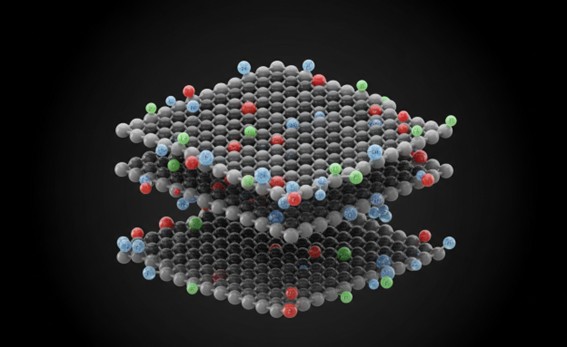 Figure 1: Single-layer MXene nanosheet showing the transition metal carbide core with surface terminations (-O, -OH, -F) on the outer metal layers, exfoliated from a multilayer stack.
Today, more than fifty distinct MXene compositions have been synthesized, with theoretical predictions suggesting over a thousand more are possible. From Ti3C2Tx and Ti2CTx to Nb2C, Mo2CTi, V2C, and Ti2N, this family spans a remarkable range of properties: metallic conductivity up to 24,000 S/cm, surface areas exceeding 400 m2/g when delaminated, hydrophilic surfaces that disperse readily in water, and mechanical strengths that challenge structural ceramics. What unites them all is the same layered architecture and the same synthetic origin — selective etching of MAX phase precursors. At Eata Nanomaterials, we supply a comprehensive portfolio of MXenes across multiple compositions, morphologies, and form factors, each synthesized with batch-to-batch consistency and fully characterized by the analytical protocols that the research community expects.
Featured Products
| Product Category | High-Volume Search Terms | Primary Applications |
| Ti3C2Tx MXene | HF-etched, LiF/HCl in-situ, delaminated, clay form, few-layer, flake size 1-10 um, conductivity 20000 S/cm | Supercapacitor electrode, battery anode, EMI shielding, conductive ink, sensor |
| Ti2CTx MXene | Lighter than Ti3C2Tx, larger interlayer spacing, Li-ion intercalation, high volumetric capacitance | Li-ion battery, Na-ion battery, K-ion battery, electrochemical actuator, energy storage |
| Ti2NTx MXene | Nitride MXene, higher electron density, metallic conductivity, elastic modulus 600 GPa, nitrided Ti4AlN3 | Flexible electronics, transparent conductive film, structural composite reinforcement |
| Nb2CTx MXene | High theoretical capacity 320 mAh/g, 2D ion channels, Nb4AlC3 precursor, pseudocapacitive | High-capacity battery electrode, pseudocapacitor, fast-charging energy storage |
| Mo2CTi MXene | Ordered double transition metal, Mo-Ti in-plane, higher catalytic activity, HER, OWS | Hydrogen evolution catalysis, overall water splitting, dual-metal electrocatalyst |
| V2CTx MXene | VC2 layered structure, multivalent ion storage, Mg2+, Al3+ intercalation, high voltage | Multivalent battery, Mg-ion battery, Al-ion battery, high-voltage energy storage |
| Cr2CTx MXene | Cr-based carbide, magnetic properties, corrosion resistant, environmental remediation | Heavy metal adsorption, organic pollutant degradation, magnetic separation, water treatment |
| MXene Conductive Ink | Aqueous colloidal dispersion, >10 mg/mL, spray coating, inkjet printing, film conductivity >8000 S/cm | Printed electronics, flexible circuit, wearable device, electromagnetic shield coating |
| HF-Free MXene | TFSI dissolution, molten salt etching, ZnCl2, safe synthesis, non-fluoride, green chemistry | Biomedical application, environmentally friendly production, clinical translation, biocompatible |
| MXene-Polymer Composite | Ti3C2Tx/PVA, Ti3C2Tx/PDMS, flexible film, tensile strength enhancement, stretchable | Flexible sensor, wearable electronics, artificial skin, structural composite, actuator |
MXene Products in Our Catalog
Ti3C2Tx: The Flagship MXene
Ti3C2Tx remains the most widely studied and broadly applied MXene, and for good reason. It combines the highest electrical conductivity among solution-processable 2D materials with hydrophilic surfaces that disperse readily in water, a layered structure that intercalates ions with extraordinary efficiency, and a synthesis route that has been refined to laboratory reproducibility. Our Ti3C2Tx is synthesized by selective etching of Ti3AlC2 MAX phase using an optimized HF/HCl mixed-acid protocol, followed by LiCl intercalation and delamination under argon at 65C to produce single- to few-layer flakes with conductivities approaching 21,000 S/cm in vacuum-filtered films.
- Synthesis: HF/HCl mixed-acid etching of Ti3AlC2, LiCl intercalation delamination.
- Flake size: 1-10 um lateral dimensions, <5 nm thickness (few-layer).
- Form factors: aqueous colloidal dispersion (1-20 mg/mL), clay, multilayer powder, or freestanding film.
- Electrical conductivity: up to 21,000 S/cm for vacuum-filtered films.
- Surface terminations: -O, -OH, -F, tunable by post-synthesis treatment.
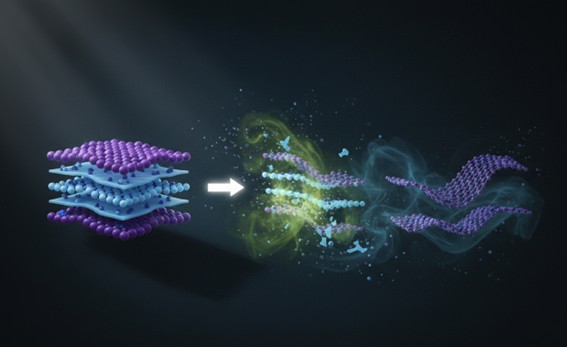 Figure 2: The MAX phase to MXene transformation: selective etching removes the interlayer atoms from the bulk MAX crystal, yielding exfoliated two-dimensional MXene nanosheets.
Ti2CTx and Ti2NTx: Lightweight Alternatives
Ti2CTx offers a lighter M2X structure compared to Ti3C2Tx, with only one transition metal layer per MXene sheet. This gives it a larger interlayer spacing that facilitates ion intercalation, making it particularly attractive for battery electrode applications where volumetric energy density matters. Ti2NTx, the nitride analogue, pushes electron density even higher and delivers an elastic modulus of 600 GPa — exceptional for a solution-processable material.
- Ti2CTx: larger interlayer spacing than Ti3C2Tx, favorable for Li/Na/K-ion intercalation.
- Ti2NTx: nitride MXene with higher electron density, elastic modulus 600 GPa.
- Both available as colloidal dispersion, multilayer clay, or transferred films.
Nb2CTx and Mo2CTi: High-Performance Variants
For applications that push beyond what Ti-based MXenes can deliver, Nb2CTx and Mo2CTi offer distinct advantages. Nb2CTx delivers a theoretical lithium storage capacity of 320 mAh/g through pseudocapacitive charge storage mechanisms, making it one of the highest-capacity MXenes for battery applications. Mo2CTi, an ordered double-transition-metal MXene with Mo and Ti arranged in-plane, exhibits enhanced catalytic activity for hydrogen evolution and overall water splitting.
- Nb2CTx: theoretical capacity 320 mAh/g, pseudocapacitive Li storage, fast charging.
- Mo2CTi: ordered double-metal structure, enhanced HER and OWS catalytic activity.
V2CTx and Cr2CTx: Specialized Compositions
V2CTx supports multivalent ion intercalation (Mg2+, Al3+) that Ti-based MXenes struggle with, enabling high-voltage energy storage architectures that monovalent systems cannot match. Cr2CTx brings magnetic properties and enhanced chemical stability for environmental remediation applications including heavy metal adsorption and organic pollutant degradation.
- V2CTx: multivalent ion storage (Mg2+, Al3+), high-voltage battery applications.
- Cr2CTx: magnetic properties, corrosion resistance, environmental remediation.
 Figure 3: Aqueous colloidal dispersions of Ti3C2Tx MXene at varying concentrations, demonstrating the concentration-dependent coloration from translucent light grey to opaque dark green characteristic of high-quality delaminated flakes.
MXene Conductive Inks and Formulations
Raw MXene flakes are only the starting point. For industrial integration, we supply MXene in application-ready formulations: aqueous conductive inks optimized for spray coating, inkjet printing, and slot-die coating; polymer-matrix composites with PVA, PDMS, or epoxy; and clay-like pastes that can be hand-shaped or molded into arbitrary geometries before drying into solid conductive forms.
- Aqueous ink: 10-20 mg/mL Ti3C2Tx, optimized for spray and inkjet deposition.
- PVA composite: enhanced tensile strength and flexibility for sensor substrates.
- PDMS composite: stretchable conductive elastomer for wearable electronics.
- Clay paste: moldable, hand-shapeable, dries to solid conductive form.
HF-Free MXene: Safer Synthesis Routes
Conventional HF-based etching raises safety and environmental concerns that limit MXene deployment in biomedical and large-scale industrial settings. Our HF-free synthesis portfolio addresses this directly. The TFSI dissolution method uses bis(trifluoromethanesulfonyl)imide to selectively dissolve Al interlayers without generating free fluoride. Molten salt etching with ZnCl2 produces halogen-terminated MXenes through an entirely different chemical pathway. These routes yield MXenes with comparable or superior electrochemical performance while eliminating the hazards associated with concentrated hydrofluoric acid.
- TFSI method: non-fluoride dissolution-driven delamination, capacitance 3090 F/g demonstrated.
- Molten salt ZnCl2: halogen termination, scalable, environmentally friendly.
- Ideal for: biomedical applications, clinical translation, green manufacturing.
Application Domains Where MXenes Lead
MXenes occupy a unique niche in the 2D materials landscape: they are simultaneously highly conductive, hydrophilic, mechanically robust, and chemically tunable. This combination translates into competitive advantages across a remarkably broad application spectrum.
- Energy storage: supercapacitor electrodes with volumetric capacitances exceeding 1500 F/cm3, Li/Na/K-ion battery anodes with high rate capability and long cycle life, and multivalent battery electrodes for Mg-ion and Al-ion systems.
- Electromagnetic interference shielding: MXene films and composites achieving >60 dB shielding effectiveness across the X-band (8-12 GHz) and Ku-band (12-18 GHz), with absorption-dominated mechanisms that prevent secondary radiation.
- Electrocatalysis: Ti3C2Tx-supported atomic Pt and Pd catalysts for HER, ORR, and CO2 reduction; Mo2CTi for overall water splitting; Nb2C for nitrogen reduction.
- Sensors: gas sensors with ppb-level detection limits for NH3, NO2, and VOCs; biosensors for glucose, dopamine, and DNA; strain and pressure sensors for wearable electronics.
- Environmental remediation: heavy metal ion adsorption (Pb2+, Cd2+, Hg2+, Cr6+), organic dye degradation, oil-water separation, and membrane desalination.
- Printed and flexible electronics: transparent conductive films (>85% transmittance with sheet resistance <100 ohm/sq), flexible circuits, wearable antennas, and electromagnetic shielding coatings.
 Figure 4: A flexible MXene-based film demonstrating electromagnetic interference shielding capability, with incident electromagnetic waves being absorbed and reflected by the conductive MXene layer.
Analytical Characterization: Every Batch
We characterize every batch of MXene before release. The data accompanies your order as a batch-specific analytical report.
- X-ray diffraction (XRD): confirmation of MXene phase, interlayer spacing d(0002), absence of unetched MAX.
- Scanning electron microscopy (SEM): flake morphology, lateral dimensions, layer stacking.
- Atomic force microscopy (AFM): exact flake thickness and layer count.
- X-ray photoelectron spectroscopy (XPS): elemental composition, surface termination ratio (-O/-OH/-F).
- UV-Vis spectroscopy: characteristic plasmonic absorption peak (~760-790 nm for Ti3C2Tx).
- Dynamic light scattering (DLS): hydrodynamic diameter and colloidal stability.
- Four-point probe: sheet resistance and electrical conductivity of films.
- Zeta potential: surface charge and dispersion stability assessment.
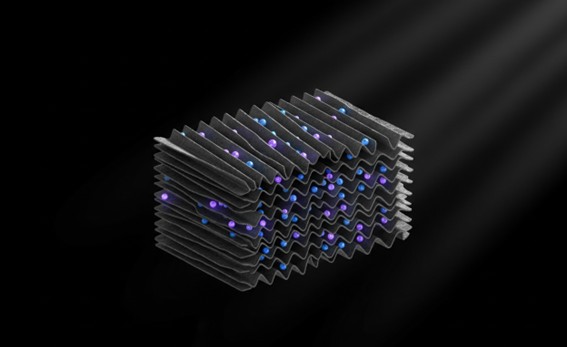 Figure 5: Cross-sectional view of a MXene-based energy storage electrode showing the characteristic accordion-like layered structure with electrolyte ions intercalating between the stacked MXene sheets.
Custom MXene Synthesis and Formulation
Standard MXene products serve many needs, but frontier research routinely demands compositions, morphologies, or formulations outside the catalog. Our custom synthesis service leverages deep expertise in MAX phase preparation, selective etching chemistry, and post-synthesis processing to deliver tailored MXene materials. We have synthesized solid-solution MXenes with tunable metal ratios, produced MXenes with specific surface termination profiles through controlled post-treatment, developed MXene-polymer composites with target mechanical properties, and created HF-free MXene batches for biomedical studies requiring the highest purity and safety standards. We have also fabricated MXene films on customer-specified substrates and produced MXene-based coatings with target thickness and conductivity.
Describe your target composition, flake size, surface chemistry, formulation, or application requirement. Our materials chemists will propose a synthesis protocol, quote a timeline, and deliver a purified, characterized batch for your evaluation.
Request a Data Sheet or Start a Custom Project
Browse our MXene catalog, request detailed characterization data, or describe the specific composition, morphology, or formulation your research requires. Our materials scientists are available to advise on MXene selection, integration strategies, and application optimization.
| Catalog Number | Product Name | Order | Quantity |
|---|---|---|---|
| TDTMC-0001 | Ti3C2Tx MXene Few Layer Dispersion Solution, <10 μm |
-
+
|
|
| TDTMC-0002 | Ta4AlC3 MAX Phase Ceramic Material |
-
+
|
|
| TDTMC-0003 | Cr2AlB2 MAB Phase Ceramic Material (Type 212) |
-
+
|
|
| TDTMC-0004 | Nb4C3Tx MXene Multilayer Nanosheet |
-
+
|
|
| TDTMC-0005 | Ti4AlN3 MAX Phase Ceramic Material |
-
+
|
|
| TDTMC-0006 | Ti3CN MXene Few Layer Dispersion Solution |
-
+
|
|
| TDTMC-0007 | MoAlB MAB Phase Ceramic Material (Type 111) |
-
+
|
|
| TDTMC-0008 | Ta4C3Tx MXene Multilayer Nanosheet |
-
+
|
|
| TDTMC-0009 | Ti3SiC2 MAX Phase Ceramic Material |
-
+
|
|
| TDTMC-0010 | Mo4/3Y2/3AlB2 MAB Phase Ceramic Material (Type 212) |
-
+
|
For Research or Industrial Raw Materials, Not For Personal Medical Use!