

Products
- High-Quality Graphene
- CVD Graphene, Graphene-Like Materials
- Graphene-Like Series
- Defect-Free Single-Crystal Graphene and Graphene-Like Materials (Mechanical Exfoliation)
- Quantum Dot Series
- Aggregation-Induced Emission (AIE)
- Near-Infrared II (NIR-II) Fluorescent Dyes
- Graphdiyne
- Two-Dimensional Transition Metal Carbides/Nitrides/Borides (MXene)
- Metal Nanomaterials and Other Functional Bio-Nanomaterials
- Metal-Organic Frameworks (MOF)
- Covalent Organic Frameworks (COF)
- Two-Dimensional Layered Metal Oxides (LDH)
- Carbon Nanotube Powders, Pastes
- Carbon Nanotube Arrays and Special Carbon Nanotube Materials
- High-Quality Metallic and Semiconducting High-Purity Single-Walled Carbon Nanotubes
- Carbon Nanotube Sponges
- Mesoporous Carbon and Carbon Nanomaterials
- High-Quality Fullerenes
- One-Dimensional Nanomaterials
- Molecular Sieves
- Inorganic Nanomaterials
- Perovskite Materials
- Highly Oriented Pyrolytic Graphite (HOPG)
- Organic Materials
- Single-Atom Catalysts
- Thermoelectric Materials
- Sodium Storage Materials
- Industrial-Grade Nanomaterials
- Solid-State Lithium Batteries
- Hydrogel Series and Consumables
Online Inquiry
Metal Nanomaterials and Other Functional Bio-Nanomaterials
Every branch of modern materials science eventually arrives at the same crossroads: the need to control matter at dimensions where quantum confinement, surface-dominated physics, and molecular-level interactions dictate behavior. Metal nanomaterials sit at this intersection. Shrink gold to the nanoscale and its plasmon resonance shifts from the ultraviolet into the visible and near-infrared, turning it into a molecular antenna that concentrates electromagnetic energy into sub-wavelength volumes. Shrink iron oxide and it becomes superparamagnetic, responding to external magnetic fields with no residual magnetization, making it ideal for magnetic resonance imaging and targeted drug delivery. Shrink silver and its surface chemistry generates reactive oxygen species that disrupt bacterial membranes with devastating efficiency. These are not incremental improvements over bulk metals — they are entirely new material behaviors that emerge only at the nanoscale.
 Figure 1: A collection of metal nanoparticles of different compositions and sizes dispersed in aqueous medium, showcasing gold, silver, and copper tones with core-shell architectures.
Eata Nanomaterials supplies a comprehensive portfolio of metal nanoparticles and functional bio-nanomaterials, synthesized by precisely controlled chemical routes and fully characterized before release. Our catalog spans noble metal nanoparticles (gold, silver, platinum, palladium), transition metal oxides (iron oxide, copper oxide, zinc oxide), and functional bio-nanomaterials including magnetic nanoparticles, lipid-based carriers, silica nanoparticles, and composite theranostic platforms.
Featured Products
| Product Category | High-Volume Search Terms | Primary Applications |
| Gold Nanoparticles (AuNPs) | 5-100 nm diameter, SPR ~520 nm, citrate stabilized, PEGylated, amine/carboxyl functionalized, SERS substrate | Biosensor, SERS imaging, photothermal therapy, drug carrier, lateral flow assay |
| Silver Nanoparticles (AgNPs) | 10-50 nm, antimicrobial, citrate/PVP capped, ROS generation, surface plasmon ~400 nm, Ag+ release | Wound dressing, antimicrobial coating, water purification, food packaging, conductive ink |
| Platinum Nanoparticles (PtNPs) | 5-30 nm, catalytic, Pt(0) metallic, peroxidase mimic, high surface/mass ratio, CT contrast | Catalysis, fuel cell electrode, nanoenzyme, radiation dose enhancement, biosensor |
| SPION (Fe3O4/Fe2O3) | 10-20 nm, superparamagnetic, T2 MRI contrast agent, DMSA/PEG coated, magnetic hyperthermia | MRI contrast, magnetic drug targeting, cell separation, hyperthermia, gene delivery |
| Copper Nanoparticles (CuNPs) | 20-80 nm, Cu/CuO, photocatalytic, conductive, ROS generation, cost-effective antimicrobial | Conductive ink, antimicrobial composite, catalysis, environmental remediation |
| Zinc Oxide Nanoparticles (ZnO) | 20-100 nm, UV absorption, piezoelectric, ROS generation, wide bandgap 3.37 eV | Sunscreen, UV LED, piezoelectric nanogenerator, photocatalysis, antibacterial |
| Lipid Nanoparticles | Liposome, solid lipid NP, LNP, mRNA delivery, phospholipid bilayer, 50-200 nm | Drug delivery, gene therapy, vaccine formulation, siRNA encapsulation |
| Silica Nanoparticles | Mesoporous SiO2, MSN, Stober synthesis, tunable pore 2-10 nm, high surface area, biocompatible | Drug carrier, molecular imaging, gene delivery, protein separation, catalyst support |
| Theranostic Nanocomposites | Au-Fe3O4, core-shell, MRI-SERS dual-modal, targeted, stimuli-responsive, multifunctional | Cancer theranostics, image-guided therapy, smart drug delivery, multimodal imaging |
Metal Nanomaterials in Our Catalog
Gold Nanoparticles: The Versatile Plasmonic Platform
Gold nanoparticles are perhaps the most extensively characterized and widely deployed nanomaterial in biomedical research. Their surface plasmon resonance — collective oscillation of conduction electrons — produces intense absorption and scattering in the visible-to-NIR range, tunable by particle size, shape, and aggregation state. This optical fingerprint makes AuNPs invaluable for biosensing, surface-enhanced Raman scattering, and photothermal therapy. Equally important, gold surfaces bind thiol-containing molecules with extraordinary affinity, enabling precise control over surface chemistry.
- Sizes available: 5, 10, 15, 20, 40, 60, 80, 100 nm spherical; nanorod aspect ratios 2-10.
- Surface options: citrate, PEG, amine (-NH2), carboxyl (-COOH), biotin, streptavidin, antibody.
- Formulation: aqueous dispersion, dried powder, lyophilized with stabilizer.
- Purity: >99.5% trace metal basis, endotoxin <0.1 EU/mL for biological grades.
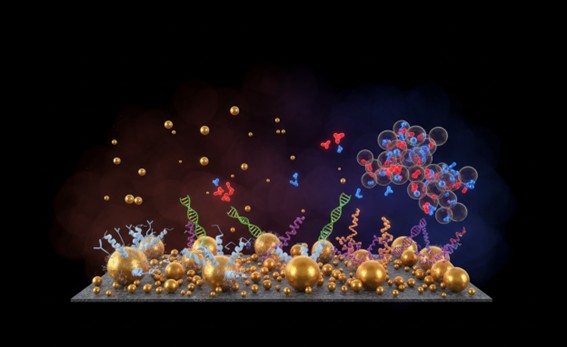 Figure 2: Gold nanoparticles functionalized with antibodies, DNA strands, and peptide ligands for biosensor applications, demonstrating size-dependent SPR color changes from wine-red to blue-purple.
Silver Nanoparticles: Potent Antimicrobial Action
Silver has been used for its antimicrobial properties for millennia. At the nanoscale, this effect is amplified by orders of magnitude. AgNPs release Ag+ ions that disrupt bacterial cell membranes, interfere with respiratory chain enzymes, and generate reactive oxygen species. Unlike antibiotics, bacterial resistance to silver develops slowly, making AgNPs a critical tool in the fight against multidrug-resistant pathogens.
- Sizes: 10-100 nm spherical, available in narrow size distributions (PDI <0.2).
- Capping agents: citrate, PVP, PEG, chitosan, silica coating for controlled release.
- Antimicrobial spectrum: effective against Gram-positive, Gram-negative, and fungal pathogens.
- Formulation: aqueous dispersion, antimicrobial masterbatch for polymer integration.
Iron Oxide Nanoparticles: Magnetic Control at the Nanoscale
Superparamagnetic iron oxide nanoparticles (SPIONs), primarily magnetite (Fe3O4) and maghemite (Fe2O3), are the most clinically mature nanomaterial platform in medicine. Their magnetic responsiveness enables external manipulation by magnetic fields for targeted drug delivery and cell separation, while their influence on proton relaxation times makes them the contrast agent of choice for T2-weighted MRI. When exposed to alternating magnetic fields, SPIONs generate localized heat for magnetic hyperthermia therapy.
- Core sizes: 5-30 nm with narrow size distribution.
- Surface coatings: oleic acid, DMSA, PEG, PVA, silica, dextran, PEI.
- Saturation magnetization: 60-80 emu/g depending on size and coating.
- MRI relaxivity: r2 values 100-400 mM-1s-1 depending on surface chemistry.
 Figure 3: Superparamagnetic iron oxide nanoparticles with polymer shell coatings, responding to magnetic field lines — the foundation of MRI contrast agents and targeted drug delivery platforms.
Platinum, Palladium and Other Noble Metal Nanoparticles
Beyond gold and silver, platinum and palladium nanoparticles offer unique catalytic properties that make them indispensable for electrochemical sensing, fuel cell electrodes, and nanoenzyme applications. PtNPs exhibit peroxidase-mimetic activity that enables colorimetric detection of glucose, H2O2, and ascorbic acid without the stability limitations of natural enzymes. PdNPs excel as catalysts for cross-coupling reactions and hydrogen storage.
- PtNPs: 5-30 nm, high catalytic activity, peroxidase mimic, fuel cell electrode.
- PdNPs: 10-50 nm, hydrogen storage catalysis, cross-coupling reactions.
- CuNPs: 20-80 nm, cost-effective antimicrobial and photocatalytic agent.
Transition Metal Oxide Nanoparticles
Metal oxide nanoparticles extend the functional range of metal nanomaterials into domains where semiconducting, piezoelectric, and photocatalytic properties are required. ZnO nanoparticles combine UV absorption with piezoelectricity and antimicrobial activity. CuO and Cu2O offer cost-effective photocatalysis and ROS generation.
- ZnO NPs: 20-100 nm, UV absorption, piezoelectric, antibacterial, ROS generation.
- CuO NPs: 20-80 nm, photocatalytic dye degradation, conductive ink precursor.
Functional Bio-Nanomaterials
Lipid-Based Nanoparticles: Nature's Own Delivery System
Lipid nanoparticles — liposomes, solid lipid nanoparticles, and lipid nanoparticles (LNPs) — represent the most clinically successful nanocarrier platform. Their phospholipid bilayer membrane is biocompatible, biodegradable, and structurally analogous to cell membranes, enabling efficient cellular uptake. The aqueous core can encapsulate hydrophilic drugs, while the lipid bilayer solubilizes hydrophobic payloads. Surface PEGylation extends circulation half-life, and targeting ligands enable active delivery to specific tissues.
- Liposomes: 50-200 nm, unilamellar or multilamellar, passive or active drug loading.
- Solid lipid nanoparticles (SLN): 50-500 nm, lipid matrix, high drug loading stability.
- LNPs: 60-100 nm, optimized for nucleic acid delivery (siRNA, mRNA).
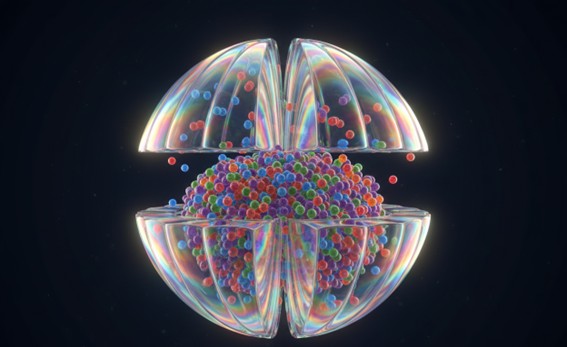 Figure 4: Cross-section of a lipid nanoparticle showing the phospholipid bilayer membrane encapsulating drug molecules in both the aqueous core and within the lipid bilayer itself.
Mesoporous Silica Nanoparticles: Tunable Pore Architectures
Mesoporous silica nanoparticles (MSNs) offer a unique combination of high surface area (>1000 m2/g), tunable pore sizes (2-10 nm), and surface chemistry that can be modified with organic functional groups. These properties make MSNs ideal for controlled drug release, where cargo molecules are loaded into the pores and released through stimuli-responsive gatekeepers.
- Pore size: 2-10 nm tunable by surfactant template choice.
- Surface functionalization: amine, carboxyl, thiol, PEG, targeting ligands.
- Stimuli-responsive: pH, redox, temperature, enzyme-triggered release.
Theranostic Nanocomposites: All-in-One Platforms
The convergence of therapy and diagnostics — theranostics — demands nanomaterials that perform multiple functions simultaneously. Our theranostic composites integrate magnetic cores for MRI guidance, plasmonic shells for photothermal therapy and SERS imaging, and polymer coatings for drug loading and targeting. These multifunctional platforms enable real-time monitoring of drug delivery and treatment response.
- Au-Fe3O4 core-shell: MRI + SERS + photothermal therapy.
- Fe3O4@SiO2@Au: magnetic targeting + drug delivery + imaging.
- Stimuli-responsive composites: pH/redox/temperature-triggered drug release.
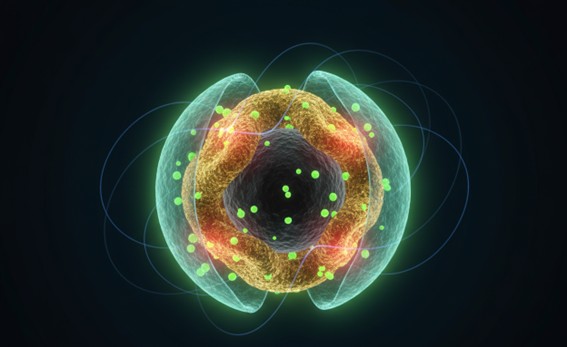 Figure 5: A core-shell theranostic nanocomposite with magnetic core, plasmonic middle layer, and polymer outer coating — integrating MRI guidance, photothermal therapy, fluorescence imaging, and targeted drug delivery.
Application Domains
The breadth of applications for metal nanomaterials and functional bio-nanomaterials reflects their extraordinary versatility. Our customers deploy these materials across diverse research and industrial programs.
- Biosensing and diagnostics: SPR biosensors, SERS substrates, lateral flow assays, electrochemical sensors, MRI contrast agents, and colorimetric detection platforms.
- Antimicrobial and environmental: wound dressings, medical device coatings, water purification, food packaging, photocatalytic pollutant degradation.
- Drug delivery and gene therapy: targeted chemotherapy, siRNA/mRNA delivery, nucleic acid transfection, stimuli-responsive release systems.
- Imaging and theranostics: MRI contrast enhancement, photothermal therapy, photoacoustic imaging, multimodal imaging-guided therapy.
- Energy and catalysis: fuel cell electrodes, photocatalytic water splitting, electrochemical sensors, hydrogen storage.
- Printed electronics: conductive inks, flexible circuits, transparent electrodes, EMI shielding coatings.
Characterization Protocols
We characterize every batch of nanomaterial before release. The data accompanies your order as a batch-specific report.
- Dynamic light scattering (DLS): hydrodynamic diameter and polydispersity index.
- Transmission electron microscopy (TEM): direct visualization of size, shape, and morphology.
- UV-Vis spectroscopy: plasmon resonance peak (Au, Ag), bandgap (semiconductors).
- X-ray diffraction (XRD): crystal phase and crystallinity.
- X-ray photoelectron spectroscopy (XPS): elemental composition and surface chemistry.
- Zeta potential: surface charge and colloidal stability.
- Vibrating sample magnetometry (VSM): magnetic properties of SPIONs and composites.
- Inductively coupled plasma (ICP-MS): trace metal purity and concentration.
Custom Nanomaterial Design and Synthesis
Standard products cover many research needs, but frontier projects often require tailored nanomaterials. Our custom synthesis service leverages expertise in colloidal chemistry, surface modification, and composite engineering to produce materials with precisely engineered properties. We have synthesized gold nanorods with specific aspect ratios for NIR absorption tuning, core-shell Au-Fe3O4 particles with controlled shell thickness for dual-modal imaging, PEGylated SPIONs with targeting ligands for cancer therapy, and lipid nanoparticles with custom phospholipid compositions for optimized mRNA encapsulation. We have also developed silica-coated metal nanoparticles for enhanced stability and stimuli-responsive release.
Describe your target size, shape, surface chemistry, functionalization, or composite architecture. Our materials chemists will propose a synthesis protocol, provide a feasibility assessment, and deliver a purified, characterized batch.
Request a Data Sheet or Start a Custom Project
Browse our metal nanomaterials and functional bio-nanomaterials catalog, request detailed characterization data, or describe the specific nanoparticle design your research requires.
| Catalog Number | Product Name | Order | Quantity |
|---|---|---|---|
| MNOFB-0001 | Gold Nanorods (Sodium Citrate Modified) |
-
+
|
|
| MNOFB-0002 | PEG Modified Gold Nanorods (Aspect Ratio 6.5, Carboxyl Terminal) |
-
+
|
|
| MNOFB-0003 | Carboxylated Magnetic Microspheres (Low Non-specificity) |
-
+
|
|
| MNOFB-0004 | Hollow Prussian Blue Nanoparticles |
-
+
|
|
| MNOFB-0005 | PEG Modified Fe3O4 Nanoparticles (Methoxy Terminal), ~10 nm |
-
+
|
|
| MNOFB-0006 | PEG Modified Spherical Gold Nanoparticles (60 nm) |
-
+
|
|
| MNOFB-0007 | PEG Modified Spherical Gold Nanoparticles (80 nm) |
-
+
|
|
| MNOFB-0008 | Streptavidin Modified Gold Nanoparticles |
-
+
|
|
| MNOFB-0009 | Biotargeting Small Molecule Modified Magnetic Nanoparticles (Custom Service) |
-
+
|
|
| MNOFB-0010 | PEI Modified Polystyrene Microspheres |
-
+
|
For Research or Industrial Raw Materials, Not For Personal Medical Use!