

Products
- High-Quality Graphene
- CVD Graphene, Graphene-Like Materials
- Graphene-Like Series
- Defect-Free Single-Crystal Graphene and Graphene-Like Materials (Mechanical Exfoliation)
- Quantum Dot Series
- Aggregation-Induced Emission (AIE)
- Near-Infrared II (NIR-II) Fluorescent Dyes
- Graphdiyne
- Two-Dimensional Transition Metal Carbides/Nitrides/Borides (MXene)
- Metal Nanomaterials and Other Functional Bio-Nanomaterials
- Metal-Organic Frameworks (MOF)
- Covalent Organic Frameworks (COF)
- Two-Dimensional Layered Metal Oxides (LDH)
- Carbon Nanotube Powders, Pastes
- Carbon Nanotube Arrays and Special Carbon Nanotube Materials
- High-Quality Metallic and Semiconducting High-Purity Single-Walled Carbon Nanotubes
- Carbon Nanotube Sponges
- Mesoporous Carbon and Carbon Nanomaterials
- High-Quality Fullerenes
- One-Dimensional Nanomaterials
- Molecular Sieves
- Inorganic Nanomaterials
- Perovskite Materials
- Highly Oriented Pyrolytic Graphite (HOPG)
- Organic Materials
- Single-Atom Catalysts
- Thermoelectric Materials
- Sodium Storage Materials
- Industrial-Grade Nanomaterials
- Solid-State Lithium Batteries
- Hydrogel Series and Consumables
Online Inquiry
Aggregation-Induced Emission (AIE)
The Paradox That Changed Fluorescence Forever
For more than a century, fluorescence chemists lived with a frustrating limitation. The brighter a molecule glowed in dilute solution, the dimmer it became when concentrated or solidified. This aggregation-caused quenching (ACQ) plagued everything from organic dyes to conjugated polymers, forcing device engineers to isolate individual fluorophores within rigid host matrices just to preserve their emission. Then, in 2001, Ben Zhong Tang and his team at the Hong Kong University of Science and Technology reported something that upended the entire field: a family of propeller-shaped molecules that were virtually non-emissive when dissolved, yet blazed with intense fluorescence when clustered together. They named the phenomenon aggregation-induced emission (AIE).
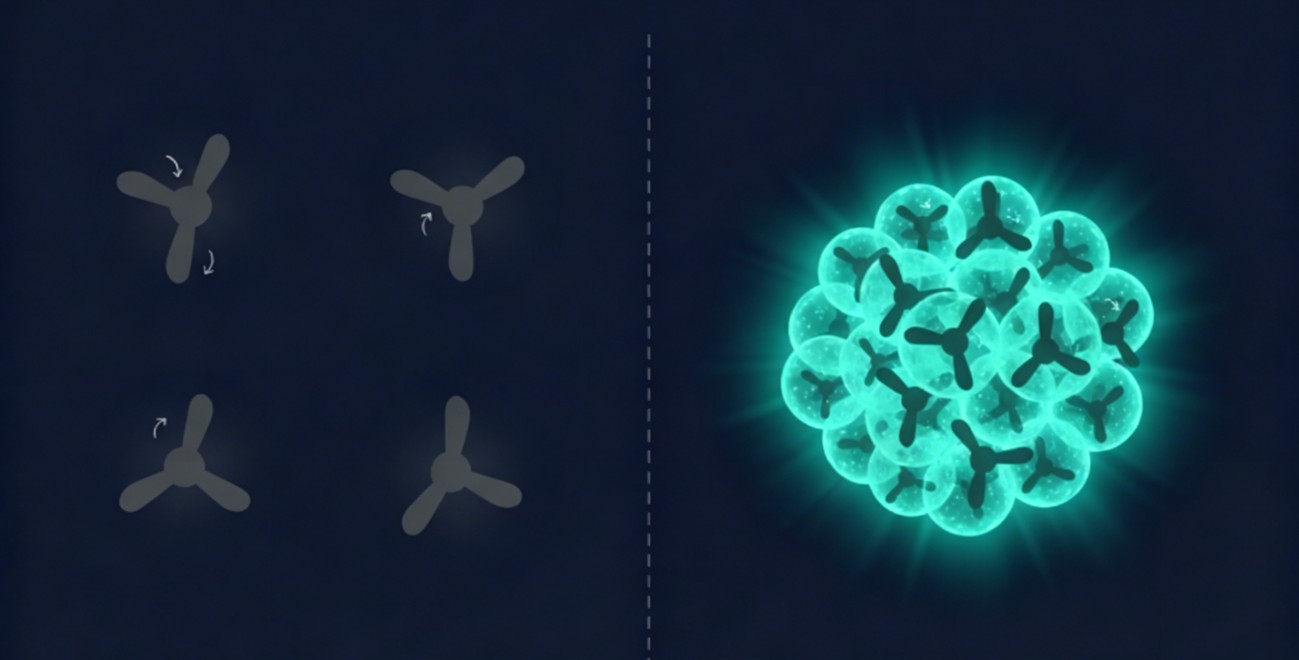 Figure 1: The aggregation-induced emission phenomenon — AIE molecules are non-emissive when dispersed in solution (left) but glow intensely upon aggregation into nanoparticles (right).
The key insight was mechanistic. In solution, the peripheral phenyl rings of an AIE molecule rotate freely around the central bond, dissipating excitation energy through molecular motion — a non-radiative decay pathway that outcompetes photon emission. When the same molecules aggregate, physical crowding blocks those rotations. The energy that was previously lost to molecular gymnastics gets rerouted into light. This restriction of intramolecular motion (RIM) mechanism explains not only why AIE molecules behave oppositely to traditional fluorophores, but also why they are uniquely suited to applications where high brightness in the solid state is essential: OLED emissive layers, biological aggregates, fluorescent sensors, and security inks. Eata Nanomaterials supplies a comprehensive portfolio of AIE luminogens and their derivatives, synthesized with batch-to-batch consistency and fully characterized for immediate integration into your research or product pipeline.
Featured Products
| Product Category | High-Volume Search Terms | Primary Applications |
| TPE (Tetraphenylethene) | AIE luminogen, propeller structure, RIM mechanism, core building block, functionalizable, PLQY >50% solid state | OLED emitters, bioimaging probes, fluorescent sensors, mechanochromic materials |
| HPS (Hexaphenylsilole) | Silole-based AIEgen, archetypal AIE molecule, vapor sensor, crystal/amorphous dual emission, reversible switching | Volatile organic compound detection, dual-responsive luminescent films, smart materials |
| TPE-BA (Boronic Acid) | Glucose sensor, sugar detection, turn-on fluorescence, oligoboronate formation, specific D-glucose probe | Diabetes diagnostics, carbohydrate sensing, metabolic monitoring, point-of-care devices |
| BTPE (Bis-TPE Biphenyl) | Microfiber self-assembly, crystalline nanowires, 100% quantum efficiency, ultrabright solid emitter, 1D aggregation | Organic nanophotonics, microscale waveguides, electroluminescent devices, optical computing |
| TPE-Sulfonate | Protein aggregation probe, amyloid fibril detection, insulin fibrosis monitoring, wash-free imaging, AIE photosensitizer | Alzheimer diagnostics, protein misfolding studies, conformational disorder research, PDT |
| TPA Derivatives | Triphenylamine AIEgen, red/NIR emission, lipid droplet imaging, mitochondria targeting, singlet oxygen generation | Image-guided photodynamic therapy, organelle-targeted imaging, cancer theranostics, antibacterial |
| AIE Polymer (pTPE) | Poly-TPE, main-chain AIE polymer, solution-processable, PLED, high solid-state PLQY, bipolar transport | Polymer light-emitting diodes, flexible displays, large-area lighting, printable electronics |
| TPE-PI Derivatives | Phenanthroimidazole, deep-blue emitter, HLCT strategy, non-doped OLED, low efficiency roll-off, high brightness | Commercial OLED displays, solid-state lighting, full-color display pixel, blue-channel emitter |
| AIE Hydrogel | TPE-RB encapsulated, agarose gel, mercury ion detection, fluorescent hydrogel, rapid quantitative assay | Environmental heavy metal sensing, water quality monitoring, wearable chemical sensors |
| Mn-Doped AIE System | Mechanochromic luminescence, piezochromic, pressure-responsive, reversible color change, solid-state switch | Anti-counterfeiting ink, pressure mapping, smart packaging, information encryption |
AIE Luminogens in Our Catalog
Tetraphenylethene (TPE): The Foundation of Modern AIE
Tetraphenylethene is the archetypal AIE luminogen. Its four phenyl rings, arranged in a propeller-like geometry around a central ethylene bridge, rotate freely in solution but lock into place upon aggregation. This simple structural motif has spawned an entire research field. TPE serves as the starting scaffold for the vast majority of functional AIE derivatives because it offers both strong AIE activity and remarkable synthetic versatility — the peripheral phenyls can be modified with electron-donating or electron-withdrawing groups to tune emission color, and terminal functional groups enable bioconjugation or polymerization.
- Solid-state PL quantum yield: typically >50 percent depending on substituents.
- Emission tunable from deep blue (~420 nm) to orange (~580 nm) through structure modification.
- Synthesis: McMurry coupling of benzophenone derivatives, scalable to multi-gram batches.
- Available as pure TPE or with pre-installed functional groups for downstream chemistry.
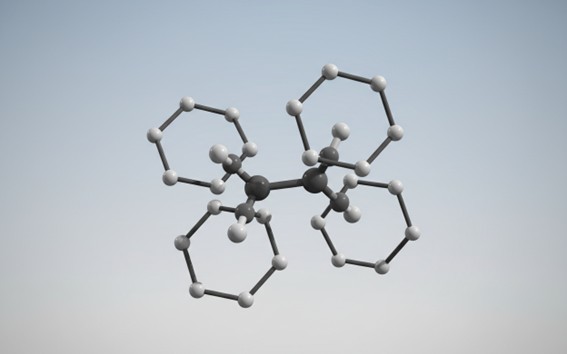 Figure 2: Ball-and-stick model of tetraphenylethene (TPE), the archetypal AIE luminogen, showing the propeller-shaped arrangement of four phenyl rings around the central ethylene core.
Hexaphenylsilole (HPS): The Original AIE Discovery
Hexaphenylsilole predates TPE as the molecule that first demonstrated the AIE phenomenon to the world. The silole ring at its core provides a unique electronic structure, and the six phenyl substituents give it even more rotational degrees of freedom than TPE — which translates into stronger AIE contrast between solution and aggregate states. HPS also exhibits fascinating dual-state emission: its crystalline and amorphous solid forms fluoresce at different wavelengths, a property that enables reversible switching between luminescent states by solvent fumigation.
- Crystalline emission: blue-shifted by ~35 nm compared to amorphous powder.
- Reversible crystallization/amorphization cycling via ethanol/toluene vapor exposure.
- Vapor sensing: absorbed solvent dissolves HPS and quenches emission; evaporation restores aggregation and brightness.
Functionalized TPE Derivatives for Targeted Applications
The real power of AIE materials lies not in the parent molecules but in the functional derivatives that marry AIE behavior with specific targeting, sensing, or device capabilities. We synthesize a broad range of functionalized TPE-based AIEgens, each designed for a distinct application domain.
- TPE-BA: terminal boronic acid groups enable specific glucose detection via oligoboronate formation and aggregation-induced fluorescence turn-on.
- TPE-Sulfonate: anionic water-soluble derivative for protein conformational studies, amyloid fibril detection, and wash-free cell imaging.
- BTPE: two TPE units fused via a biphenyl bridge; self-assembles into crystalline microfibers with 100 percent quantum efficiency in the solid state.
- TPA-18 and related TPA derivatives: cationic triphenylamine-AIEgens with mitochondria targeting, NIR emission, and singlet oxygen generation for image-guided photodynamic therapy.
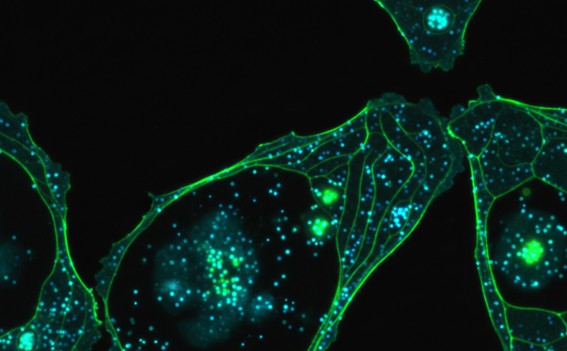 Figure 3: Fluorescence microscopy image showing AIE nanoparticles localized within live cells, demonstrating the bright emission and high photostability of AIE luminogens in biological environments.
TPE-Phenanthroimidazole (TPE-PI) Series for OLEDs
The phenanthroimidazole (PI) core is one of the most effective rigid pi-conjugated structures for building deep-blue to green electroluminescent materials. When combined with TPE blocks through the HLCT (hybridized local and charge-transfer) strategy, the resulting TPE-PI derivatives achieve both AIE characteristics and efficient exciton harvesting. These materials perform exceptionally well as non-doped emitters, eliminating the host-guest complexity of traditional OLED architectures.
- TPE-PI derivatives: emission tunable from deep blue (467 nm) to green by conjugation pattern adjustment.
- Non-doped OLED performance: EQEmax up to 7.16%, brightness >31,000 cd/m2, negligible efficiency roll-off.
- Solution-processable variants available for printable and flexible display fabrication.
AIE Polymers and Macromolecules
Low-molecular-weight AIEgens deliver excellent optical performance but can suffer from poor film-forming and mechanical properties. AIE polymers solve this by embedding TPE or HPS units into polymer backbones or side chains, combining the brightness of molecular AIEgens with the processability of macromolecular materials. Our AIE polymer line includes main-chain poly-TPEs, side-chain functionalized copolymers, and hyperbranched architectures.
- pTPE-DPA-Cz and pTPE-DPA-Flu: main-chain AIE polymers with solid-state PL efficiency up to 63.3 percent in doped films.
- Hyperbranched CP-TPE polymers: PLQY 50.1% in neat films, EQEmax 9.74% in TADF-hosted OLED devices.
- AIE hydrogels: TPE-RB encapsulated in agarose matrices for solid-state sensing platforms with rapid response.
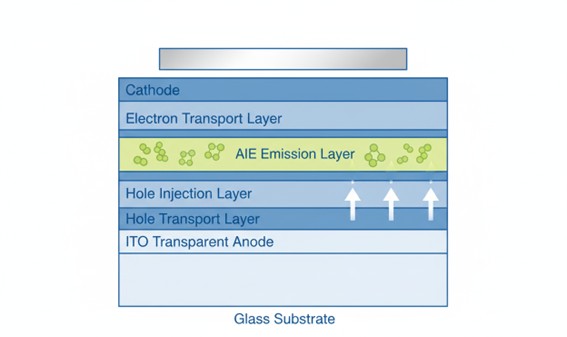 Figure 4: Cross-sectional diagram of an OLED device utilizing AIE luminogens as the emissive layer, showing the layered architecture from ITO anode through transport layers to cathode.
Where AIE Materials Outperform Everything Else
The unique photophysics of AIE luminogens translates into competitive advantages across a remarkably broad application landscape. Unlike conventional fluorophores, which require dilution or isolation to function, AIEgens get brighter under the very conditions where other dyes fail: high concentration, solid films, biological aggregates, and compressed solids. Here are the domains where our customers deploy AIE materials most successfully.
- Biological imaging and theranostics: AIE nanoparticles for wash-free cell imaging, mitochondria-targeted organelle tracing, long-term in vivo tumor imaging, and image-guided photodynamic therapy with built-in singlet oxygen generation.
- OLED and solid-state lighting: non-doped AIE emitters with negligible efficiency roll-off, deep-blue TPE-PI derivatives, and solution-processable AIE polymers for printable displays.
- Chemical and biological sensing: glucose-specific fluorescence turn-on with TPE-BA, heavy metal ion detection using AIE hydrogels, protein aggregation monitoring for amyloid-related disease diagnostics.
- Security and anti-counterfeiting: mechanochromic AIE materials that change emission color under mechanical stress, vapor-reversible luminescent switching with HPS, time-gated long-lifetime authentication beyond the reach of organic dye counterfeits.
- Organic nanophotonics: self-assembled AIE microfibers and nanowires with near-unity quantum efficiency serving as active waveguides and miniature optical resonators.
- Environmental monitoring: AIE-based fluorescent probes for pesticide detection, explosive trace analysis, and food additive screening.
Characterization Protocols for AIE Materials
AIE activity is not a property you can verify by eye alone. We characterize every batch of AIE luminogens with the same analytical rigor we apply to any semiconductor or nanomaterial, ensuring that what you receive matches the specifications your experiment or product demands.
- UV-Vis absorption spectroscopy: determination of absorption maxima and optical bandgap.
- Photoluminescence spectroscopy: emission peak position, FWHM, and PL quantum yield in both solution and aggregated states (measured with an integrating sphere).
- Time-resolved photoluminescence: fluorescence lifetime measurement to confirm radiative versus non-radiative decay pathways.
- NMR spectroscopy: 1H and 13C NMR for structural confirmation and purity assessment.
- Mass spectrometry: exact mass confirmation of molecular structure.
- X-ray diffraction: crystal phase identification and degree of crystallinity for solid-state samples.
- TEM and SEM: morphology characterization of AIE aggregates, nanofibers, and nanoparticles.
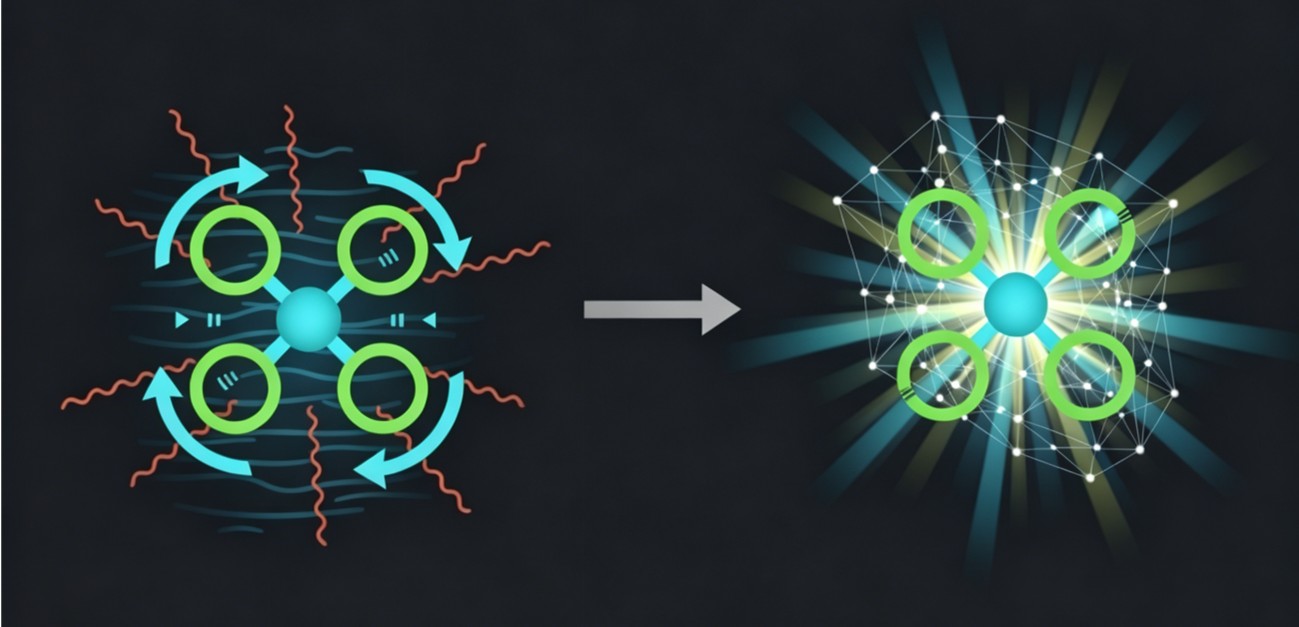 Figure 5: The restriction of intramolecular motion (RIM) mechanism — free molecular rotation in solution dissipates energy as heat, while physical confinement in the aggregated state blocks non-radiative decay and channels energy into bright fluorescence.
Custom AIE Luminogen Design and Synthesis
The modular nature of AIE chemistry means that nearly any functional group, targeting moiety, or electronic tuning element can be grafted onto a TPE, HPS, or silole core. Our custom synthesis service leverages this flexibility to produce AIEgens tailored to your exact specifications. We have synthesized TPE derivatives with specific alkoxy chain lengths for optimized OLED charge transport, triphenylamine-AIEgens with tailored HOMO-LUMO gaps for targeted emission wavelengths, and mannose-functionalized TPE probes for selective macrophage imaging via receptor-mediated uptake. We have also developed AIE-active polymeric systems with controlled molecular weight distributions for solution-processed device fabrication.
Describe your target emission wavelength, targeted organelle, analyte of interest, or device architecture. Our synthetic chemists will propose a molecular design, quote a timeline and price, and deliver a purified, characterized batch for your validation.
Request a Product Data Sheet or Custom Quotation
Browse our Aggregation-Induced Emission Series catalog, request detailed characterization data for any AIE luminogen, or tell us about the specific functional group, emission color, or targeting capability your project requires. Our materials scientists will respond with a feasibility assessment and a clear path forward.
For Research or Industrial Raw Materials, Not For Personal Medical Use!