

Polymer Grafting and Brush Modification Services
Polymer grafting and brush modification transform bare nanoparticles into sophisticated hybrid materials with precisely engineered surface properties. By tethering polymer chains to nanoparticle surfaces at controlled densities and lengths, researchers gain the ability to modulate colloidal stability, biocompatibility, environmental responsiveness, and interfacial interactions with remarkable precision.
At Eata Nanomaterials, we specialize in both grafting-to and grafting-from methodologies, enabling us to match the optimal synthetic strategy to your substrate and application. Our expertise spans surface-initiated controlled radical polymerizations, end-functionalized polymer attachment, and the preparation of complex brush architectures including block copolymer and bimodal brush systems.
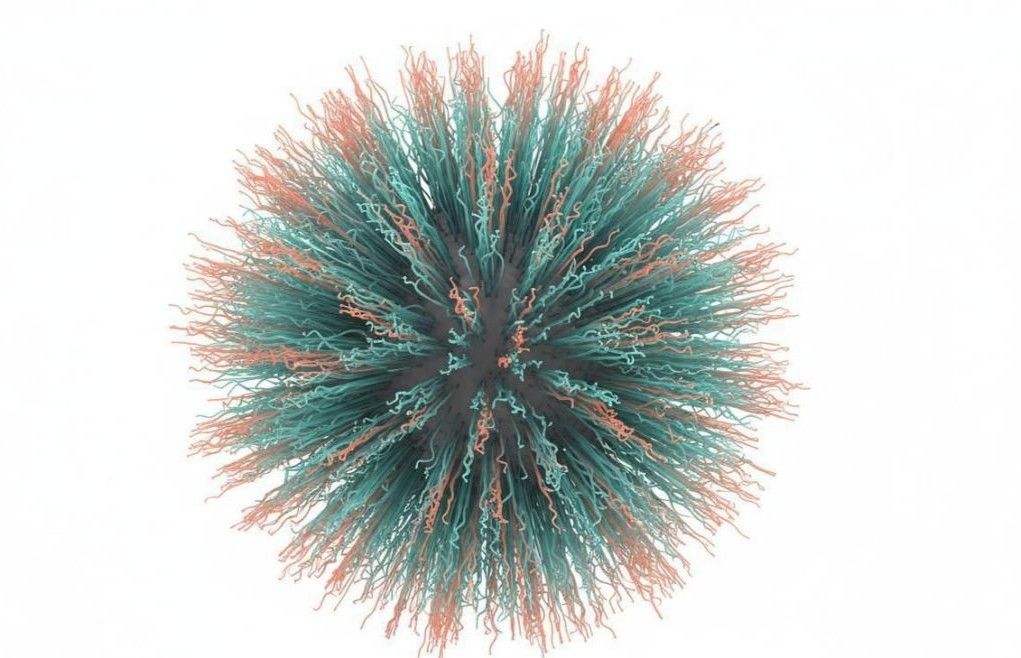 Figure 1: A polymer brush-coated nanoparticle with densely grafted chains extending radially from the core surface.
Grafting-To and Grafting-From Strategies
The choice between grafting-to and grafting-from approaches fundamentally determines the achievable grafting density, molecular weight control, and architectural complexity of the resulting polymer brush. We offer both strategies with process optimization tailored to your specific requirements.
Grafting-to: Pre-synthesized end-functionalized polymer chains are chemically attached to reactive sites on the nanoparticle surface. This method provides excellent control over polymer molecular weight and dispersity since the polymers are characterized prior to attachment. However, steric hindrance from already-adsorbed chains limits achievable grafting density, making this approach most suitable for applications requiring moderate coverage with well-defined polymer characteristics.
Grafting-from: Polymer chains grow directly from initiator-functionalized nanoparticle surfaces via surface-initiated polymerization. This approach achieves substantially higher grafting densities because monomers can access initiator sites without steric interference from existing chains. Molecular weight increases progressively during polymerization, enabling tuning of brush thickness through reaction time and monomer conversion.
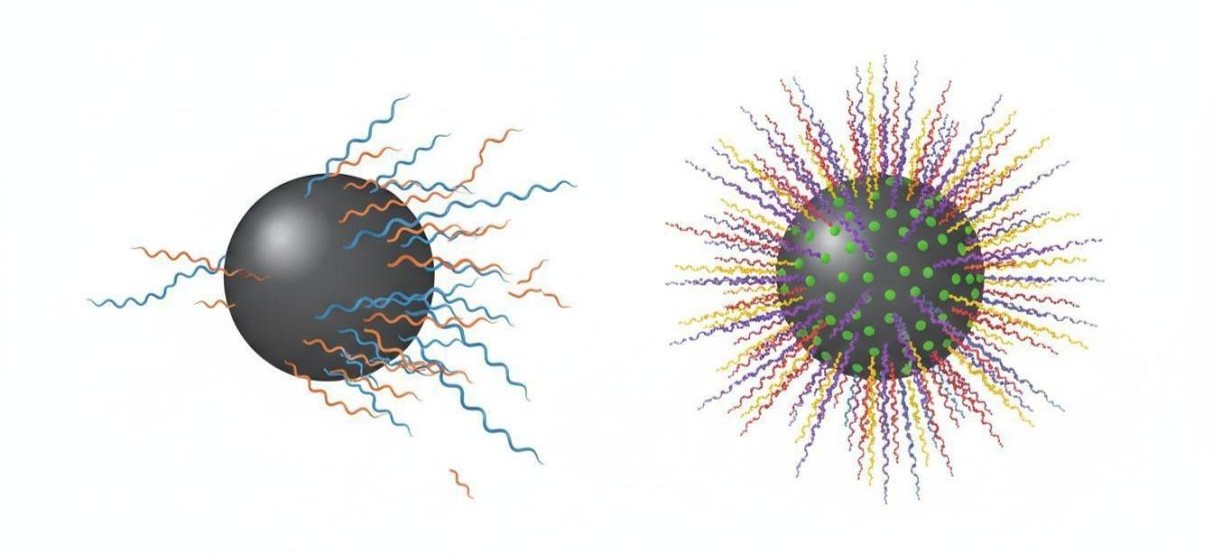 Figure 2: Visual comparison of grafting-to (left) with pre-formed chains attaching to the surface, and grafting-from (right) with chains growing directly from surface initiator sites.
Surface-Initiated ATRP for Precision Brush Growth
Surface-initiated atom transfer radical polymerization (SI-ATRP) represents our premier grafting-from technique for growing well-defined polymer brushes with narrow molecular weight distributions. This controlled radical polymerization mechanism enables precise regulation of brush thickness, composition, and architecture through careful selection of catalyst systems, ligands, and reaction conditions.
Our SI-ATRP workflow encompasses:
- Nanoparticle surface functionalization with ATRP initiators such as bromoisobutyryl bromide (BiB) anchored through silane or catechol chemistry
- Cu(I)/ligand-mediated activation-deactivation equilibrium maintaining low radical concentration for controlled chain growth with dispersity indices typically below 1.3
- ARGET ATRP and SARA ATRP variants utilizing ppm-level copper catalysts for environmentally robust, oxygen-tolerant polymerization
- Photoinduced organocatalyzed ATRP (O-ATRP) employing organic photoredox catalysts for metal-free brush synthesis suitable for biomedical applications
- Sequential monomer addition enabling block copolymer brush architectures with distinct inner and outer block functionalities
Polymers we routinely grow via SI-ATRP include polystyrene, polymethyl methacrylate, poly(oligoethylene glycol methacrylate) for stealth properties, poly(N-isopropylacrylamide) for temperature responsiveness, and poly(2-dimethylaminoethyl methacrylate) for pH-responsive behavior.
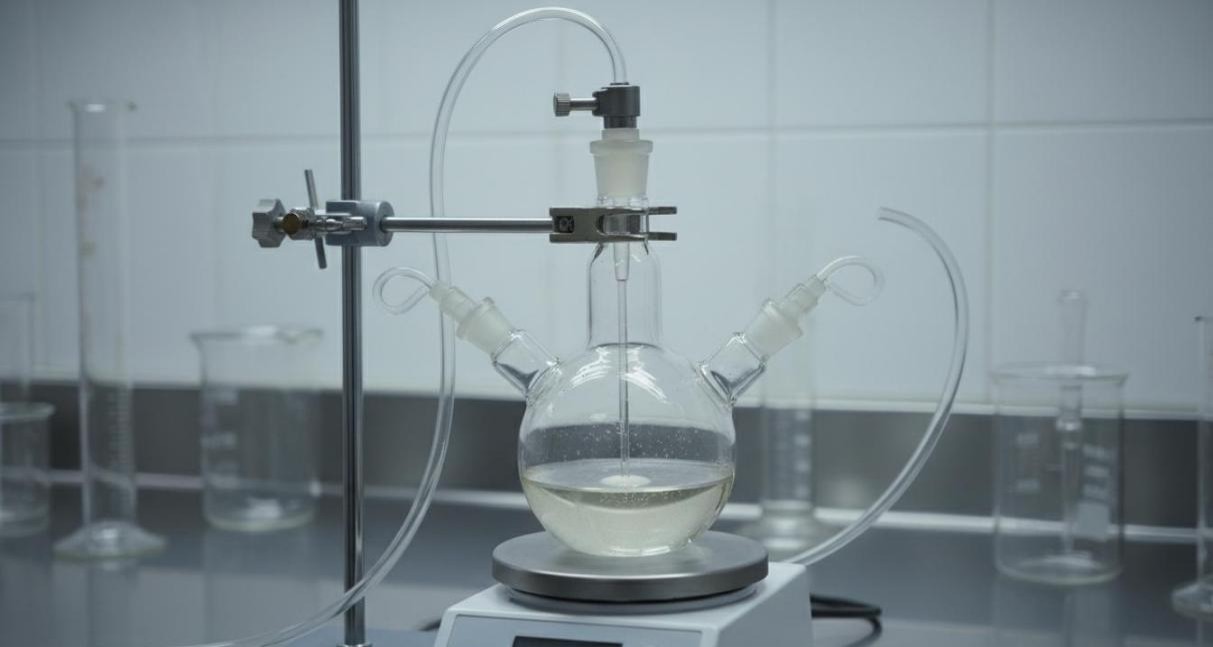 Figure 3: A Schlenk flask setup for surface-initiated ATRP polymerization under inert atmosphere on a heated magnetic stirrer.
RAFT Polymerization for Diverse Brush Architectures
Reversible addition-fragmentation chain transfer (RAFT) polymerization complements ATRP by offering functional group tolerance and metal-free operation. Our surface-initiated RAFT protocols enable brush synthesis with exceptional control over molecular weight distribution and the incorporation of functional monomers that may be incompatible with transition metal catalysts.
Key advantages of our SI-RAFT platform include:
- Compatibility with a broad range of monomer classes including acrylic acids, acrylamides, and vinyl esters for diverse brush chemistries
- Absence of metal catalyst residues, eliminating post-polymerization purification steps for sensitive biological applications
- Stepwise RAFT polymerization enabling bimodal brush architectures with separately controlled composition, molecular weight, and grafting density of two distinct polymers
- Thermogravimetric analysis (TGA) and gel permeation chromatography (GPC) of cleaved chains providing quantitative grafting density and molecular weight verification
PEG Brush Coatings for Stealth Nanoparticles
Polyethylene glycol brush coatings represent the gold standard for conferring stealth properties to nanoparticles. Unlike simple PEG adsorption, covalently grafted PEG brushes at high density create a thick hydrated layer that effectively shields the underlying surface from protein adsorption and immune recognition. Research has established that PEG grafting densities substantially exceeding the minimum threshold for brush conformation are essential for evading macrophage uptake and achieving prolonged circulation.
Our PEG brush modification services provide:
- Dense PEG brushes via grafting-from SI-ATRP of oligo(ethylene glycol) methacrylate, achieving high grafting densities with precise molecular weight control
- Mushroom-to-brush transition engineering by tuning PEG chain length and surface density to optimize the hydration layer thickness for specific applications
- Heterobifunctional PEG brushes with reactive terminal groups for subsequent attachment of targeting ligands, imaging probes, or therapeutic payloads
- Clusterin-enriched corona formation through brush conformation optimization, enhancing dysopsonin recruitment for active phagocytosis evasion
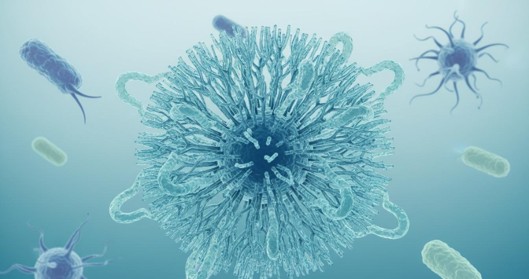 Figure 4: A PEG brush-coated stealth nanoparticle evading recognition by surrounding immune cells in the bloodstream.
Stimuli-Responsive and Smart Polymer Brushes
Beyond static PEG coatings, we engineer smart polymer brushes that dynamically respond to environmental triggers. These intelligent surfaces enable controlled drug release, switchable protein interactions, and adaptive behavior in complex biological environments.
| Polymer Brush | Stimulus | Response Behavior |
| PNIPAM / PVCL | Temperature | LCST-induced collapse above 32-37C for thermally triggered release |
| PDMAEMA / PDEA | pH | Protonation/deprotonation driving charge and solubility transitions |
| PSPMA / SBMA | Ionic strength | Antipolyelectrolyte swelling in salt for zwitterionic responses |
| PPEGMA / POx | Protein repulsion | Stealth hydration layer resisting nonspecific biofouling |
| PtBA (hydrolyzed) | Chemical trigger | Acid-labile groups enabling controlled deprotection |
Polymer-Grafted Nanoparticles for Nanocomposites
Polymer-grafted nanoparticles function as one-component composite materials where the grafted brush mediates dispersion and interfacial compatibility with polymer matrices. By tailoring grafting density and molecular weight, we optimize nanoparticle dispersion, entanglement with matrix polymers, and the resulting mechanical, dielectric, or thermal properties of nanocomposite formulations.
Key formulation parameters we engineer include:
- Bimodal brush architectures combining short chains for steric stabilization with long chains for matrix entanglement, dramatically improving toughness and processability
- Grafting density optimization to achieve transitions from particle-dominated to brush-dominated regimes, controlling interparticle spacing and assembly morphology
- Brush-matrix compatibility matching through selection of brush chemistry to ensure favorable interactions with the host polymer, preventing phase separation
- Variable grafting density protocols producing concentration-dependent dispersion behavior useful for self-assembly and structure formation studies
 Figure 5: Three vials containing stable colloidal dispersions of polymer-grafted nanoparticles with distinct surface chemistries.
Analytical Characterization of Polymer Brushes
Comprehensive characterization underpins every polymer grafting project. Our analytical toolkit verifies successful brush formation, quantifies critical structural parameters, and ensures batch-to-batch reproducibility:
- Thermogravimetric analysis (TGA) determining organic content and calculating grafting density from the mass fraction of grafted polymer
- Gel permeation chromatography (GPC) of cleaved chains measuring number-average and weight-average molecular weight with dispersity indices
- Dynamic light scattering (DLS) tracking hydrodynamic diameter increases following brush growth, confirming colloidal stability
- Nuclear magnetic resonance (NMR) spectroscopy verifying brush composition and monomer incorporation ratios in copolymer systems
- X-ray photoelectron spectroscopy (XPS) confirming surface elemental composition changes following initiator attachment and brush growth
- Atomic force microscopy (AFM) characterizing brush thickness and morphology on flat model substrates
Applications of Polymer Brush-Modified Nanoparticles
| Application | Brush Function | Key Benefit |
| Drug delivery | Stealth PEG / targeting ligand | Prolonged circulation, reduced immune clearance |
| Diagnostic imaging | Fluorophore / contrast agent brush | Enhanced signal, reduced background |
| Biosensing | Antibody / aptamer brush | Controlled receptor density, antifouling |
| Nanocomposites | Matrix-compatible polymer brush | Improved dispersion, enhanced mechanical properties |
| Catalysis | Catalyst-support brush | Stabilized active sites, controlled access |
| Coatings | Hydrophobic / antifouling brush | Tailored wetting, biofilm resistance |
Start Your Polymer Brush Modification Project
Whether you require dense PEG brushes for stealth drug delivery, temperature-responsive coatings for controlled release, or matrix-compatible polymer grafts for advanced nanocomposites, Eata Nanomaterials provides the synthetic expertise and analytical infrastructure to achieve your research objectives with precision and reproducibility.
Reach out to our technical team to discuss your nanoparticle substrate, desired brush chemistry, and target application. We will recommend the optimal grafting strategy and provide a detailed project proposal.