

Core-Shell Nanostructure Fabrication Services
Core-shell nanostructures represent one of the most powerful design paradigms in nanomaterial engineering. By combining two or more materials into a single particle with a defined core surrounded by a conformal shell layer, these architectures unlock synergistic properties that neither component can achieve alone. A magnetic core encased in a silica shell gains both colloidal stability and bioconjugation handles. A quantum dot core wrapped in a wider-bandgap shell sees its photoluminescence quantum yield soar toward unity. A polymer core surrounded by a stimuli-responsive shell delivers drugs on demand. The possibilities are virtually limitless, constrained only by the imagination and the precision of fabrication.
At Eata Nanomaterials, we specialize in the rational design and precise fabrication of core-shell nanostructures across the full material spectrum. Our platform integrates seeded growth, sol-gel coating, layer-by-layer assembly, and microemulsion polymerization to produce core-shell particles with controlled dimensions, uniform shell thickness, and tailored interfacial chemistry. We work with polymeric, inorganic, metallic, magnetic, and semiconductor core materials, and engineer shells that confer protection, functionality, targeting specificity, or controlled release behavior.
Core-Shell Design Strategy & Architecture Selection
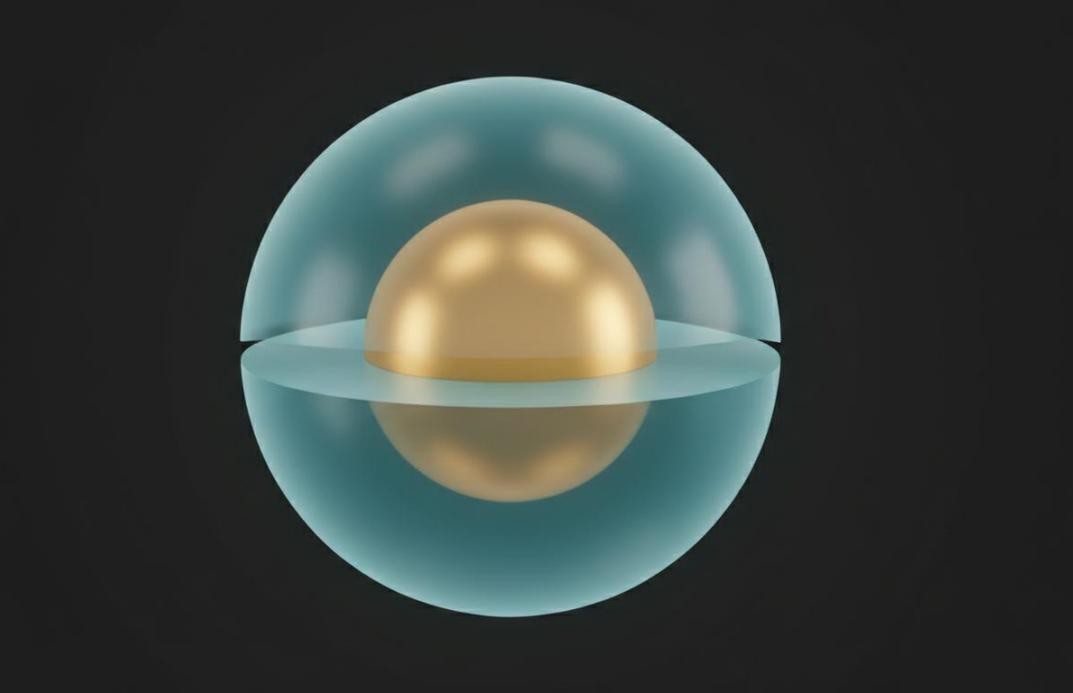 Figure 1: Cross-sectional view of a generic core-shell nanoparticle showing a solid spherical core encapsulated by a uniform shell layer
The success of a core-shell nanostructure begins at the design stage. Selecting the appropriate core material, shell material, and fabrication method requires careful consideration of the intended application, the chemical compatibility of the components, and the desired interfacial properties. Our design consultation service guides you through this process, drawing on deep expertise across materials chemistry, surface science, and nanofabrication to recommend an optimal architecture.
We classify core-shell designs into several strategic categories, each suited to different functional objectives. In a conventional core-shell architecture, the shell passivates the core surface, protects it from the environment, and provides functional handles for further modification. In a yolk-shell or rattle-type architecture, the core is detached from the shell interior, creating a void that can serve as a nanoreactor or reservoir. In a multicore architecture, multiple functional nanoparticles are encapsulated within a single shell, creating synergistic multifunctional systems.
Architecture types we fabricate:
- Conventional core-shell: Single core fully enclosed within a continuous shell; the most versatile architecture for protection, passivation, and surface functionalization.
- Multilayer onion structures: Multiple alternating shell layers creating a Russian-doll morphology; each layer can be independently functionalized for sequential release or multi-modal imaging.
- Yolk-shell (rattle-type): Core particle surrounded by a hollow void and outer shell; enables high cargo loading, nanoreactor confinement, and density-tuned buoyancy.
- Multicore: Multiple core nanoparticles within a single shell; combines multiple functionalities such as magnetic targeting, plasmonic heating, and drug delivery in one carrier.
- Asymmetric (Janus) structures: Half-coated or dumbbell morphologies with spatially separated functional domains; enables simultaneous incompatible reactions or orthogonal targeting.
Polymeric Core-Shell Nanoparticle Fabrication
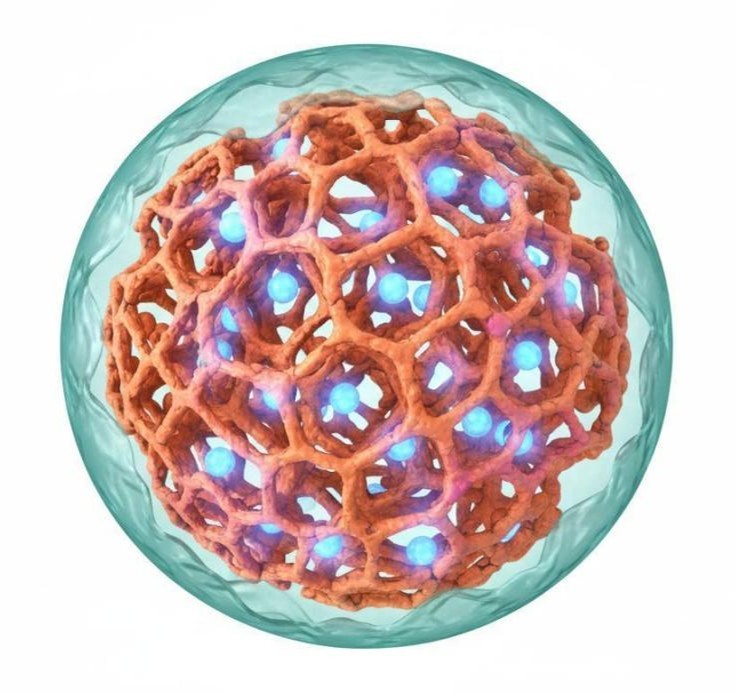 Figure 2: Polymeric core-shell nanoparticle with drug-loaded PLGA core and PEG protective shell for controlled therapeutic release
Polymeric core-shell nanoparticles represent the most clinically advanced class of nanocarrier systems, with multiple FDA-approved products currently on the market. The polymer core provides a biocompatible, biodegradable matrix for drug encapsulation, while the shell layer controls surface properties, stealth behavior, targeting specificity, and release kinetics. Our polymeric core-shell fabrication service produces precisely engineered particles with tunable sizes from 50 to 500 nm, narrow polydispersity, and high drug loading efficiency.
We fabricate polymeric core-shell systems through several complementary methods. Miniemulsion polymerization produces particles with hydrophobic drug-loaded cores and hydrophilic shells in a single step. Nanoprecipitation followed by shell deposition enables precise control over core composition and shell thickness independently. Self-assembly of amphiphilic block copolymers creates micelle-like structures with a hydrophobic cargo core and a hydrophilic PEG corona. Each method is selected based on the drug payload, release requirements, and scale-up considerations.
Polymeric platforms:
- PLGA/PLA cores with PEG shells: Biodegradable polyester cores for sustained drug release over days to weeks; PEG shell for stealth and prolonged circulation.
- Chitosan cores with alginate shells: Naturally occurring polysaccharide pair for mucoadhesive delivery; pH-dependent release in acidic environments.
- PEG-PLA micelles: Self-assembled core-shell structures with 20-100 nm diameters; exceptional solubilization of hydrophobic drugs.
- Temperature-responsive systems: PNIPAM or poloxamer shells that undergo thermally triggered collapse or dissolution for on-demand release.
- pH-responsive core-shell: Acid-labile bonds or protonatable polymers in the shell that destabilize in tumor microenvironments or endosomal compartments.
Silica-Based Core-Shell Nanostructures
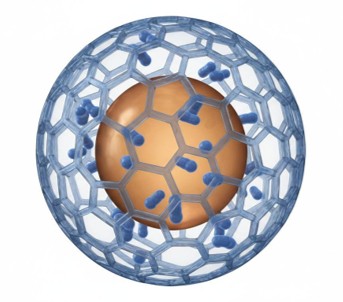 Figure 3: Mesoporous silica core-shell nanoparticle showing a core surrounded by ordered porous silica shell with drug molecules loading into pore channels
Silica shells offer an extraordinary combination of properties that make them ideal for core-shell nanostructure engineering. They are chemically inert, optically transparent, thermally stable, and biocompatible. Their surface chemistry is extraordinarily versatile — silane coupling chemistry enables the attachment of virtually any functional group, biomolecule, or polymer. The sol-gel process for silica coating is mild, aqueous-compatible, and applicable to virtually any core material that is stable at near-neutral pH.
We employ the Stober method for non-porous silica coating and surfactant-templated sol-gel routes for mesoporous silica shells. The Stober process produces dense, uniform silica layers with controlled thickness from 5 to 50 nm. Mesoporous silica coating introduces ordered pore channels within the shell, creating a high-surface-area reservoir for drug loading or catalytic sites. The shell thickness, pore size, and surface functionalization are all independently tunable.
Silica core-shell capabilities:
- Dense SiO2 coating: Uniform shells on Au, Ag, Fe3O4, CdSe, and quantum dot cores; thickness 5-50 nm controlled by TEOS concentration; protects cores from oxidation and aggregation.
- Mesoporous SiO2 shells: MCM-41 and SBA-15 type shells with 2-10 nm pores; loading capacity >30 wt% for small molecule drugs; high surface area >700 m2/g.
- Hollow SiO2 nanoshells: Sacrificial template removal to create hollow silica capsules; high cargo loading; low density; ideal for ultrasound contrast and delivery.
- Fluorescent silica shells: Co-condensation of TEOS with FITC or RITC silanes; built-in fluorescence for tracking without quenching the core.
- Bioconjugated silica surfaces: Amine, thiol, carboxyl, and PEG functionalization; antibody, peptide, and aptamer attachment for targeted delivery.
Magnetic & Metal Core-Shell Systems
 Figure 4: Magnetic core-shell nanoparticle with iron oxide core and gold shell combining magnetic targeting with plasmonic properties
Magnetic core-shell nanostructures combine the responsiveness of magnetic fields with the surface functionality of the shell material, creating dual-action platforms for magnetic separation, targeted delivery, hyperthermia, and multimodal imaging. Gold-coated magnetic particles, for example, can be guided to a target site using an external magnetic field and then heated using near-infrared light through plasmonic absorption of the gold shell. This synergistic behavior has profound implications for theranostics.
Our fabrication of magnetic and metal core-shell systems employs seeded growth, galvanic replacement, and sol-gel coating strategies adapted to the specific metal or oxide core. We produce dense, pinhole-free shells that protect reactive metal surfaces from oxidation while preserving their intrinsic magnetic or plasmonic functionality. The shell material can be gold for bioconjugation, silica for drug loading, carbon for conductivity, or polymers for stealth.
| Core Material | Shell Options | Applications |
| Fe3O4 / gamma-Fe2O3 | Au, SiO2, polymer, carbon | MRI contrast, magnetic hyperthermia, targeted drug delivery |
| Au / Ag | SiO2, TiO2, polymer, MOF | SERS, photothermal therapy, catalysis, imaging |
| CdSe / InP QDs | ZnS, SiO2, polymer | Quantum yield enhancement, LED emitters, bioimaging |
| TiO2 / ZnO | SiO2, carbon, noble metal | Photocatalysis, solar cells, UV protection |
| Upconversion NPs | SiO2, Au, polymer | NIR bioimaging, photodynamic therapy, sensing |
| Cu / CuO | SiO2, carbon, ZrO2 | Catalysis, antimicrobial, conductive inks |
Advanced Multi-Layer & Heterostructured Systems
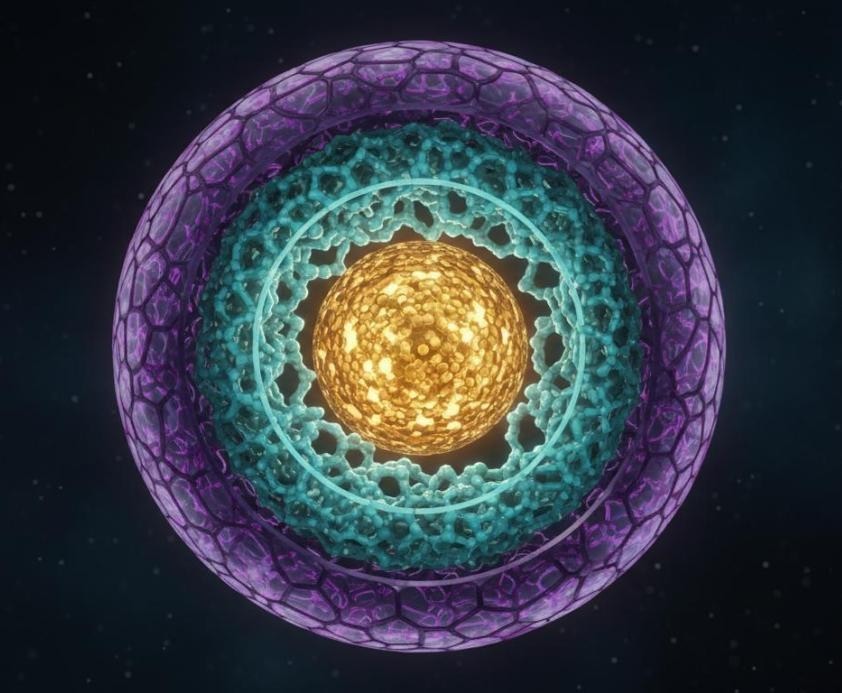 Figure 5: Multi-layered onion-like core-shell nanostructure with three concentric layers of different functional materials
When a single shell layer is insufficient to meet complex functional demands, multi-layer and heterostructured core-shell systems provide an elegant solution. These advanced architectures integrate three or more distinct material phases within a single nanoparticle, each serving a dedicated function. An inner shell might provide passivation, an intermediate shell might serve as a cargo reservoir, and an outer shell might present targeting ligands. The precision fabrication of such structures demands meticulous control over each deposition step to ensure layer uniformity, interfacial integrity, and preservation of the core's functionality.
We fabricate multi-layer systems through sequential growth approaches where each layer is deposited under conditions optimized for that specific material pair. Interfacial engineering ensures strong adhesion between layers while preventing interdiffusion or phase mixing. The result is structurally robust particles with well-defined, sharp interfaces that maintain their architecture under physiological, thermal, and mechanical stress.
- Fe3O4@SiO2@Au: Magnetic core, silica spacer, gold outer shell; combines MRI visibility, drug loading, and photothermal/plasmonic functionality.
- Fe3O4@Au@SiO2: Magnetic core encapsulated in gold with silica outer shell; plasmonic heating with silica bioconjugation and protection.
- QD@ZnS@SiO2: Quantum dot core, semiconductor passivation shell, silica protective and functional shell; maximum photostability.
- Drug@MOF@SiO2: Drug-loaded MOF core, silica shell with stimuli-responsive gatekeepers; zero-premature-release delivery system.
- Au@SiO2@Ag: Plasmonic core-dielectric-plasmonic sandwich; electromagnetic hot spot engineering for SERS amplification.
Comprehensive Core-Shell Characterization
Verifying the structural integrity, shell uniformity, and functional performance of core-shell nanostructures requires a multi-technique analytical approach. Our characterization suite confirms that every core-shell particle meets dimensional, compositional, and performance specifications.
- Morphology & dimensions: Transmission electron microscopy (TEM) for core and shell diameter measurement; high-resolution TEM for lattice imaging and interface sharpness; scanning electron microscopy (SEM) for surface morphology.
- Shell thickness & uniformity: Energy-filtered TEM (EFTEM) for elemental mapping across the core-shell interface; dynamic light scattering (DLS) for hydrodynamic size changes upon shell deposition.
- Elemental composition: Energy-dispersive X-ray spectroscopy (EDX) line scans across particles; X-ray photoelectron spectroscopy (XPS) for surface elemental analysis; inductively coupled plasma mass spectrometry (ICP-MS) for quantitative metal content.
- Phase & crystallinity: X-ray diffraction (XRD) for phase identification of core and shell materials; selected area electron diffraction (SAED) for local crystallinity confirmation.
- Functional performance: UV-Vis absorption and photoluminescence spectroscopy for optical properties; vibrating sample magnetometry (VSM) for magnetic characterization; BET surface area and pore size analysis for mesoporous shells.
Design Your Multi-Functional Core-Shell Nanostructure Today
Reach out to Eata Nanomaterials to explore how custom core-shell nanostructures can advance your research. Our nanofabrication specialists will design and fabricate precisely engineered architectures tailored to your application requirements.