

Products
- High-Quality Graphene
- CVD Graphene, Graphene-Like Materials
- Graphene-Like Series
- Defect-Free Single-Crystal Graphene and Graphene-Like Materials (Mechanical Exfoliation)
- Quantum Dot Series
- Aggregation-Induced Emission (AIE)
- Near-Infrared II (NIR-II) Fluorescent Dyes
- Graphdiyne
- Two-Dimensional Transition Metal Carbides/Nitrides/Borides (MXene)
- Metal Nanomaterials and Other Functional Bio-Nanomaterials
- Metal-Organic Frameworks (MOF)
- Covalent Organic Frameworks (COF)
- Two-Dimensional Layered Metal Oxides (LDH)
- Carbon Nanotube Powders, Pastes
- Carbon Nanotube Arrays and Special Carbon Nanotube Materials
- High-Quality Metallic and Semiconducting High-Purity Single-Walled Carbon Nanotubes
- Carbon Nanotube Sponges
- Mesoporous Carbon and Carbon Nanomaterials
- High-Quality Fullerenes
- One-Dimensional Nanomaterials
- Molecular Sieves
- Inorganic Nanomaterials
- Perovskite Materials
- Highly Oriented Pyrolytic Graphite (HOPG)
- Organic Materials
- Single-Atom Catalysts
- Thermoelectric Materials
- Sodium Storage Materials
- Industrial-Grade Nanomaterials
- Solid-State Lithium Batteries
- Hydrogel Series and Consumables
Online Inquiry
Metal-Organic Frameworks (MOF)
Metal-organic frameworks represent a radical departure from conventional porous materials. Zeolites, activated carbons, and mesoporous silicas all rely on natural or templated pore formation processes that offer limited control over pore size, shape, and chemistry. MOFs, by contrast, are built from the bottom up: inorganic metal ions or clusters serve as nodes, organic molecules act as linkers, and coordination chemistry stitches them together into crystalline frameworks with porosity that is designed rather than discovered. The result is a family of materials with surface areas that can exceed 7,000 m2/g — far surpassing activated carbon — and pore sizes that can be tuned with angstrom-level precision by simply choosing different linkers or metal centers.
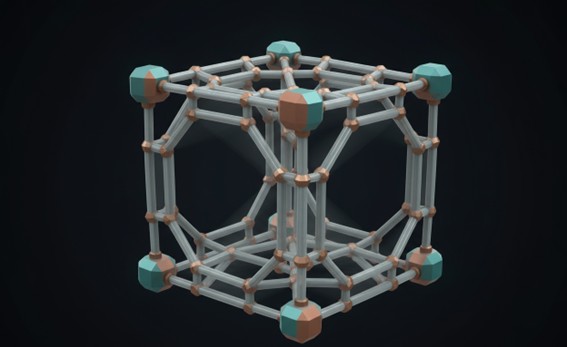 Figure 1: A metal-organic framework crystal structure showing metal nodes connected by organic linkers to form a three-dimensional porous lattice with uniform pore channels.
Since Yaghi and colleagues reported the first permanently porous MOF in 1999, the field has exploded. Over 100,000 different MOF structures have been documented, and the number of publications exceeds 200,000 per year. Industrial adoption is accelerating: MOFs are now commercialized for gas storage, carbon capture, water harvesting from air, and pharmaceutical manufacturing. At Eata Nanomaterials, we synthesize and supply the MOF compositions that drive the most active research programs — ZIF-8, UiO-66, HKUST-1, MIL-101, MOF-74, and their functionalized derivatives — produced by solvothermal, hydrothermal, microwave-assisted, and mechanochemical methods with the analytical rigor that distinguishes research-grade materials from commercial curiosities.
Featured Products
| MOF Type | High-Volume Search Specs | Primary Applications |
| ZIF-8 | Zn-based, zeolitic topology, 2-methylimidazole linker, 3.4 A pore aperture, SSA ~1600 m2/g, pH sensitive, low cytotoxicity | Drug delivery, gas separation, sensor, enzyme immobilization, DNA detection |
| UiO-66 | Zr6O4(OH)4 nodes, terephthalate linker, exceptional hydrothermal stability, SSA ~1200 m2/g, open metal sites | Catalysis, biomass conversion, water treatment, membrane separation, drug delivery |
| HKUST-1 | Cu3(btc)2, copper paddlewheel, benzene-1,3,5-tricarboxylate, Lewis acid sites, blue crystals, SSA ~1800 m2/g | CO oxidation catalyst, gas storage, electrochemical sensor, VOC capture |
| MIL-101(Cr/Fe) | Cr3+ or Fe3+ trimer, 1,4-benzenedicarboxylate, mesoporous cages ~2.9/3.4 nm, SSA ~4000 m2/g, unsaturated metal sites | Catalysis, drug delivery, water purification, adsorption, chemical sensor |
| MOF-74 Series | 1D channels, open metal sites, Mg/Ni/Co variants, high CO2/CH4 binding, SSA >1000 m2/g, CUS sites | CO2 capture, natural gas storage, water harvesting, catalysis, drug carrier |
| ZIF-67 | Co-based zeolitic imidazolate, Co2+ nodes, catalytic, water oxidation, similar topology to ZIF-8 | Catalysis, water oxidation, electrocatalysis, gas adsorption, core-shell composites |
| MIL-53(Al/Cr) | Flexible framework, breathing effect, 1,4-benzenedicarboxylate, narrow/large pore switching | Drug delivery, gas separation, flexible sensor, pollutant adsorption |
| PCN-224/MOF-545 | Zr6 cluster, porphyrin linker, mesoporous, photocatalysis, large pore ~3 nm | Photocatalytic CO2 reduction, PDT agent, biomimetic catalysis |
| Bio-MOFs | Fe, Zn, Ca, Mg biocompatible metals, nontoxic linkers, biodegradable, GMP-compatible synthesis | Oral drug delivery, biomedicine, nutritional supplement encapsulation |
MOF Products in Our Catalog
ZIF-8: The Workhorse of MOF Research
Zeolitic imidazolate framework-8 is the most widely studied MOF in the world. Built from Zn2+ ions and 2-methylimidazole linkers, ZIF-8 adopts a sodalite topology with a pore aperture of 3.4 angstroms — small enough for molecular sieving, yet large enough for many guest molecules. Its exceptional chemical stability in organic solvents, water, and even acidic conditions, combined with low cytotoxicity and pH-sensitive degradation behavior, makes it the platform of choice for drug delivery, gas separation, and sensor development.
- BET surface area: ~1,600 m2/g, confirmed by N2 adsorption at 77 K.
- Particle size: 50 nm to 10 um, tunable by modulator concentration and synthesis temperature.
- Pore aperture: 3.4 angstroms (6-membered ring windows).
- Thermal stability: up to 550 C in inert atmosphere.
- Available as: crystalline powder, methanol/ethanol suspension, or aqueous dispersion.
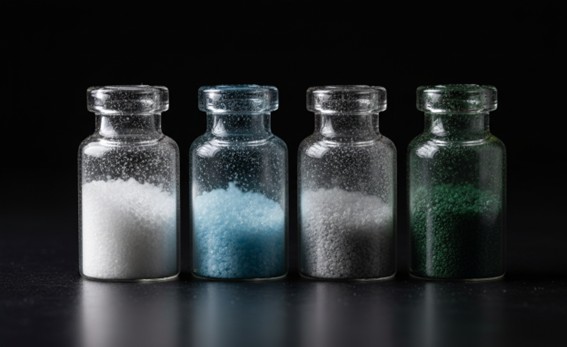 Figure 2: Metal-organic framework crystalline powder samples of different compositions in glass vials, showing the characteristic color variations from white to blue to dark green.
UiO-66: Unmatched Hydrothermal Stability
UiO-66 derives its name from the University of Oslo, where it was first synthesized. Its structure features Zr6O4(OH)4 secondary building units coordinated to twelve terephthalate linkers, creating a framework of extraordinary robustness. UiO-66 tolerates prolonged exposure to water, organic solvents, and elevated temperatures that would collapse most other MOFs. This stability, combined with open metal sites after activation and facile functionalization via linker substitution (amino, nitro, bromo), makes UiO-66 the premier choice for catalysis in aqueous environments, membrane separations, and water treatment.
- BET surface area: ~1,200 m2/g for pristine UiO-66.
- Functionalized variants: Nh3-UiO-66, NO2-UiO-66, Br-UiO-66, and mixed-linker versions.
- Open metal sites: 1.2-3.0 mmol/g accessible for catalysis and adsorption.
- Membrane-grade: available as seed crystals for thin-film composite fabrication.
HKUST-1: Catalytic Copper Framework
HKUST-1 (Hong Kong University of Science and Technology) is built from Cu2+ paddlewheel dimers and benzene-1,3,5-tricarboxylate linkers. Its most distinctive feature is the presence of coordinatively unsaturated copper sites that function as Lewis acid catalysts and strong binding sites for polar molecules. The characteristic blue crystalline appearance is unmistakable in any MOF laboratory.
- BET surface area: ~1,800 m2/g.
- Open metal site density: 4.6 mmol/g among the highest of any MOF.
- Catalytic applications: CO oxidation, benzene oxidation, cyanosilylation.
- Available as: activated blue crystals, N2-sealed for stability.
MIL-101(Cr/Fe): Mesoporous Giant
MIL-101 features chromium or iron trimers connected by 1,4-benzenedicarboxylate linkers to form a framework with two types of mesoporous cages: 2.9 nm pentagonal windows accessing 3.4 nm spherical cages. This hierarchical pore architecture enables the loading of large molecules — from antibiotics to enzymes — that smaller-pore MOFs cannot accommodate. The unsaturated metal sites provide catalytic activity for selective oxidation and Lewis acid catalysis.
- BET surface area: up to 4,000 m2/g among the highest reported for any MOF.
- Cage sizes: 2.9 nm (small) and 3.4 nm (large) mesoporous cages.
- Functionalized variants: Nh3-MIL-101, SO3H-MIL-101 for enhanced adsorption.
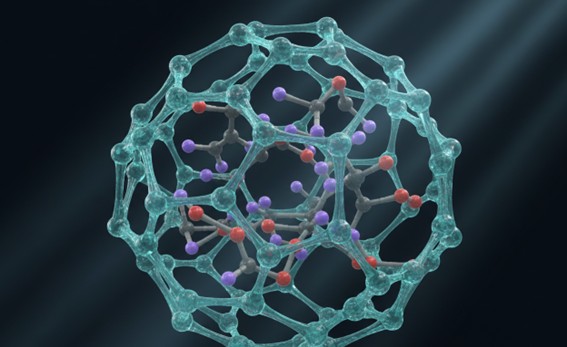 Figure 3: A metal-organic framework crystal with gas molecules adsorbed within the internal pore channels, illustrating the high-capacity gas capture capability of MOF materials.
MOF-74 Series: Open Metal Sites for Gas Binding
The MOF-74 series (also known as CPO-27) features one-dimensional channels lined with exposed metal cations that serve as high-density binding sites for gas molecules. Different metal variants — Mg, Ni, Co, Zn — offer different binding strengths and selectivities. MOF-74(Mg) achieves among the highest CO2 gravimetric capacities of any MOF at low partial pressures, while MOF-74(Ni) has been pilot-tested for vehicular natural gas storage.
- MOF-74(Mg): CO2 capacity >8 mmol/g at 0.15 bar and 298 K.
- MOF-74(Ni): CH4 working capacity >60 g/L for ANG applications.
- MOF-74(Co): selective CO2/N2 separation, water harvesting.
Bio-MOFs and Pharmaceutical-Grade MOFs
For biomedical applications, conventional MOFs containing toxic metals are unsuitable. Our bio-MOF line uses physiologically benign metals — iron, zinc, calcium, magnesium — with biocompatible linkers derived from amino acids, nucleobases, or GRAS-listed molecules. These frameworks degrade into naturally occurring substances that the body can metabolize or excrete.
- MIL-88A(Fe): iron fumarate, FDA GRAS components, pH-triggered drug release.
- ZIF-8 biocomposite: encapsulated enzymes, probiotics, oral delivery.
- Ca-MOF: calcium-based, biodegradable, nutritional supplement carrier.
Where Our MOFs Deliver Results
The breadth of MOF applications is staggering and growing annually. Our customers deploy our MOF products across a diverse range of research and industrial programs.
- Carbon capture and gas separation: MOF-74(Mg) for post-combustion CO2 capture, ZIF-8 membranes for propylene/propane separation, UiO-66 for biogas upgrading.
- Energy storage: MOF-derived carbon anodes for Li-ion batteries, MOF-encapsulated sulfur for Li-S batteries, MOF solid electrolytes for all-solid-state batteries.
- Catalysis: UiO-66 for biomass conversion to platform chemicals, HKUST-1 for CO oxidation, MIL-101 for Friedel-Crafts alkylation, MOF-supported single-atom catalysts.
- Drug delivery: ZIF-8 for oral delivery with pH-triggered release, MIL-101 for antibiotic loading, UiO-66-Nh3 for cisplatin prodrug encapsulation.
- Water treatment: UiO-66 membranes for desalination, MIL-101 for arsenic/fluoride removal, ZIF-8 for organic pollutant adsorption.
- Sensing: ZIF-8 for explosive and nerve agent detection, UiO-66 for humidity sensing, luminescent MOFs for metal ion detection.
- Atmospheric water harvesting: MOF-74(Co), MOF-801, and CAU-10 for water extraction from desert air.
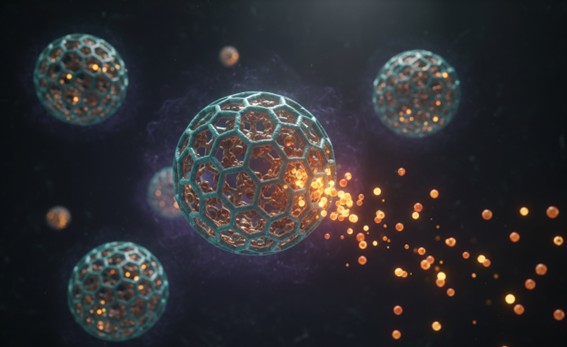 Figure 4: MOF nanoparticles releasing encapsulated drug molecules into a biological environment, illustrating pH-triggered controlled drug release from the porous framework.
Characterization: Every Batch Verified
MOFs are only as good as their crystallinity, purity, and surface area. We characterize every batch with the analytical rigor that serious research demands.
- Powder X-ray diffraction (PXRD): phase purity, crystallinity index, comparison to simulated pattern.
- N2 adsorption at 77 K: BET surface area, total pore volume, pore size distribution by DFT/NLDFT.
- Thermogravimetric analysis (TGA): thermal stability, solvent/guest content, framework decomposition temperature.
- Scanning electron microscopy (SEM): particle morphology, size, and aggregation state.
- Inductively coupled plasma (ICP-MS): metal content, batch-to-batch consistency.
- Fourier-transform infrared (FTIR): linker confirmation, functional group identification.
- Dynamic light scattering (DLS): hydrodynamic diameter for nanoparticle dispersions.
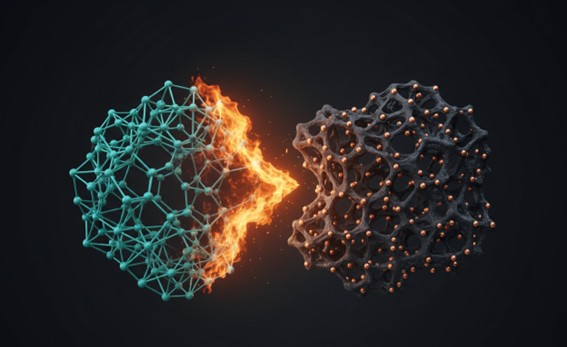 Figure 5: Transformation of a metal-organic framework through pyrolysis into a porous carbon matrix with uniformly distributed metal nanoparticles, forming a MOF-derived catalyst.
Custom MOF Synthesis and Functionalization
The modular nature of MOF chemistry enables virtually unlimited customization. Our custom synthesis service leverages this design flexibility to produce MOFs with properties tailored to your specific application. We have synthesized mixed-linker ZIF-8 with tuned pore apertures for selective gas separation, amino-functionalized UiO-66 with enhanced CO2 binding, core-shell ZIF-8@MIL-101 composites combining the stability of both frameworks, and MOF-derived carbons with atomically dispersed metal catalysts. We have also developed scalable microwave-assisted and mechanochemical synthesis routes for rapid production of kilogram-scale batches.
Describe your target framework type, metal center, functional group, particle size, or application requirement. Our synthetic chemists will design a synthesis route, provide a feasibility assessment, and deliver a purified, characterized batch.
Request a Data Sheet or Start a Custom Project
Browse our MOF catalog, request detailed characterization data, or describe the specific framework, functionalization, or application target your research requires.
| Catalog Number | Product Name | Order | Quantity |
|---|---|---|---|
| MOF-0001 | ZIF-8 (Coprecipitation Method) |
-
+
|
|
| MOF-0002 | UIO-66 |
-
+
|
|
| MOF-0003 | ZIF-67 |
-
+
|
|
| MOF-0004 | MOF-74 (Mg) |
-
+
|
|
| MOF-0005 | ZIF-8 (Hydrothermal Method) |
-
+
|
|
| MOF-0006 | ZIF-8 (Coprecipitation Method, 0.6-1um) |
-
+
|
|
| MOF-0007 | UIO-66-NH2 |
-
+
|
|
| MOF-0008 | MIL-101(Cr) |
-
+
|
|
| MOF-0009 | ZIF-8 (Hydrothermal Method, 200-400 nm) |
-
+
|
|
| MOF-0010 | UIO-66 (300-600 nm) |
-
+
|
For Research or Industrial Raw Materials, Not For Personal Medical Use!