

Metal Oxide Nanoparticle Synthesis Services
Metal oxide nanoparticles form the backbone of modern nanotechnology, bridging fundamental science and commercial application in ways that few other material classes can match. Their exceptional versatility arises from the diversity of electronic structures they span: semiconducting TiO2 and ZnO drive photocatalysis and optoelectronics; magnetic Fe3O4 enables targeted drug delivery and MRI contrast enhancement; mesoporous SiO2 serves as a universal scaffold for drug encapsulation; and redox-active CeO2 mimics antioxidant enzymes at the nanoscale. When particle dimensions shrink to the nanometer regime, quantum confinement, surface polarization, and defect chemistry converge to produce properties that are dramatically amplified beyond those of bulk oxides.
At Eata Nanomaterials, we engineer metal oxide nanoparticles with meticulous attention to crystalline phase, particle size, morphology, porosity, and surface chemistry. Our synthesis platform encompasses sol-gel processing, hydrothermal crystallization, co-precipitation, thermal decomposition, and flame spray pyrolysis — each selected and optimized to match the target material system and application. From photocatalytic TiO2 anatase crystals to superparamagnetic iron oxide colloids, we deliver nanoparticles that meet exacting research and development specifications.
TiO2, ZnO & Semiconductor Oxide Synthesis
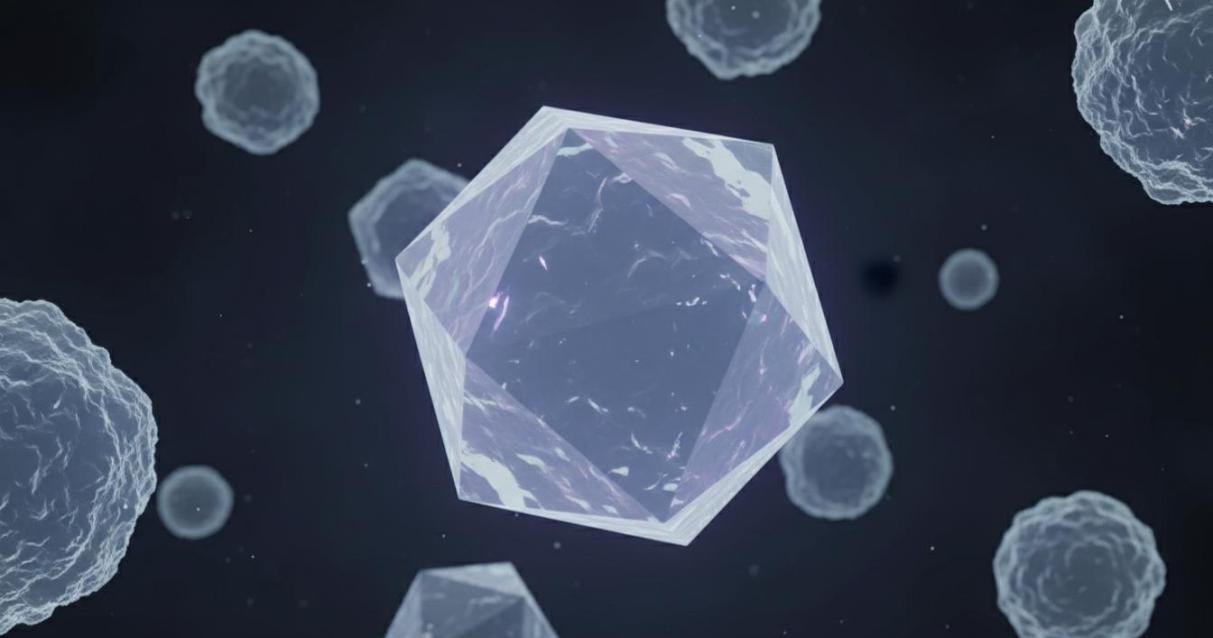 Figure 1: Titanium dioxide anatase nanocrystals with truncated octahedral bipyramidal morphology showing well-defined crystalline facets
Titanium dioxide and zinc oxide stand as the most extensively studied semiconductor metal oxides, powering applications in photocatalysis, solar energy conversion, UV protection, antibacterial coatings, and gas sensing. The performance of these materials is exquisitely sensitive to crystalline phase, particle size, morphology, and surface area. Our synthesis service provides precisely engineered TiO2 and ZnO nanoparticles optimized for the intended function.
For TiO2, we control the balance between anatase, rutile, and brookite phases to maximize photocatalytic activity or optimize optical properties. Anatase-phase TiO2 with high surface area and reactive facets delivers superior photocatalytic performance for pollutant degradation and water splitting. Rutile-phase TiO2 offers enhanced UV absorption for sunscreen applications. Our protocols produce monodisperse nanoparticles, nanorods, and hierarchical architectures with controlled facet exposure.
Semiconductor oxide capabilities:
- TiO2 anatase nanoparticles: Sol-gel and hydrothermal routes; 5-50 nm; high surface area >150 m2/g; exposed reactive facets for photocatalysis and DSSC photoanodes.
- TiO2 rutile & mixed-phase: Higher temperature hydrothermal and calcination routes; enhanced UV blocking; controlled anatase-rutile ratios for synergistic photocatalysis.
- ZnO nanostructures: Wet chemical, hydrothermal, and solvothermal methods; spheres, rods, flowers, and hierarchical architectures; tunable emission and UV absorption.
- Doped TiO2 & ZnO: Nitrogen, sulfur, or metal-doped variants for visible-light photocatalysis; bandgap engineering for extended spectral response.
- Core-shell architectures: TiO2@SiO2 and ZnO@SiO2 core-shell particles combining photocatalytic cores with protective or functional shells.
Iron Oxide & Magnetic Oxide Nanoparticle Synthesis
 Figure 2: Zinc oxide hexagonal nanorods with elongated crystal shape, faceted tips, and wurtzite crystalline structure
Magnetic iron oxide nanoparticles, principally magnetite (Fe3O4) and maghemite (gamma-Fe2O3), have become the workhorse materials of nanomedicine and magnetic nanotechnology. Their superparamagnetic behavior at small particle sizes, combined with biocompatibility and the versatility of iron oxide surface chemistry, enables a remarkable range of applications from targeted drug delivery and magnetic hyperthermia to environmental remediation and catalysis.
We synthesize iron oxide nanoparticles through co-precipitation, thermal decomposition of iron-oleate complexes, and hydrothermal methods. Co-precipitation offers simplicity and scalability; thermal decomposition yields highly crystalline, monodisperse particles with exceptional magnetic properties; hydrothermal routes enable morphological control over nanocubes, nanoplates, and flower-like architectures. Our products achieve saturation magnetization values of 60-85 emu/g, with superparamagnetic blocking temperatures tunable through particle size control.
Magnetic oxide portfolio:
- Fe3O4 (magnetite) nanoparticles: Co-precipitation and thermal decomposition; 5-50 nm; superparamagnetic; saturation magnetization up to 85 emu/g; aqueous and organic phase dispersions.
- Gamma-Fe2O3 (maghemite) nanoparticles: Oxidation-controlled synthesis from magnetite precursors; enhanced chemical stability; tunable surface chemistry for biomedical applications.
- Doped ferrites: Manganese, cobalt, nickel, and zinc ferrites with composition-tuned magnetic anisotropy, coercivity, and Curie temperature for hyperthermia and data storage.
- Hematite (alpha-Fe2O3): Hydrothermal and sol-gel routes; n-type semiconductor; photocatalytic water splitting; gas sensing applications.
- Shape-controlled iron oxides: Cubic, octahedral, and flower-like morphologies with facet-dependent catalytic and magnetic properties.
Silica-Based Nanoparticle & Sol-Gel Platform
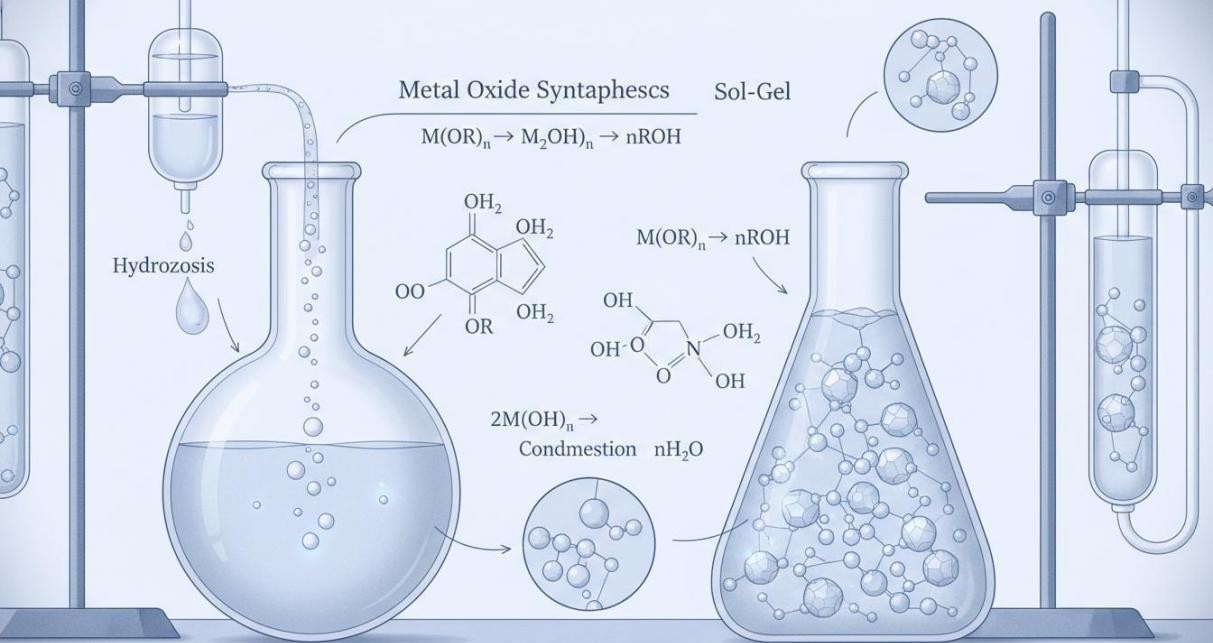 Figure 3: Sol-gel synthesis process showing metal alkoxide hydrolysis and condensation forming metal oxide nanoparticles in laboratory glassware
The sol-gel process stands as one of the most versatile and widely applicable methods for metal oxide nanoparticle synthesis. By hydrolyzing metal alkoxide or metal salt precursors followed by polycondensation, this technique produces high-purity oxides at low temperatures with precise control over particle size, porosity, and surface chemistry. At Eata Nanomaterials, our sol-gel platform serves as the foundation for synthesizing a broad spectrum of metal oxide and mixed-oxide nanoparticle systems.
Mesoporous silica nanoparticles deserve special attention as perhaps the most adaptable nanocarrier platform in drug delivery. Their enormous surface area, tunable pore sizes from 2 to 10 nm, and well-established silane chemistry for surface functionalization make them ideal vehicles for small molecule drugs, proteins, and nucleic acids. We synthesize MSN through surfactant-templated sol-gel routes with control over particle size, pore volume, and surface functionality.
Silica and sol-gel capabilities:
- Mesoporous silica nanoparticles (MSN): CTAB-templated synthesis; MCM-41 and SBA-15 analogues; 50-300 nm particles; 2-10 nm pores; >700 m2/g surface area.
- Non-porous SiO2 nanoparticles: Stober method for monodisperse spherical silica; 20-500 nm; excellent for shell formation and surface functionalization.
- Mixed metal oxides: Sol-gel synthesis of Al2O3, ZrO2, MgO, CuO, and ternary oxides with controlled stoichiometry and phase purity.
- Core-shell oxide particles: Fe3O4@SiO2, TiO2@SiO2, ZnO@SiO2, and multi-shell architectures for multifunctional composite materials.
- Surface functionalized silica: Amine, carboxyl, thiol, and PEG surface groups via silane chemistry; stimuli-responsive gatekeepers for controlled release.
Cerium Oxide & Catalytic Oxide Synthesis
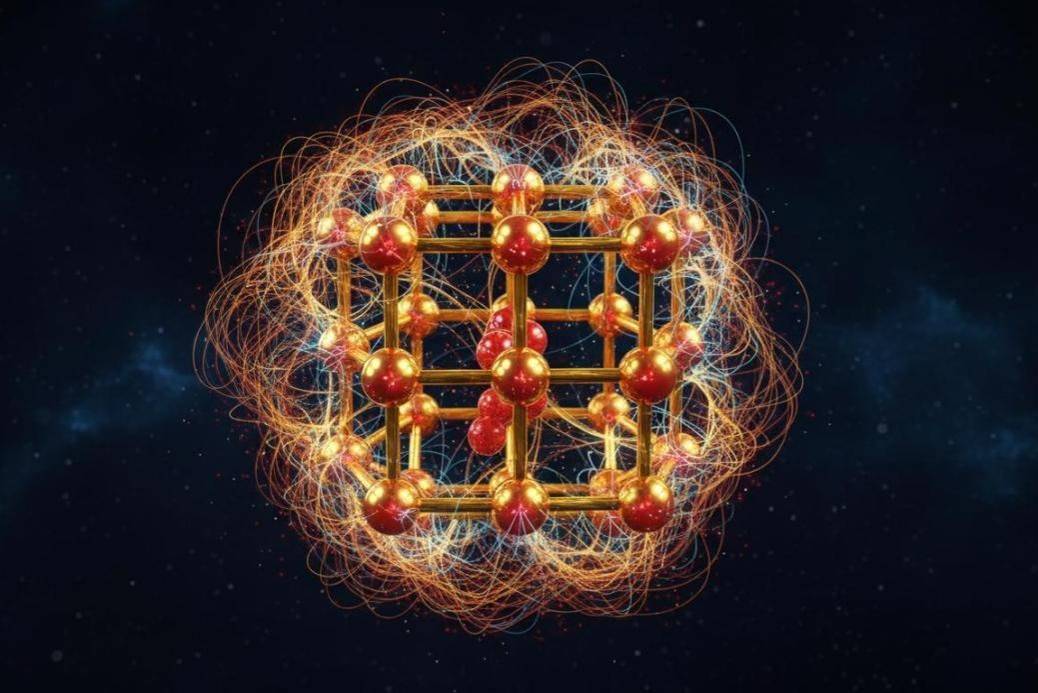 Figure 4: Cerium oxide CeO2 fluorite cubic crystal structure with cerium and oxygen atoms and oxygen vacancy sites for redox catalytic activity
Cerium oxide nanoparticles possess a unique and scientifically fascinating property: the facile Ce4+/Ce3+ redox cycle that enables them to mimic the activity of antioxidant enzymes such as superoxide dismutase and catalase. This autoregenerative redox capability, combined with high oxygen storage capacity and strong metal-support interaction in catalytic systems, positions ceria nanoparticles at the forefront of nanomedicine, catalysis, and energy research. As particle size decreases, the concentration of oxygen vacancies increases dramatically, amplifying these desirable properties.
Beyond ceria, we synthesize a broad range of catalytically active metal oxides including copper oxide, alumina, cobalt oxide, and tungsten oxide. Each material brings distinct catalytic functionalities: CuO for carbon monoxide oxidation and glucose sensing; Al2O3 as a high-surface-area catalyst support; Co3O4 for oxygen evolution reaction; and WO3 for electrochromic and gas sensing applications.
| Material | Synthesis Method | Applications |
| CeO2 | Precipitation, hydrothermal, sol-gel, microemulsion | Antioxidant therapy, catalysis, UV filtering, oxygen storage |
| CuO / Cu2O | Precipitation, hydrothermal, thermal reduction | Catalysis, glucose sensing, antimicrobial, gas sensors |
| Al2O3 | Sol-gel, hydrothermal, flame spray | Catalyst support, adsorption, ceramic reinforcement |
| Co3O4 | Co-precipitation, hydrothermal, thermal decomposition | OER catalyst, Li-ion battery anode, gas sensing |
| WO3 | Hydrothermal, sol-gel, acid precipitation | Electrochromics, gas sensing, photocatalysis |
| NiO | Co-precipitation, sol-gel, hydrothermal | Battery electrodes, supercapacitors, catalysis |
| MnO2 | Hydrothermal, co-precipitation, redox reaction | Supercapacitors, catalysis, water treatment |
Mesoporous Silica for Drug Delivery & Biomedicine
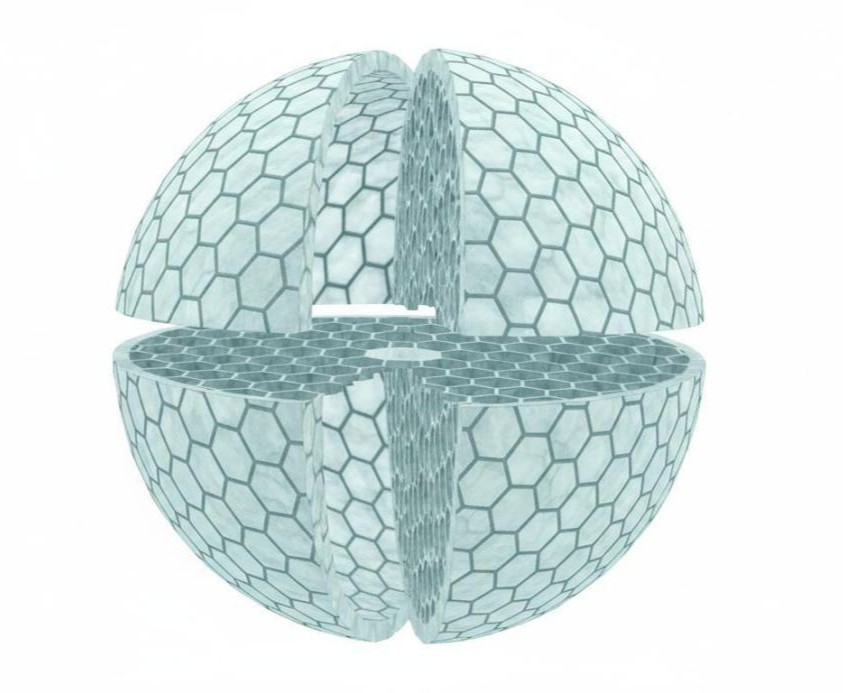 Figure 5: Mesoporous silica nanoparticle with ordered hexagonal pore channels and accessible pore windows for high-capacity drug loading
Mesoporous silica nanoparticles have emerged as one of the most promising nanocarrier platforms for drug delivery due to their high loading capacity, excellent biocompatibility, and versatile surface chemistry. The ordered pore structure provides a protected environment for therapeutic molecules, while surface functionalization enables targeting ligand attachment, stimuli-responsive release, and stealth properties for in vivo applications.
Our MSN synthesis produces particles with well-defined pore structures, high surface areas, and narrow size distributions. We control particle morphology from spherical to rod-like, pore size from micropore to mesopore regimes, and surface functionality through direct co-condensation or post-synthetic grafting. The resulting materials are optimized for specific payloads, release kinetics, and administration routes.
Biomedical MSN capabilities:
- Drug loading & release: High-capacity encapsulation of chemotherapy agents, antibiotics, and anti-inflammatory drugs; tunable release kinetics through pore size and gatekeeper engineering.
- Surface functionalization: Amine, carboxyl, and thiol groups for biomolecule conjugation; PEGylation for stealth properties; targeting ligands for active delivery.
- Stimuli-responsive delivery: pH-sensitive, redox-responsive, and enzyme-triggered release systems for site-specific drug delivery to tumor microenvironments.
- Imaging & theranostics: Integration of fluorescent dyes, MRI contrast agents, and radiotracers for multimodal imaging-guided therapy.
Surface Functionalization & Post-Synthetic Modification
The surface of a metal oxide nanoparticle determines how it interacts with its environment, and thus ultimately dictates its practical utility. Our surface functionalization service transforms bare oxide nanoparticles into materials optimized for specific dispersing media, biological environments, and composite matrices. We employ multiple chemistries tailored to each oxide's surface characteristics.
- Silanization: APTES, MPTMS, and PEG-silanes for SiO2, TiO2, ZnO, and Fe3O4 surfaces; introduces amine, thiol, carboxyl, or PEG chains for versatile bioconjugation.
- Phosphonate & dopamine chemistry: Strong binding to TiO2, ZnO, Fe3O4, and CeO2 surfaces; introduces functional groups resistant to hydrolysis and displacement.
- Polymer coating: PEG, PVP, PVA, and polyelectrolyte coatings for steric stabilization; stealth properties for biological applications; enhanced colloidal stability.
- Carboxyl & amine activation: EDC/NHS coupling chemistry for covalent attachment of antibodies, peptides, and enzymes; reliable and reproducible bioconjugation.
- Fluorescent & radiotracer labeling: Integration of organic fluorophores, quantum dots, and radiometal chelators for multimodal imaging and tracking.
Comprehensive Characterization
Every batch of metal oxide nanoparticles undergoes rigorous characterization to confirm phase purity, particle dimensions, surface properties, and application-relevant performance metrics. We provide complete data packages to support research publications, patent applications, and quality control documentation.
- Structural analysis: X-ray diffraction for phase identification and crystallite size; transmission electron microscopy for morphology, size, and crystallinity; selected area electron diffraction for local phase confirmation.
- Size & dispersion: Dynamic light scattering for hydrodynamic diameter and polydispersity; zeta potential for surface charge and colloidal stability; BET surface area for porosity assessment.
- Chemical composition: X-ray photoelectron spectroscopy for elemental composition and oxidation states; energy-dispersive X-ray spectroscopy for elemental mapping; ICP-MS for trace metal quantification.
- Magnetic properties: Vibrating sample magnetometry for saturation magnetization, coercivity, and blocking temperature of magnetic oxide nanoparticles.
- Optical & photocatalytic: UV-Vis diffuse reflectance spectroscopy for bandgap determination; photoluminescence spectroscopy; photocatalytic activity testing for pollutant degradation.
Access Custom Metal Oxide Nanoparticles Engineered for Your Research
Contact Eata Nanomaterials to discuss your metal oxide nanoparticle synthesis requirements. Our materials scientists will develop a tailored synthesis and characterization program that delivers precisely what your project demands.