

Metal Nanoparticle Synthesis Services
Metal nanoparticles occupy a unique position at the intersection of chemistry, physics, and materials science. Their nanoscale dimensions give rise to properties that diverge dramatically from bulk metals: localized surface plasmon resonance in noble metals produces intense optical absorption and scattering; quantum confinement shifts electronic states and alters catalytic selectivity; and the enormous surface-to-volume ratio creates interfaces that drive reactions, bind biomolecules, and interact with electromagnetic fields in extraordinary ways. These phenomena have made metal nanoparticles indispensable tools across catalysis, biosensing, biomedical imaging, drug delivery, and advanced electronics.
At Eata Nanomaterials, we synthesize metal nanoparticles with the precision that advanced research demands. Our platform spans chemical reduction, thermal decomposition, seed-mediated growth, and electrochemical methods, enabling independent control over particle size, shape distribution, crystallinity, and surface chemistry. Every batch is characterized exhaustively, and our scientists collaborate directly with your team to ensure that the material specifications align perfectly with your experimental requirements.
Noble Metal Nanoparticle Synthesis: Au, Ag, Pt, Pd
 Figure 1: Colloidal gold nanoparticles exhibiting size-dependent surface plasmon resonance from ruby-red to deep burgundy
Noble metal nanoparticles remain the most widely studied and applied class of metallic nanomaterials. Gold and silver derive their utility from surface plasmon resonance — collective oscillations of conduction electrons that produce intense absorption and scattering in the visible and near-infrared regions, with peak wavelengths tunable through particle size and shape. Platinum and palladium bring exceptional catalytic activity, with surface atoms serving as active sites for hydrogenation, oxidation, and carbon-carbon coupling reactions at the nanoscale.
Our noble metal synthesis service produces monodisperse colloids with coefficient of variation routinely below 10%. We control nucleation and growth kinetics through precise management of precursor concentration, reducing agent identity and dosage, stabilizing ligand selection, temperature profiles, and solution pH. This multi-parameter control enables reproducible synthesis across scales from milligram research batches to gram-scale quantities.
Synthesis platforms we offer:
- Gold nanoparticles (spherical): Turkevich citrate reduction (10-100 nm); Brust-Schiffrin two-phase method (2-5 nm); seed-mediated growth (20-200 nm); all with narrow size distributions and tunable surface plasmon peaks.
- Gold nanorods: Seed-mediated surfactant template synthesis using CTAB and AgNO3; aspect ratios 2-20 with longitudinal plasmon peaks from 650-1100 nm; high purity through selective oxidation purification.
- Gold nanostars & nanocages: Seeded growth in PVP with directing agents for multi-branched morphology; galvanic replacement of Ag templates for hollow nanocages with near-infrared plasmon absorption.
- Silver nanoparticles: Citrate and borohydride reduction routes; spherical, cubic, and triangular morphologies; sizes 5-100 nm; excellent SERS substrates and antimicrobial agents.
- Platinum & palladium: Polyol reduction, seed-mediated, and electrochemical methods; sizes 2-20 nm; high surface area for catalysis; alloy compositions with controlled Pt/Pd ratios.
Anisotropic Shape-Controlled Synthesis
 Figure 2: Anisotropic metal nanoparticles including gold nanorods, silver nanocubes, and platinum nanostars with distinct crystalline facets
Shape is not merely a morphological curiosity — it is a powerful handle for engineering nanoparticle function. Anisotropic nanoparticles exhibit shape-dependent plasmonic properties, facet-selective catalytic activity, and orientation-dependent interactions with cells, proteins, and surfaces. Our shape-controlled synthesis service produces metal nanoparticles in a wide variety of well-defined morphologies, each optimized for specific application requirements.
The key to shape control lies in directing the relative growth rates of different crystallographic facets. We achieve this through selective adsorption of capping agents, introduction of oxidative etchants, and manipulation of reduction kinetics. Nanorods exhibit two distinct plasmon modes and polarization-dependent optical properties. Nanocubes expose high-index facets with enhanced catalytic activity. Nanostars generate intense electromagnetic field enhancements at their tips for SERS and photothermal applications.
Shape catalog and applications:
- Nanorods: Gold and silver; tunable aspect ratios; dual plasmon modes; NIR absorption for photothermal therapy and polarization-sensitive devices.
- Nanocubes: Silver and palladium; sharp corners and edges; high-index facets; enhanced catalytic activity and SERS sensitivity.
- Nanostars & nanoflowers: Gold and palladium; multiple tips with plasmonic hot spots; exceptional SERS enhancement; photothermal conversion.
- Nanoplates & nanodisks: Gold and silver; flat morphology with in-plane dipole resonance; tunable across visible to NIR; plasmonic biosensors.
- Nanoprisms & nanobipyramids: Gold; sharp vertices with strong field enhancement; high monodispersity; narrow plasmon linewidths.
Magnetic Metal & Metal Oxide Nanoparticles
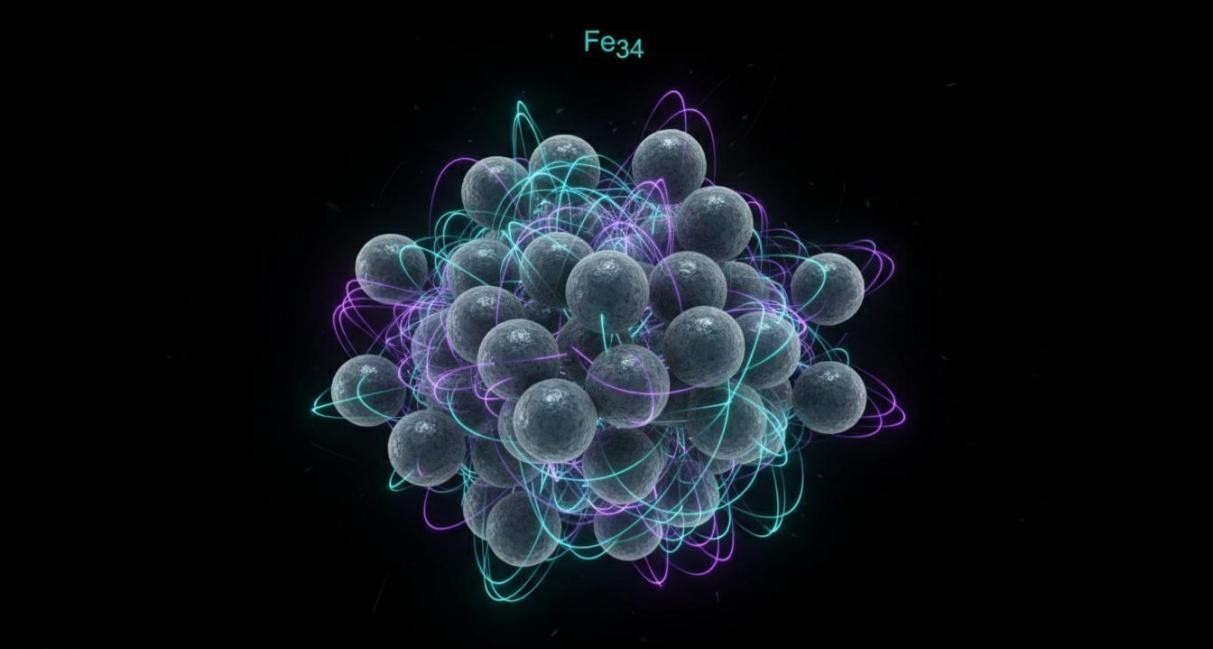 Figure 3: Superparamagnetic iron oxide nanoparticles showing magnetic field lines emanating from spherical magnetite particles
Magnetic nanoparticles, primarily iron oxides in the form of magnetite (Fe3O4) and maghemite (gamma-Fe2O3), combine nanoscale dimensions with magnetic responsiveness to create materials that can be manipulated by external magnetic fields, heated by alternating magnetic fields, and detected by magnetic resonance imaging. Our magnetic nanoparticle synthesis produces superparamagnetic iron oxide nanoparticles (SPIONs) with precisely controlled sizes, high saturation magnetization, and surface chemistries optimized for colloidal stability and bioconjugation.
Beyond iron oxides, we synthesize metallic magnetic nanoparticles including cobalt, nickel, and iron nanoparticles, as well as ferrite nanoparticles with composition-engineered magnetic properties. These materials serve applications in magnetic separation, hyperthermia, contrast-enhanced MRI, targeted drug delivery, and environmental remediation.
Magnetic nanoparticle portfolio:
- Magnetite (Fe3O4) nanoparticles: Thermal decomposition of iron oleate/acetylacetonate; sizes 5-50 nm; tunable from superparamagnetic to ferrimagnetic; saturation magnetization 60-80 emu/g.
- Maghemite (gamma-Fe2O3) nanoparticles: Oxidation of magnetite precursors; stable against further oxidation; identical crystal structure with cation vacancies; sizes 5-30 nm.
- Cobalt & cobalt ferrite: High magnetocrystalline anisotropy; hard magnetic properties; sizes 10-100 nm; ferromagnetic behavior at room temperature.
- Metallic iron & iron-cobalt: Higher saturation magnetization than oxides; oxygen-sensitive requiring protective coating; soft magnetic alloys with high permeability.
- Nickel & nickel ferrite: Catalytic and magnetic dual functionality; sizes 10-200 nm; applications in catalysis, magnetic recording, and EMI shielding.
Bimetallic & Alloy Nanoparticle Engineering
 Figure 4: Bimetallic core-shell nanoparticle showing gold core surrounded by platinum shell with distinct metallic layers
Combining two or more metals within a single nanoparticle produces synergistic properties that exceed the simple sum of the constituent elements. Bimetallic nanoparticles can exhibit enhanced catalytic activity through electronic ligand and ensemble effects, tunable plasmonic properties through composition-dependent dielectric functions, and improved stability through the incorporation of corrosion-resistant shell metals. Our bimetallic synthesis service produces alloy, core-shell, and heterostructured nanoparticles with precisely controlled compositions and architectures.
We employ both one-pot co-reduction methods that produce alloy particles and sequential growth strategies that yield core-shell or dumbbell morphologies. The choice of architecture profoundly influences properties: alloy particles benefit from homogeneous electronic modification across the entire surface, while core-shell structures leverage the distinct properties of each metal in spatially separated regions. Our electrochemical and galvanic replacement methods provide additional routes to complex nanostructures.
| System | Architecture | Key Properties & Applications |
| Au-Pt / Au-Pd | Core-shell, alloy | Plasmon-enhanced catalysis; electrocatalysis; fuel cell electrodes |
| Ag-Au | Alloy, core-shell | Tunable plasmon; antibacterial + SERS; bimetallic sensing |
| Fe-Pt / Fe-Pd | Core-shell, alloy | Magnetic + catalytic; high anisotropy; data storage catalysts |
| Cu-Pd / Cu-Pt | Alloy | Cost-effective catalysis; hydrogenation; electrochemical CO2 reduction |
| Au-Fe3O4 | Dumbbell, core-shell | Magnetic targeting + plasmonic imaging; theranostics; separation |
| Ni-Cu / Co-Cu | Alloy | Composition-tunable magnetic and catalytic properties |
Surface Functionalization & Bioconjugation
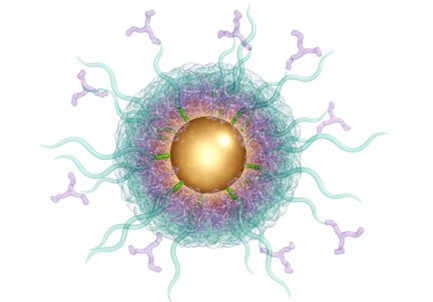 Figure 5: Thiol-functionalized gold nanoparticle with PEG polymer chains and antibody ligands attached for biomedical targeting
The surface of a metal nanoparticle is its functional interface — the region where it interacts with solvents, biomolecules, cells, substrates, and electromagnetic fields. Our surface functionalization service transforms as-synthesized metal nanoparticles into application-ready tools by introducing precisely defined chemical groups, polymer coatings, biological ligands, and responsive elements.
Gold nanoparticles present the thiol-gold bond as a uniquely robust and versatile attachment chemistry. Silver, iron oxide, and platinum nanoparticles are functionalized through silane chemistry, carboxyl/amine coupling, and coordination to phosphonic acids or dopamine derivatives. We match the functionalization strategy to both the nanoparticle core material and the intended application environment.
Functionalization capabilities:
- Thiol-based conjugation (Au, Ag): Thiol-PEG, thiol-DNA, thiol-peptide attachment; stable Au-S bond; precise control of surface density through molar ratios.
- Silane functionalization (metal oxides): APTES, MPTMS, PEG-silane for -NH2, -SH, -COOH presentation on iron oxide and silica-coated nanoparticles.
- Polymer coating: PEGylation for stealth and biocompatibility; PVP, PAA, chitosan for colloidal stability; stimuli-responsive polymer brushes.
- Biomolecule conjugation: Antibodies, Fab fragments, aptamers, and peptides for targeted delivery and sensing; enzyme immobilization for biocatalysis.
- Silica & polymer encapsulation: Mesoporous silica shells for drug loading; polymer encapsulation for protection and controlled release.
Comprehensive Characterization Suite
Every batch of metal nanoparticles undergoes thorough analytical characterization to confirm size, shape, crystallinity, composition, surface chemistry, and colloidal stability. Our characterization reports provide the data you need for publication, patent filing, and process documentation.
- Size and morphology: Transmission electron microscopy (TEM) for direct size and shape measurement; dynamic light scattering (DLS) for hydrodynamic diameter in dispersion; nanoparticle tracking analysis (NTA) for concentration and size distribution.
- Optical properties: UV-Vis absorption spectroscopy for plasmon peak position and intensity; photoluminescence spectroscopy for fluorescent variants; extinction coefficient determination for concentration quantification.
- Crystallographic analysis: X-ray diffraction (XRD) for phase identification and crystallite size; selected area electron diffraction (SAED) in TEM for local crystallinity confirmation.
- Surface chemistry: Zeta potential for surface charge and colloidal stability; Fourier-transform infrared (FTIR) for ligand confirmation; X-ray photoelectron spectroscopy (XPS) for elemental composition and oxidation states.
- Magnetic properties: Vibrating sample magnetometry (VSM) and SQUID magnetometry for saturation magnetization, coercivity, and blocking temperature of magnetic nanoparticles.
- Elemental analysis: Inductively coupled plasma mass spectrometry (ICP-MS) for trace metal quantification; energy-dispersive X-ray spectroscopy (EDX) for elemental mapping in TEM.
Application-Driven Development Programs
Metal nanoparticles serve as enabling materials across an extraordinarily broad range of scientific and technological domains. We structure our development programs around the specific demands of each application, optimizing synthesis parameters, surface chemistry, and formulation to maximize performance.
- Catalysis: High-surface-area Pt, Pd, Au, and alloy nanoparticles for heterogeneous catalysis; facet-controlled synthesis for selectivity; magnetic recovery using Fe3O4-supported catalysts.
- Biosensing & diagnostics: Plasmonic gold and silver nanoparticles for colorimetric and SERS-based assays; magnetic nanoparticles for immunoassay separation; multimodal imaging contrast agents.
- Biomedical therapeutics: Photothermal therapy using NIR-absorbing gold nanorods and nanostars; drug delivery vehicles; magnetic hyperthermia using iron oxide nanoparticles.
- Electronics & photonics: Conductive silver and copper inks for printed electronics; plasmonic devices; transparent conductive coatings.
- Environmental remediation: Zero-valent iron nanoparticles for groundwater treatment; photocatalytic silver and titanium-based systems; heavy metal adsorption.
Start Your Custom Metal Nanoparticle Project Today
Contact Eata Nanomaterials to discuss your metal nanoparticle synthesis requirements. Our team will evaluate your material, size, shape, and surface chemistry needs to develop a tailored synthesis and characterization program that delivers precisely what your research demands.