

ICP-MS Elemental Purity and Trace Analysis Services
Nanomaterial synthesis inevitably introduces trace elemental impurities from starting reagents, reactor vessel surfaces, post-synthesis washing solvents, and environmental exposure. A gold nanoparticle batch intended for in vivo imaging may contain residual silver from the precursor salt, transition metals from the reducing agent, or silicon from glassware contact. At the nanogram-per-gram level, these contaminants are invisible to most characterization techniques, yet they can profoundly alter catalytic selectivity, trigger cytotoxicity, or compromise electronic device yield.
Eata Nanomaterials operates a collision-reaction cell ICP-MS platform that quantifies over 70 elements spanning the periodic table at detection limits routinely reaching the low parts-per-trillion range in solution. Whether the objective is certifying the elemental purity of a research-grade nanoparticle batch, quantifying dopant incorporation in semiconductor nanocrystals, or tracking environmental transport of engineered nanomaterials, our ICP-MS services provide the sensitivity and specificity required for definitive elemental characterization.
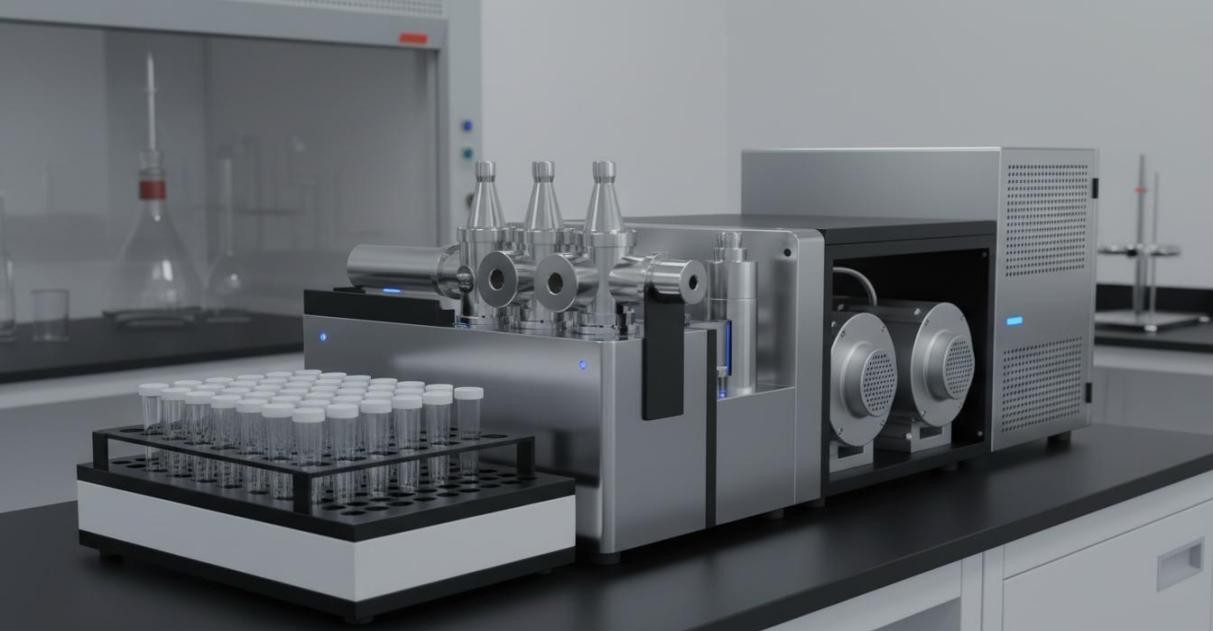 Figure 1: A modern single quadrupole ICP-MS instrument with autosampler, interface cones, collision reaction cell, and turbomolecular vacuum pumps in a trace analysis laboratory.
Bulk Elemental Analysis with Collision-Reaction Cell Interference Removal
Inductively coupled plasma mass spectrometry achieves its extraordinary sensitivity by introducing liquid samples as an aerosol into an argon plasma at approximately 10,000 Kelvin. At this temperature, all chemical bonds break, and analytes convert predominantly to singly charged atomic ions. These ions pass through interface cones into a high-vacuum mass spectrometer where they are separated by mass-to-charge ratio and counted by an electron multiplier detector.
The primary challenge in ICP-MS analysis arises from polyatomic ion interferences. When analyzing a silicon-containing sample for iron at mass 56, the background includes intense signals from ArO+ and CaO+ that can exceed the analyte signal by orders of magnitude. Our collision-reaction cell overcomes these interferences through kinetic energy discrimination: helium cell gas collides with polyatomic ions more frequently than atomic ions due to their larger cross-sectional area, stripping away enough kinetic energy that interferences fail to surmount the energy barrier at the cell exit while analyte ions pass through efficiently.
This interference removal capability enables reliable multielement analysis of the most challenging interfered elements:
- Iron at mass 56: free from ArO+ interference, achieving detection limits below 0.1 nanograms per milliliter even in matrices containing calcium and argon
- Arsenic at mass 75: resolved from ArCl+ interference originating from hydrochloric acid digestion, enabling accurate quantification in semiconductor-grade chemicals and biological tissues
- Selenium at mass 78: separated from Ar2+ dimer interference, with detection limits approaching 0.05 nanograms per milliliter through optimized helium flow and energy discrimination
- Chromium at masses 52 and 53: freed from ArC+ and ClOH+ overlaps, supporting reliable speciation and total Cr determination in polymer nanocomposites and environmental samples
For samples with extreme matrix complexity, we employ triple quadrupole MS-MS mode, where the first quadrupole filters the ion beam before the collision cell and the third quadrupole isolates the target mass after reaction chemistry. This configuration provides interference-free analysis of elements such as sulfur, phosphorus, and silicon that suffer intense plasma-based backgrounds in conventional single-quadrupole instruments.
Sample Preparation and Digestion Protocols
The accuracy of any ICP-MS analysis depends critically on complete sample decomposition and analyte solubilization without contamination or loss. Solid nanomaterials present particular challenges because their high chemical resistance and refractory nature can resist conventional acid dissolution. Eata Nanomaterials maintains a dedicated cleanroom-grade sample preparation facility equipped with multiple digestion platforms matched to specific material classes:
- Closed-vessel microwave digestion using high-purity nitric acid and hydrogen peroxide for metal and metal oxide nanoparticles, achieving complete dissolution at temperatures up to 240 degrees Celsius and pressures of 100 bar while preventing volatile analyte loss
- Hydrofluoric acid digestion for silica, silicate, and silicon carbide nanomaterials, followed by boric acid complexation to neutralize excess HF before introduction to the ICP-MS, preventing quartz component damage
- Aqua regia digestion for noble metal nanoparticles including gold, platinum, and palladium, leveraging the combined oxidizing power of nitric and hydrochloric acids to dissolve even thermally sintered clusters
- Alkaline fusion using lithium metaborate for refractory oxide ceramics and rare-earth doped phosphors that resist acid attack, producing a homogeneous borate glass bead subsequently dissolved in dilute acid
- Dry ashing at controlled temperatures for polymer nanocomposites and organic-stabilized colloids, combusting the organic matrix and concentrating the inorganic residue for acid dissolution
All digestion vessels are pre-cleaned in heated acid baths, and reagent blanks are analyzed with every batch to monitor and subtract background contributions. Internal standard elements are added to every sample to correct for instrumental drift and nebulization efficiency variations.
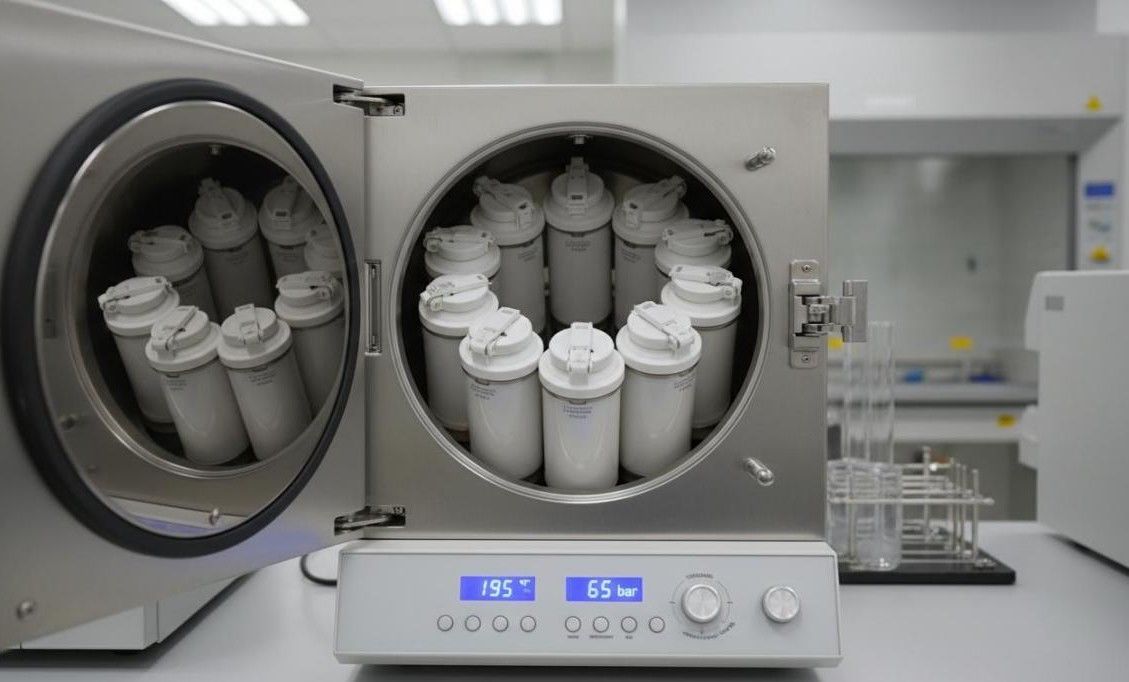 Figure 2: A closed-vessel microwave digestion system with a rotating carousel of PTFE-TFM vessels inside a stainless steel cavity for high-temperature sample decomposition.
Quantitative Analysis Capabilities
Our ICP-MS platform supports multiple calibration and quantification strategies tailored to the analytical question and sample matrix complexity:
- External calibration with matrix-matched standards for routine analysis of dissolved samples in clean matrices, using multi-point calibration curves typically spanning three orders of magnitude with correlation coefficients exceeding 0.999
- Standard addition method for samples with severe matrix suppression effects, where the calibration standards are spiked directly into the sample aliquots, inherently compensating for any signal enhancement or suppression caused by the matrix
- Isotope dilution analysis for the highest accuracy requirements, employing enriched stable isotope spikes as internal standards. This method corrects for quantitative recovery during digestion, instrument drift, and matrix effects simultaneously, achieving measurement uncertainties below 2 percent even at trace levels
- Semiquantitative screening mode surveying all masses from lithium to uranium in a single acquisition, providing rapid elemental fingerprinting of unknown samples with typical accuracy within 30 percent of true values, followed by targeted quantitative methods for elements of interest
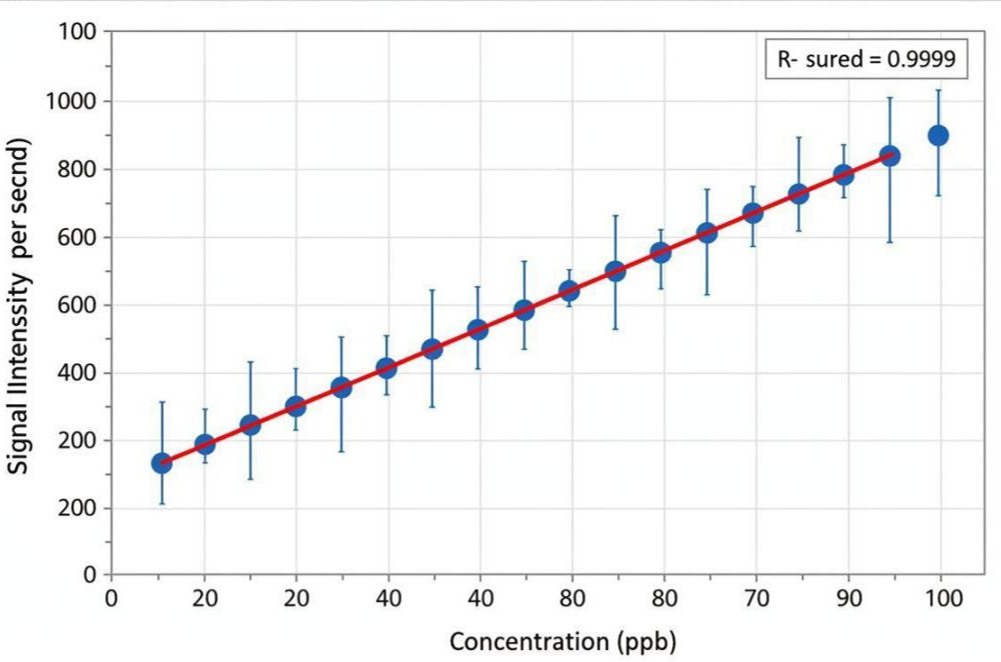 Figure 3: A representative ICP-MS calibration curve showing linear signal response across three orders of magnitude with a correlation coefficient of 0.9999.
Single-Particle ICP-MS for Nanoparticle Characterization
Single-particle ICP-MS represents a revolutionary extension of conventional ICP-MS that enables simultaneous determination of nanoparticle size, particle number concentration, and dissolved metal concentration without prior separation. In SP-ICP-MS, the sample introduction system is configured to deliver individual nanoparticles into the plasma as discrete events, each producing a brief signal spike whose intensity is proportional to the mass of the element contained in that particle.
The power of SP-ICP-MS lies in its ability to differentiate nanoparticulate metal from dissolved metal in a single measurement. When a nanoparticle enters the plasma, it vaporizes and ionizes almost instantaneously, generating a short-duration signal spike lasting microseconds. Dissolved metal, by contrast, enters the plasma continuously at the nebulization rate, producing a steady background signal. By counting spikes above a transport-efficiency-calculated threshold, the technique quantifies:
- Particle size distribution derived from spike intensity histograms, converted to equivalent spherical diameter using the element density and instrument transport efficiency
- Particle number concentration in particles per milliliter, determined from the ratio of particle-derived events to total acquisition time and sample flow rate
- Dissolved element concentration from the continuous signal component, providing the mass balance between particulate and ionic forms
- Particle dissolution kinetics through time-resolved monitoring of the shift from spike-dominated to background-dominated signals as particles release ions into solution
SP-ICP-MS is applicable to metal and metal oxide nanoparticles including silver, gold, titanium dioxide, zinc oxide, cerium dioxide, and iron oxide, with particle size detection limits extending below 10 nanometers for high-sensitivity elements such as gold and silver.
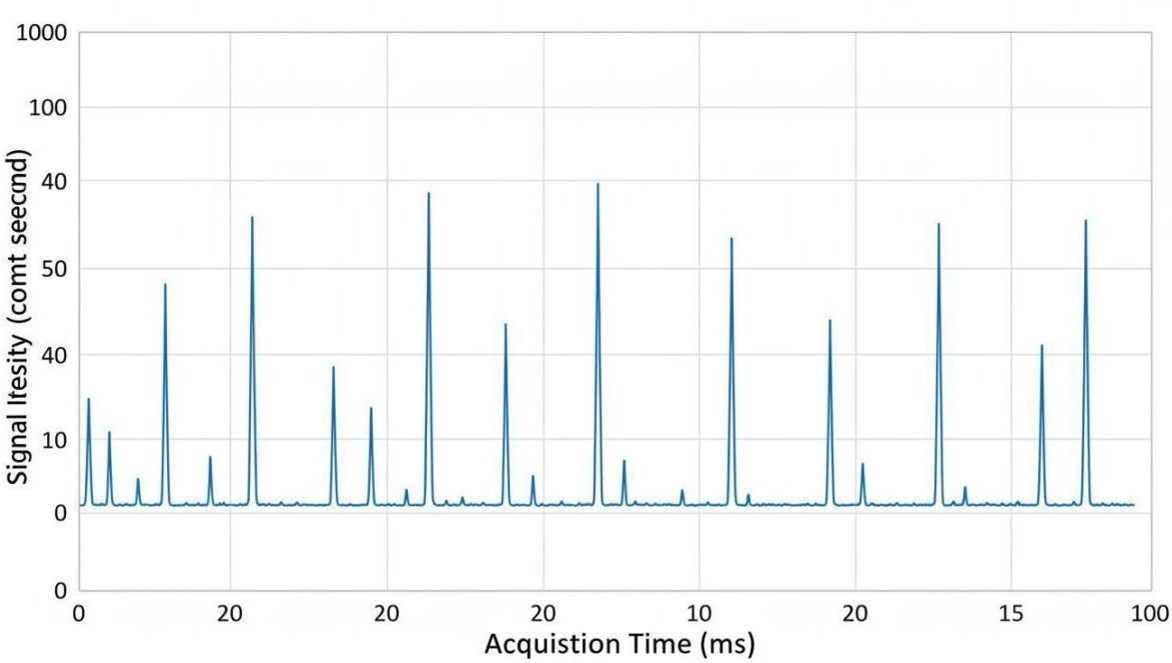 Figure 4: A time-resolved SP-ICP-MS signal trace showing sharp Gaussian intensity spikes representing individual nanoparticles passing through the plasma, superimposed on a low dissolved-element background.
Application Areas and Typical Detection Limits
ICP-MS elemental analysis serves diverse nanomaterial research applications where knowing the elemental composition at trace levels directly impacts material performance interpretation:
- Catalyst characterization: quantifying noble metal loading on supports, detecting poisoning elements such as sulfur and lead, and measuring promoter dopants like cerium or lanthanum at loading levels below 0.01 weight percent
- Semiconductor nanocrystal quality control: determining dopant incorporation efficiency in quantum dots, verifying precursor purity, and screening for contamination from reactor components that degrade photoluminescence quantum yield
- Environmental fate studies: tracking engineered nanomaterial release and transformation in soil, water, and biological matrices at environmentally relevant concentrations below one microgram per liter
- Biomedical nanomaterial safety assessment: screening for toxic heavy metals including arsenic, cadmium, lead, and mercury in injectable formulations, with detection limits comfortably below pharmacopeial limits
- Battery material development: measuring lithium, cobalt, nickel, and manganese stoichiometry in cathode active materials, and detecting corrosion-derived iron and copper in electrolyte solutions
| Element Group | Representative Elements | Typical LOD | Application | Cell Mode |
| Alkali metals | Li, Na, K, Rb, Cs | 0.001-0.01 ppb | Battery electrolytes | No gas |
| Transition metals | Fe, Co, Ni, Cu, Zn | 0.01-0.1 ppb | Catalysts, Biomaterials | He KED |
| Precious metals | Au, Pt, Pd, Ag | 0.001-0.01 ppb | Nanoparticle sizing | No gas |
| Semiconductor | Si, Ge, As, Se | 0.01-0.5 ppb | Wafer contamination | He KED / MS-MS |
| Rare earths | La, Ce, Eu, Gd | 0.001-0.01 ppb | Phosphors, MRI agents | No gas |
| Toxic heavy metals | As, Cd, Pb, Hg | 0.001-0.01 ppb | Safety screening | He KED / H2 |
Sample Submission Requirements
Liquid samples should be submitted in acid-cleaned polypropylene or fluoropolymer containers with a minimum volume of 5 milliliters. Acid concentration should not exceed 5 percent to prevent excessive matrix loading, though higher acid concentrations can be accommodated with dilution protocols. Solid samples ranging from 10 to 500 milligrams are accepted, with the exact mass depending on expected analyte concentrations and the digestion method required.
For SP-ICP-MS analysis of nanoparticle suspensions, samples should be provided at particle concentrations between 10,000 and 10,000,000 particles per milliliter. Excessive concentrations cause coincidental particle events that distort size distributions, while insufficient concentrations prolong acquisition times. We provide guidance on optimal dilution factors based on preliminary DLS or TEM size estimates. Samples in organic solvents require solvent-matched nebulizer configurations; please specify the solvent composition when submitting.
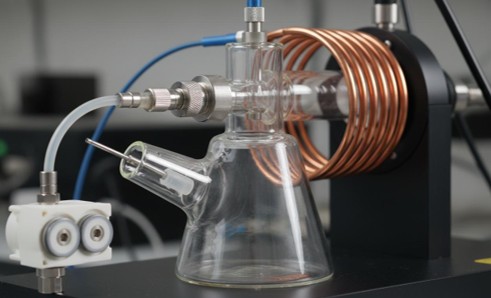 Figure 5: Close-up of an ICP-MS sample introduction system showing the concentric glass nebulizer, cyclonic spray chamber, and quartz torch with RF load coil.
If you are interested in our products or services, please don't hesitate to contact us.