

Nanocomposite Polymer Matrix Development Services
Adding nanoparticles to a polymer matrix can transform a commodity plastic into a high-performance material. A mere 0.5 weight percent of carbon nanotubes dispersed in polypropylene can increase tensile modulus by 40 percent while simultaneously raising electrical conductivity by ten orders of magnitude. Graphene at 0.6 weight percent in polystyrene has been shown to nearly double tensile strength and triple Young's modulus. These improvements arise not from the filler alone, but from the interfacial region surrounding each nanoparticle, where polymer chain mobility is restricted and stress transfer between matrix and reinforcement becomes highly efficient.
Eata Nanomaterials specializes in designing, compounding, and characterizing polymer nanocomposite systems that exploit this interfacial engineering principle. We work with thermoplastics, thermosets, and biodegradable polymers, incorporating carbon nanotubes, graphene, nanoclays, metal oxides, and other functional nanofillers to achieve property combinations unattainable with conventional composites or neat polymers. Every development project includes dispersion optimization, processing parameter refinement, and full mechanical and thermal characterization.
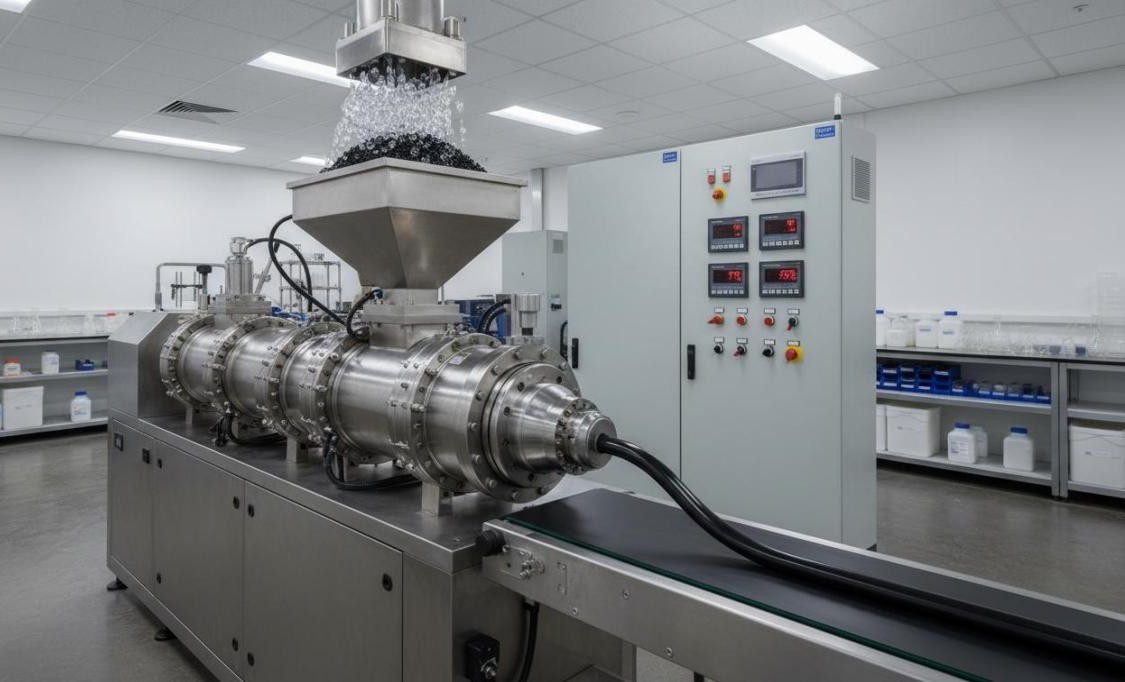 Figure 1: A co-rotating twin-screw extruder processing polymer pellets with carbon nanotube filler, with heated barrel sections and a control panel for temperature and screw speed monitoring.
Nanocomposite Synthesis Methods
The processing method determines the final dispersion state, interfacial adhesion, and orientation of nanofillers within the polymer matrix, which in turn govern virtually all macroscopic properties. Eata Nanomaterials offers three primary compounding approaches, each selected based on the polymer type, filler characteristics, and target application:
- Melt mixing via twin-screw extrusion for thermoplastic matrices including polypropylene, polyamide, polycarbonate, PLA, and PEEK. The co-rotating intermeshing screws generate distributive and dispersive mixing through kneading blocks and reverse-flight elements, breaking down filler agglomerates while maintaining controlled residence time to prevent thermal degradation. We optimize barrel temperature profiles, screw speed, and specific energy input for each polymer-filler combination to maximize dispersion quality
- Solution casting for polymers sensitive to thermal degradation or when extremely fine dispersion is required. The nanofiller is first dispersed in a solvent compatible with the polymer, followed by polymer dissolution, homogenization, and controlled solvent evaporation. This method is particularly effective for preparing thin films and for systems where solvent-mediated surface modification of the filler enhances polymer-filler compatibility
- In-situ polymerization for creating strong covalent or coordination bonds between the nanofiller and the polymer matrix. The nanofiller is dispersed in monomer, and polymerization is initiated in the presence of the filler, resulting in polymer chains growing directly from or around the nanoparticle surface. This approach has demonstrated remarkable results for PLA-based systems, where in-situ ring-opening polymerization produced flexible nanocomposites with elongation exceeding 130 percent, compared to brittle behavior in melt-mixed equivalents
For high-viscosity thermoset systems such as epoxy and polyurethane, we employ three-roll milling and high-shear planetary mixing to achieve uniform filler dispersion without premature curing. Post-cure thermal profiles are optimized to maximize glass transition temperature and crosslink density while preserving the integrity of the nanofiller structure.
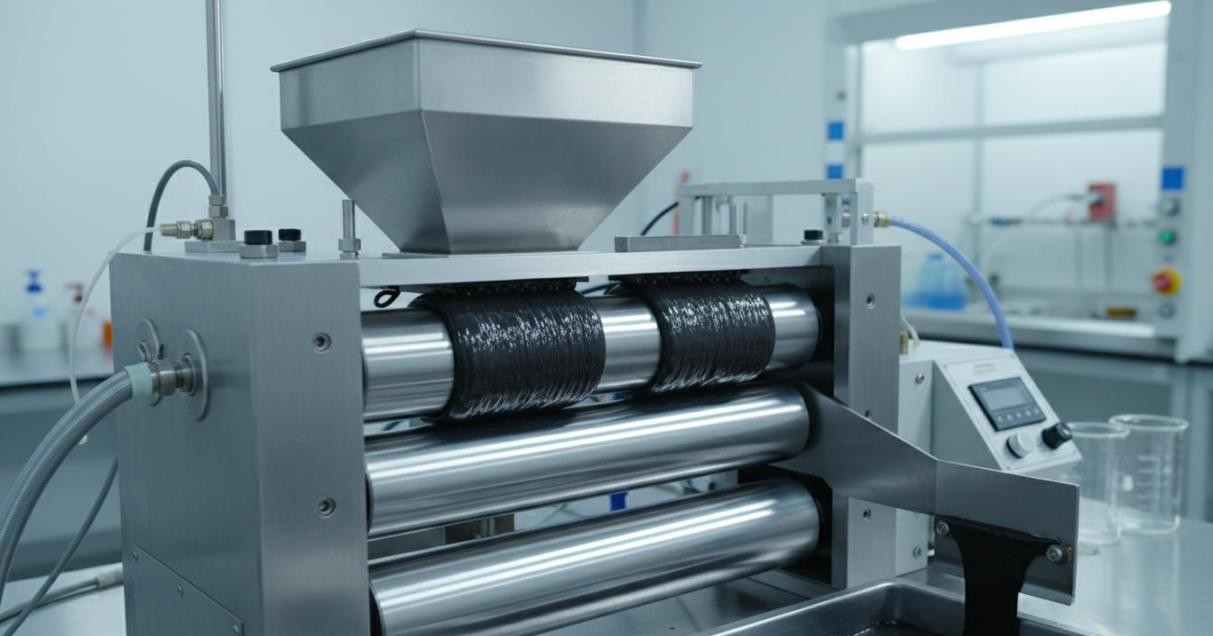 Figure 2: A three-roll mill processing a viscous nanocomposite paste, with three precision-ground steel rollers operating at differential speeds for high-shear dispersion of nanofillers.
Surface Functionalization for Interface Engineering
The greatest challenge in nanocomposite development is achieving strong interfacial adhesion between the organic polymer matrix and the inorganic or carbonaceous nanofiller. Without proper surface chemistry, fillers agglomerate into microscale clusters that act as stress concentrators, degrading rather than enhancing material properties. Eata Nanomaterials addresses this through systematic surface functionalization:
- Covalent functionalization of carbon nanotubes and graphene through acid oxidation, followed by coupling agent attachment. Carboxylic acid groups introduced via sulfuric-nitric acid treatment serve as anchor points for silane coupling agents, isocyanates, or amine-terminated molecules that react with functional groups on the polymer chain
- Non-covalent functionalization using polymer wrapping or surfactant adsorption. This approach preserves the intrinsic properties of the nanofiller by avoiding disruption of the conjugated structure. Polymers such as PVP, SDS, or tailor-made block copolymers adsorb onto the filler surface through pi-pi stacking or hydrophobic interactions, creating a compatibilizing layer
- Organosilane treatment of metal oxide and silica nanoparticles. Silanes with appropriate organic tail groups form stable Si-O-M bonds with the filler surface while the organic moiety entangles with or reacts into the polymer matrix. Common treatments include aminopropyltriethoxysilane for epoxy matrices and methacryloxypropyltrimethoxysilane for acrylic systems
- Polymer grafting via surface-initiated polymerization, where polymer brushes are grown directly from the nanofiller surface. This creates a hairy particle architecture with exceptional compatibility and stress transfer efficiency, though at higher processing complexity
Functionalization strategy selection depends on the target property profile, processing constraints, and cost considerations. We provide guidance on the optimal approach through preliminary compatibility screening using contact angle measurements and molecular dynamics simulations.
Mechanical and Thermal Characterization
Quantifying the property improvements achieved through nanocomposite formulation is essential for validating the development approach and guiding optimization. Eata Nanomaterials maintains a comprehensive characterization laboratory for polymer nanocomposite evaluation:
- Tensile testing per ASTM D638 and ISO 527 standards, measuring Young's modulus, tensile strength, and elongation at break. Universal testing machines with load cells matched to sample geometry provide precise stress-strain curves that reveal subtle changes in yield behavior and strain hardening induced by nanofillers
- Dynamic mechanical analysis from -150 to 400 degrees Celsius, capturing storage modulus, loss modulus, and tan delta as functions of temperature and frequency. DMA reveals glass transition shifts, filler-induced changes in segmental mobility, and the effectiveness of interfacial coupling through the magnitude of the storage modulus plateau above Tg
- Differential scanning calorimetry for glass transition temperature, crystallization kinetics, and melting behavior. Nanofillers frequently act as nucleating agents, increasing crystallization temperature and degree of crystallinity. Understanding these thermal transitions is critical for setting processing temperatures and predicting long-term dimensional stability
- Thermogravimetric analysis under nitrogen and air atmospheres to evaluate thermal stability, filler content verification, and decomposition kinetics. Enhanced thermal stability due to filler barrier effects is a common benefit of nanocomposite formulations
- Transmission and scanning electron microscopy for direct visualization of filler dispersion state, intercalation or exfoliation in layered silicate systems, and fracture surface morphology indicating the quality of interfacial adhesion
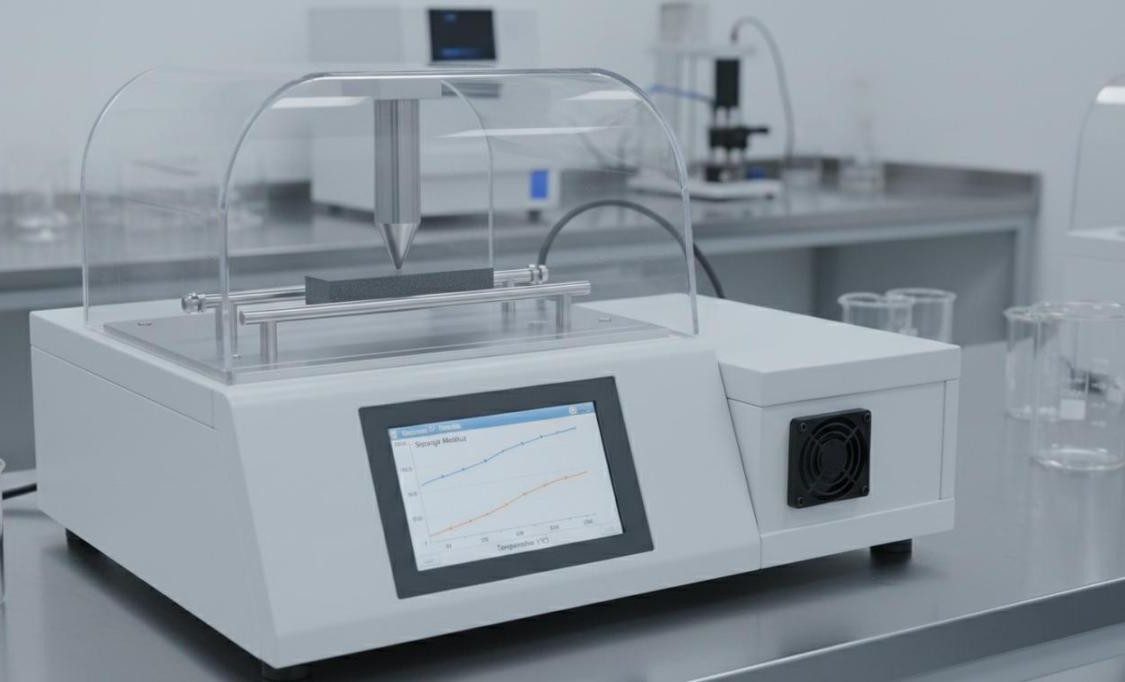 Figure 3: A dynamic mechanical analyzer with three-point bending fixture and temperature-controlled sample chamber, displaying storage modulus and tan delta curves.
Electrical and EMI Shielding Nanocomposites
Conductive polymer nanocomposites offer a compelling alternative to metals for electromagnetic interference shielding, electrostatic discharge protection, and flexible electrode applications. By loading an insulating polymer with conductive nanofillers at concentrations near or above the percolation threshold, materials are created that conduct electricity through a network of interconnected filler particles or through electron tunneling between closely spaced particles.
Eata Nanomaterials develops electrically conductive nanocomposites with precise control over percolation behavior:
- CNT-polymer systems achieving percolation thresholds as low as 0.1 to 0.5 weight percent through optimized dispersion and alignment. Electrical conductivity ranges from anti-static levels of 10^-6 S/m to EMI shielding levels above 1 S/m, tailored by filler loading and functionalization
- Graphene-CNT hybrid fillers creating synergistic conductive networks where graphene sheets provide large-area contact points and CNTs bridge between sheets, reducing the total filler loading required for a given conductivity level compared to single-filler systems
- Metal nanoparticle-polymer composites for applications requiring exceptionally high conductivity, such as printed circuit substrates and connector housings. Silver-coated fillers and copper nanoparticles are dispersed with oxidation protection strategies
EMI shielding effectiveness is measured using the coaxial transmission line method across frequency ranges from 8 GHz to 18 GHz, with typical target values of 30 to 60 dB for commercial shielding applications.
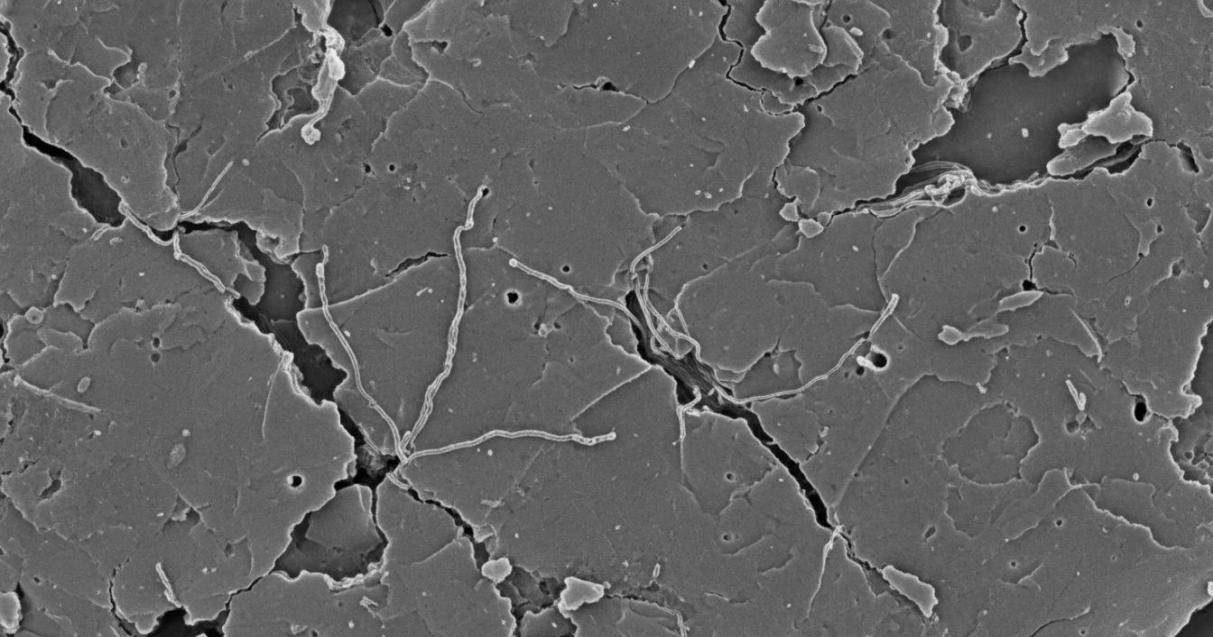 Figure 4: A scanning electron microscope image of a carbon nanotube-polymer nanocomposite fracture surface showing individual nanotubes embedded in and protruding from the polymer matrix.
Application-Specific Development Programs
Our nanocomposite development portfolio spans diverse research and industrial application areas:
- Aerospace lightweighting: replacing metal components with carbon nanotube-reinforced thermoplastic composites offering comparable stiffness at half the weight, validated through creep testing and fatigue life assessment under cyclic loading conditions
- Automotive under-hood applications: developing nanoclay-reinforced polyamide with improved barrier properties against automotive fluids and enhanced dimensional stability at continuous operating temperatures above 150 degrees Celsius
- Flexible and wearable electronics: creating electrically conductive TPU and PDMS nanocomposites with gauge factors exceeding 80,000 for strain sensor applications, capable of detecting deformations from microstrain levels to several hundred percent elongation
- Biodegradable packaging: enhancing PLA and PHB with nanocellulose or modified nanoclays to improve barrier properties against oxygen and water vapor while maintaining compostability, supporting the transition from petroleum-based packaging materials
- Thermal management materials: developing boron nitride or aluminum oxide-filled epoxy composites with thermal conductivity above 5 W/mK for LED encapsulation and power electronics potting applications
Material System Overview
| Matrix Polymer | Nanofiller | Key Property Gain | Loading Range | Application |
| PP, PA, PC | CNT, Graphene | Mechanical + EMI | 0.1-5 wt% | Aerospace, Auto |
| PLA, PHB | Nanoclay, CNC | Barrier + Strength | 1-5 wt% | Packaging |
| Epoxy, PU | BN, Al2O3 | Thermal cond. | 10-60 vol% | Thermal mgmt |
| TPU, PDMS | CNT, rGO | Piezoresistive | 0.5-10 wt% | Strain sensors |
| PEEK, PI | CNT, SiO2 | Tribological | 0.5-3 wt% | Bearings, Seals |
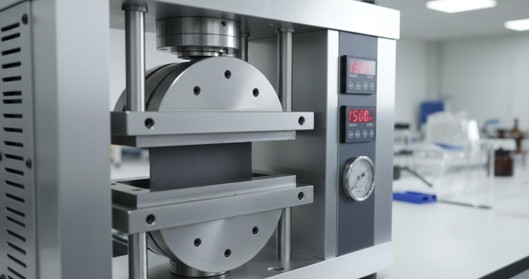 Figure 5: A hydraulic compression molding press with heated platens pressing a polymer nanocomposite sheet into a precision steel mold.
Project Engagement and Sample Preparation
New nanocomposite development projects typically begin with a feasibility phase where we screen 3 to 5 filler candidates at 1 to 3 loading levels in the target polymer matrix, using small-scale batch compounding of 50 to 200 grams. Promising candidates advance to an optimization phase with systematic variation of filler loading, functionalization level, and processing parameters through a design-of-experiments framework.
Compression-molded test plaques and extruded strands are prepared from each formulation for mechanical and thermal characterization. Standard specimen geometries including dog-bone tensile bars, flexural beams, and impact specimens are molded per ASTM or ISO standards. We also accommodate custom geometries required for specialized testing or prototype evaluation. Sample quantities range from kilogram-scale batches for preliminary characterization to 50-kilogram pilot lots for client prototype fabrication and pre-production validation.
If you are interested in our products or services, please don't hesitate to contact us.