

Magnetic Property Characterization Services (VSM)
Magnetic nanomaterials occupy a unique position at the intersection of nanotechnology and magnetism, where size-dependent phenomena unlock properties impossible to achieve with bulk counterparts. Iron oxide nanoparticles exhibit superparamagnetism, cobalt ferrite nanocrystals demonstrate size-tunable coercivity, and rare-earth doped structures display remarkably high magnetic anisotropy. Characterizing these magnetic signatures with precision is essential for developing materials that perform reliably in magnetic hyperthermia, drug delivery, separation technologies, and data storage applications.
At Eata Nanomaterials, our vibrating sample magnetometer (VSM) system delivers high-sensitivity magnetic characterization across a broad range of temperatures and applied fields. From confirming superparamagnetic behavior in iron oxide colloids to mapping the full hysteresis response of hard magnetic nanocomposites, we provide the quantitative magnetic data your research requires.
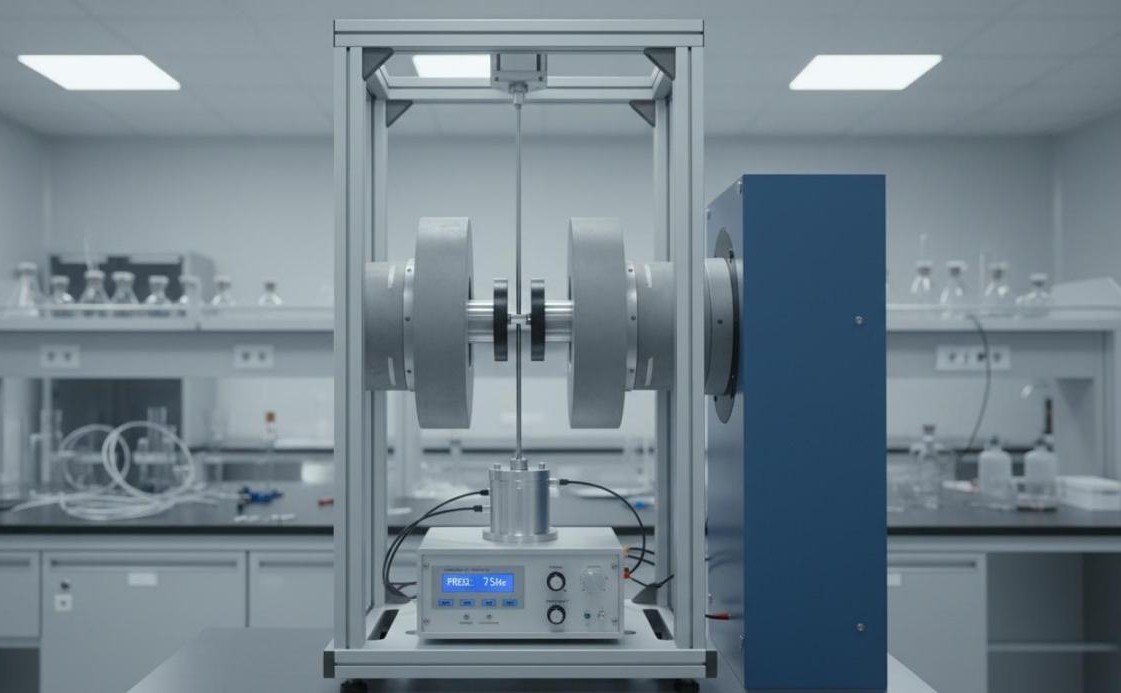 Figure 1: A vibrating sample magnetometer with vertical sample rod positioned between electromagnet pole pieces.
Vibrating Sample Magnetometry: Measurement Principle
The vibrating sample magnetometer detects magnetic moments by mechanically oscillating a sample perpendicular to a uniform applied magnetic field. As the sample vibrates, its magnetic dipole induces an alternating voltage in nearby pickup coils through Faraday's law of electromagnetic induction. The amplitude of this induced signal is directly proportional to the magnetic moment of the sample.
By sweeping the applied magnetic field from negative saturation through zero to positive saturation and back again, the VSM records the complete magnetization-versus-field curve known as the hysteresis loop. From this single measurement, a wealth of magnetic parameters is extracted: saturation magnetization, remanent magnetization, coercivity, squareness ratio, and susceptibility. Our instrument operates at room temperature with applied fields up to 3 Tesla, accommodating powder samples, colloidal dispersions, thin films, and bulk specimens.
Hysteresis Loop Parameters and Their Significance
The hysteresis loop encodes the complete magnetic personality of a material. Each feature of the curve carries distinct physical meaning that guides application development:
Saturation magnetization (Ms): The maximum magnetization achievable when all magnetic moments align with the applied field. For nanoparticles, Ms values typically fall below bulk counterparts due to surface spin disorder, finite-size effects, and non-magnetic surface coatings. Tracking how Ms varies with particle size, coating thickness, or synthesis conditions provides direct insight into magnetic quality.
Remanent magnetization (Mr): The magnetization remaining after the applied field returns to zero. Materials with high Mr retain strong magnetization without external field, useful for permanent magnets and data storage. For biomedical applications requiring zero remanence, Mr serves as a critical quality control metric.
Coercivity (Hc): The magnetic field required to reduce magnetization to zero. Large Hc indicates magnetically hard materials resistant to demagnetization; small Hc characterizes soft magnetic materials easily magnetized and demagnetized. Nanoparticle coercivity depends strongly on size, crystallinity, and anisotropy, making it a sensitive probe of nanostructure.
Squareness ratio (Mr/Ms): The ratio of remanent to saturation magnetization, ranging from zero for perfectly superparamagnetic particles to near unity for uniaxial single-domain ferromagnets. This dimensionless parameter provides a quick assessment of magnetic anisotropy and domain structure.
Initial susceptibility: The slope of the magnetization curve near zero field, indicating how readily a material responds to weak magnetic fields. High susceptibility is desirable for magnetic separation and MRI contrast agent applications.
 Figure 2: A characteristic magnetic hysteresis loop showing saturation, remanence, and coercivity features.
Superparamagnetism: The Signature of Nanoscale Magnetism
When magnetic nanoparticles become smaller than a critical size, typically 20 to 30 nanometers for iron oxides, they enter the superparamagnetic regime. Each particle contains a single magnetic domain, and thermal energy at room temperature is sufficient to flip the magnetization direction randomly. In the absence of an applied field, the net magnetization averages to zero. Under an applied field, the moments align promptly, producing high magnetization that disappears completely when the field is removed.
This zero-remanence, zero-coercivity behavior is the hallmark of superparamagnetism and is indispensable for biomedical applications. Superparamagnetic particles generate no permanent magnetic attraction to each other, preventing aggregation in the body while still responding to externally applied fields for targeting, heating, or separation.
Our VSM services precisely characterize superparamagnetic behavior by:
- Measuring zero-field-cooled and field-cooled magnetization curves to determine the blocking temperature where superparamagnetic relaxation freezes into ferromagnetic order
- Recording zero remanence and zero coercivity at temperatures above the blocking temperature to confirm superparamagnetic status
- Quantifying the size dependence of magnetic properties to identify the single-domain to superparamagnetic transition
- Assessing the effect of surface coatings, surfactants, and oxidation on saturation magnetization values
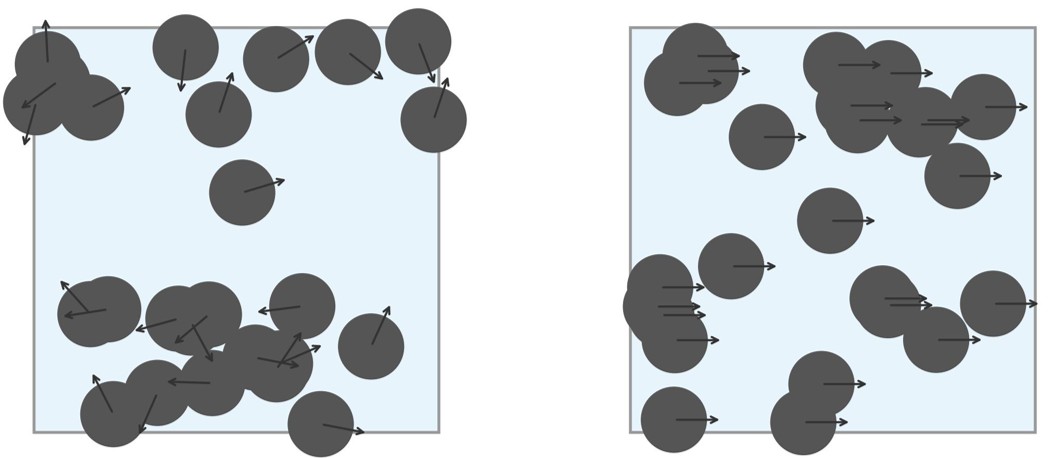 Figure 3: Magnetic nanoparticles with randomly oriented moments at zero field (left) and fully aligned moments under applied field (right).
Nanomaterial Classes and Magnetic Characterization Objectives
| Nanomaterial Type | Key Magnetic Parameters | Application Drivers |
| Iron oxide nanoparticles | Ms, Mr, Hc, blocking temperature | MRI contrast, magnetic separation, hyperthermia |
| Ferrite nanocrystals | Hc, Mr/Ms, anisotropy constant | Data storage, permanent magnets, sensors |
| Metallic magnetic NPs | Ms, coercivity, Curie temperature | High-performance magnets, catalysis |
| Core-shell magnetic NPs | Exchange bias, loop shift, Ms | Spintronics, advanced biomedicine |
| Magnetic nanocomposites | Magnetic content, percolation threshold | Electromagnetic shielding, actuators |
| Doped metal oxide NPs | Magnetic moment, spin state | Diluted magnetic semiconductors |
 Figure 4: Vials containing magnetic nanoparticle dispersions with different colors, alongside a magnet demonstrating magnetic responsiveness.
Sample Preparation and Measurement Protocols
Accurate magnetic characterization depends critically on proper sample preparation and measurement conditions. Our protocols address the unique challenges of nanomaterial samples:
- Powder samples are weighed to precise masses and loaded into gelatin capsules or pressed pellets to ensure uniform packing and reproducible geometry
- Colloidal dispersions are either dried onto substrates for solid-state measurement or analyzed as liquid samples in specialized holders that prevent evaporation during vibration
- Thin film samples are mounted with the film plane perpendicular to the applied field for in-plane magnetization measurement, or parallel for out-of-plane anisotropy studies
- Diamagnetic corrections are applied for non-magnetic substrates, capsules, and solvents to isolate the intrinsic magnetic response of the nanomaterial
- Field sweep rates and step sizes are optimized for each material class: fast sweeps for soft magnetic materials, slow sweeps for hard magnets with high coercivity
Temperature-Dependent Magnetic Measurements
Magnetic properties evolve with temperature as thermal energy competes with magnetic ordering forces. Our variable-temperature measurements track these changes to reveal fundamental physical parameters:
- Zero-field-cooled and field-cooled magnetization curves revealing blocking temperatures, spin-glass behavior, and magnetic phase transitions
- Temperature-dependent saturation magnetization tracking the approach to the Curie temperature where ferromagnetic order vanishes
- Thermal demagnetization studies quantifying how remanence degrades with heating for permanent magnet applications
- Cryogenic measurements at liquid nitrogen temperature to suppress superparamagnetic relaxation and reveal intrinsic anisotropy
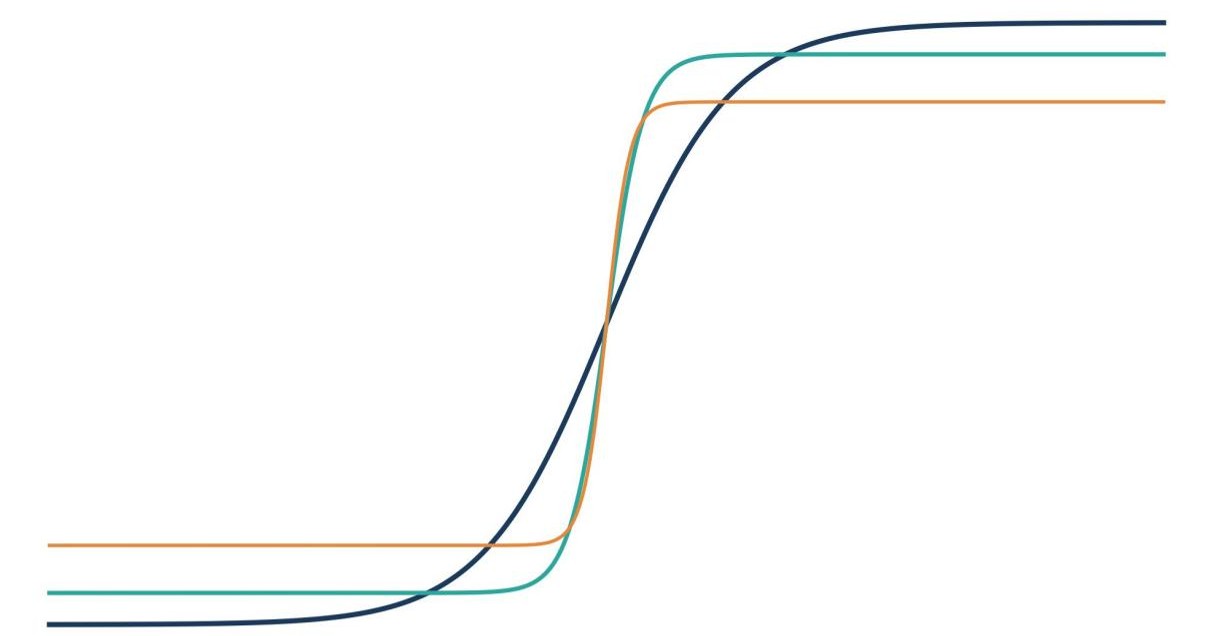 Figure 5: Comparison of hysteresis loops for hard ferromagnetic, soft ferromagnetic, and superparamagnetic materials.
Measurement Deliverables
Every magnetic characterization project includes a comprehensive report with:
- Hysteresis loop data with extracted parameters: Ms, Mr, Hc, Mr/Ms, and initial susceptibility
- Temperature-dependent magnetization data with blocking temperatures and phase transition temperatures when applicable
- Diamagnetically corrected data isolating the intrinsic magnetic response
- Publication-ready figures formatted to journal specifications upon request
- Expert interpretation discussing magnetic behavior in context of particle size, composition, structure, and intended application
Characterize Your Magnetic Nanomaterials with Eata Nanomaterials
Whether you need to confirm superparamagnetic behavior for biomedical applications, optimize coercivity for data storage media, or quantify the magnetic loading of a nanocomposite, our VSM platform delivers precise, reliable magnetic data with expert interpretation.
Contact our analytical team to discuss your sample type, desired magnetic measurements, and temperature requirements. We will recommend the optimal measurement protocol and provide guidance on sample preparation and quantity.