

Nanomaterial Thermal Management Solution Services
Every electronic device, battery pack, and LED module generates heat that must be efficiently removed for reliable operation. As power densities continue to rise in data centers, electric vehicles, and 5G telecommunications infrastructure, conventional thermal management materials are reaching their limits. A typical polymer thermal interface material conducts heat at 0.2 to 0.5 watts per meter-kelvin, creating a severe bottleneck between a hot-running processor and an aluminum heat sink. In electric vehicle battery packs, uneven thermal distribution accelerates degradation and creates safety hazards. In high-power LEDs, junction temperature increases above 85 degrees Celsius cause catastrophic lumen depreciation and color shift.
Nanomaterials fundamentally alter the thermal transport landscape. Graphene, with an intrinsic thermal conductivity of approximately 5,000 watts per meter-kelvin, can boost composite thermal conductivity by 2,300 percent at just 10 volume percent loading. Boron nitride nanosheets provide similarly dramatic enhancements while preserving electrical insulation. Phase change materials with nanoparticle additives store and release thermal energy with unprecedented efficiency. Eata Nanomaterials harnesses these properties to design, formulate, and validate thermal management solutions that outperform conventional materials by orders of magnitude.
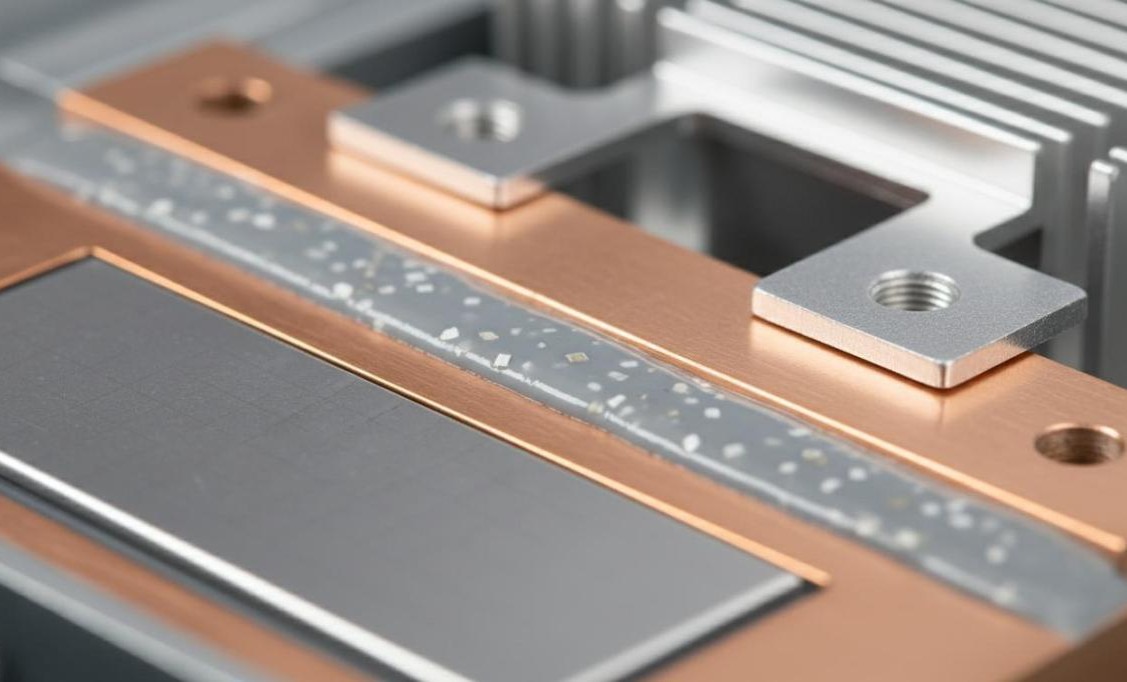 Figure 1: A cross-section view showing a nanocomposite thermal interface material filling the microscopic gaps between an electronic chip and a copper heat sink for efficient heat dissipation.
Thermal Interface Materials with Nanocomposite Formulations
Thermal interface materials bridge the microscopic air gaps between heat-generating components and heat sinks, eliminating the insulating air layers that otherwise dominate thermal resistance. The performance of a TIM depends on its bulk thermal conductivity, bond line thickness, and contact resistance at both interfaces. Eata Nanomaterials optimizes each of these parameters through engineered nanocomposite formulations.
Our TIM development services include:
- Graphene-multilayer graphene epoxy composites achieving record thermal conductivity enhancements of 2,300 percent at 10 volume percent filler loading, corresponding to composite thermal conductivities above 30 watts per meter-kelvin. The exceptional performance arises from graphene's large aspect ratio, high intrinsic conductivity, and uniquely low thermal boundary resistance at the graphene-matrix interface, approximately 3.5 times 10^-9 kelvin-meter-squared per watt
- Boron nitride nanosheet and nanotube composites for electrically insulating thermal management applications. BNNS at 40 weight percent in epoxy achieves through-plane thermal conductivity of 5.86 watts per meter-kelvin while maintaining electrical resistivity above 10^15 ohm-centimeters, making these composites ideal for power electronics packaging where electrical isolation is mandatory
- Hybrid filler architectures combining micron-scale aluminum oxide particles with protruding boron nitride nanotubes on the particle surfaces. This hierarchical structure creates additional contact points between fillers, forming continuous three-dimensional heat conduction networks at lower total loading than conventional single-filler systems, simultaneously improving thermal conductivity and mechanical properties
- Thermal grease enhancement through low-loading graphene additive incorporation. Just 2 weight percent of an optimized graphene-MLG nanocomposite mixture increases commercial thermal grease conductivity from 5.8 to 14 watts per meter-kelvin while preserving all mechanical properties and application characteristics of the base grease
We characterize TIMs by the laser flash method for through-plane thermal diffusivity, guarded hot plate for steady-state thermal conductivity, and ASTM D5470 for thermal resistance in a pressure-controlled fixture that replicates actual assembly conditions.
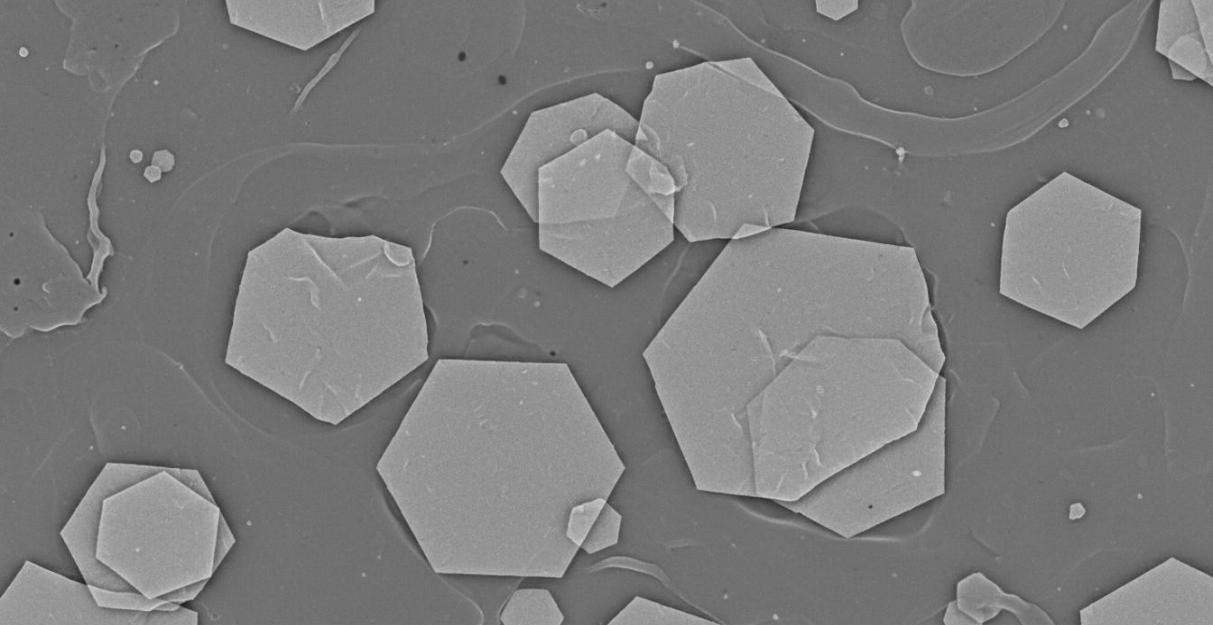 Figure 2: A scanning electron microscope image showing hexagonal boron nitride nanosheets partially overlapping within a polymer matrix, illustrating the formation of heat conduction pathways.
Electrically Insulating Thermal Management Solutions
Many high-power electronics applications require thermal management materials that conduct heat efficiently without conducting electricity. Carbon-based fillers such as graphene and carbon nanotubes, while exceptional thermal conductors, render composites electrically conductive at percolation thresholds below 0.5 volume percent. For these applications, ceramic nanofillers provide an alternative pathway.
Eata Nanomaterials develops electrically insulating thermal composites using:
- Aluminum oxide Al2O3 microspheres combined with functionalized boron nitride nanotubes. The BNNTs protrude from the Al2O3 surfaces, creating bridging connections between adjacent micro-fillers that dramatically reduce interfacial thermal resistance while maintaining electrical insulation. Tannic acid-assisted non-covalent functionalization preserves BNNT structural integrity while promoting dispersion in epoxy matrices
- Aluminum nitride AlN and silicon carbide SiC nanofillers with silane surface treatments that enhance compatibility with silicone and epoxy matrices. These composites achieve thermal conductivities of 2 to 4 watts per meter-kelvin at loadings of 40 to 60 volume percent, suitable for substrate and potting applications in power modules
- All-organic thermal composites using poly-p-phenylene benzobisoxazole PBO fibers to construct long-range ordered heat transfer paths in organosilicon matrices. These lightweight composites achieve thermal conductivity of 18.44 watts per meter-kelvin at a density of only 1.24 grams per cubic centimeter, demonstrating superior cooling performance compared to advanced commercial materials
Each insulating composite is validated for dielectric strength, volume resistivity, and thermal impedance to ensure compliance with IEC and UL standards for electronic insulation systems.
Nano-Enhanced Phase Change Materials for Thermal Energy Storage
Phase change materials absorb and release large quantities of thermal energy at near-constant temperature during solid-liquid transitions, making them ideal for thermal buffering, peak load shifting, and temperature stabilization applications. However, pure PCMs suffer from low thermal conductivity, typically 0.2 to 0.5 watts per meter-kelvin, which limits the rate of heat absorption and release. Nanoparticle incorporation addresses this limitation.
Our nano-PCM development capabilities include:
- Metal nanoparticle-enhanced organic PCMs incorporating copper, aluminum, and zinc nanoparticles at loadings of 1 to 2 weight percent. Copper-enhanced D-Mannitol achieves thermal conductivity of 0.42 watts per meter-kelvin, a significant improvement over the pristine PCM, while maintaining high latent heat storage capacity
- Carbon porous matrix-supported composite PCMs where Cu nanoparticles are embedded within a porous carbon scaffold that also serves as a shape-stabilization framework. The paraffin-Cu@C composite retains a latent heat of 148.2 joules per gram while achieving 145 percent thermal conductivity enhancement, with the added benefit of photothermal conversion capability for solar energy harvesting
- Thermal cycling characterization to evaluate long-term stability of nano-PCMs through repeated melting and freezing cycles, monitoring latent heat retention, thermal conductivity evolution, and nanoparticle dispersion stability over hundreds of cycles
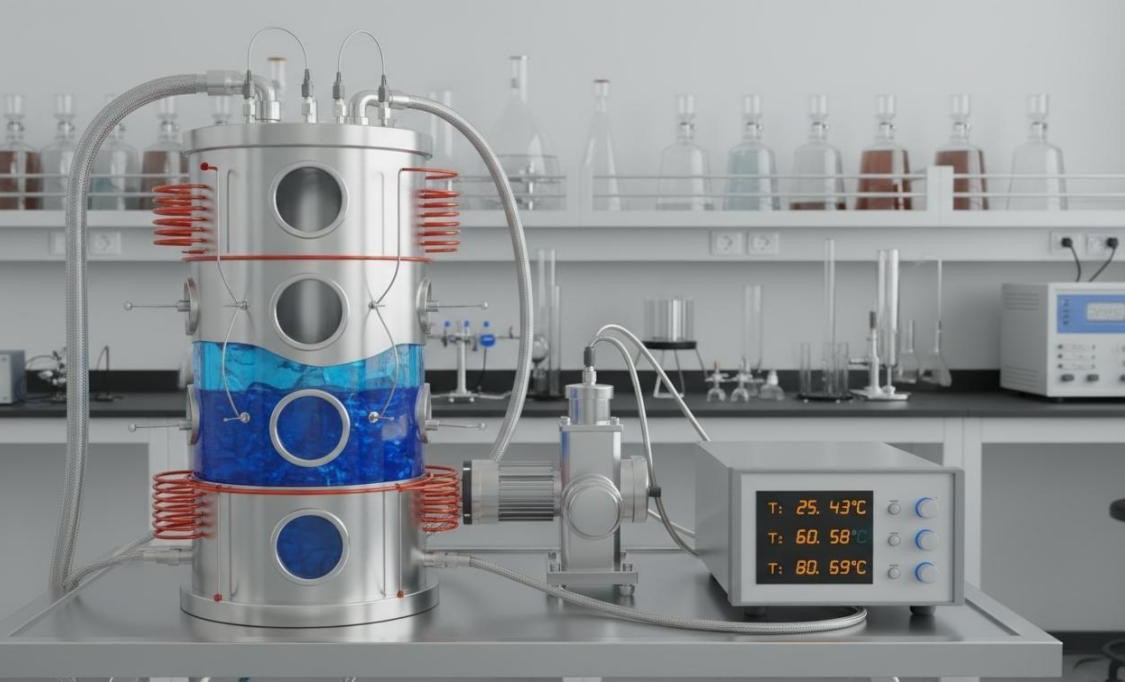 Figure 3: A phase change material thermal energy storage system with a cylindrical storage tank, heating coils, and a data acquisition unit displaying temperature readings at multiple positions.
Nanofluid Heat Transfer Enhancement
Nanofluids, engineered colloidal suspensions of metallic or ceramic nanoparticles in conventional heat transfer fluids, exhibit thermal conductivities 20 to 150 percent higher than base fluids. This enhancement enables more compact heat exchangers, more efficient cooling systems, and reduced energy consumption in thermal management applications.
Eata Nanomaterials formulates nanofluids for specific cooling applications:
- Water-based Al2O3, CuO, and TiO2 nanofluids for data center liquid cooling systems, with thermal conductivity enhancements up to 15 percent at nanoparticle concentrations below 1 volume percent. These formulations use optimized surfactant packages to maintain dispersion stability and minimize viscosity increases that would otherwise increase pumping power
- Ethylene glycol-water mixture nanofluids with Cu and SiO2 nanoparticles for automotive cooling systems and solar thermal collectors. Copper nanoparticles at optimal concentrations yield heat transfer performance enhancements exceeding 10 percent, though careful formulation is required to avoid increased viscosity at excessive loadings
- Mineral oil-based nanofluids for transformer and electrical equipment cooling where dielectric properties must be preserved. Al2O3 nanoparticles in YT198 mineral oil demonstrate consistent thermal conductivity improvements with monotonically increasing enhancement as a function of volume fraction
Each nanofluid formulation is characterized for thermal conductivity by the hot-wire or transient plane source method, viscosity by rotational rheometry, and dispersion stability by dynamic light scattering and zeta potential measurement. We also evaluate heat transfer coefficients under flow conditions and assess the risk of surface deposition in the target cooling system.
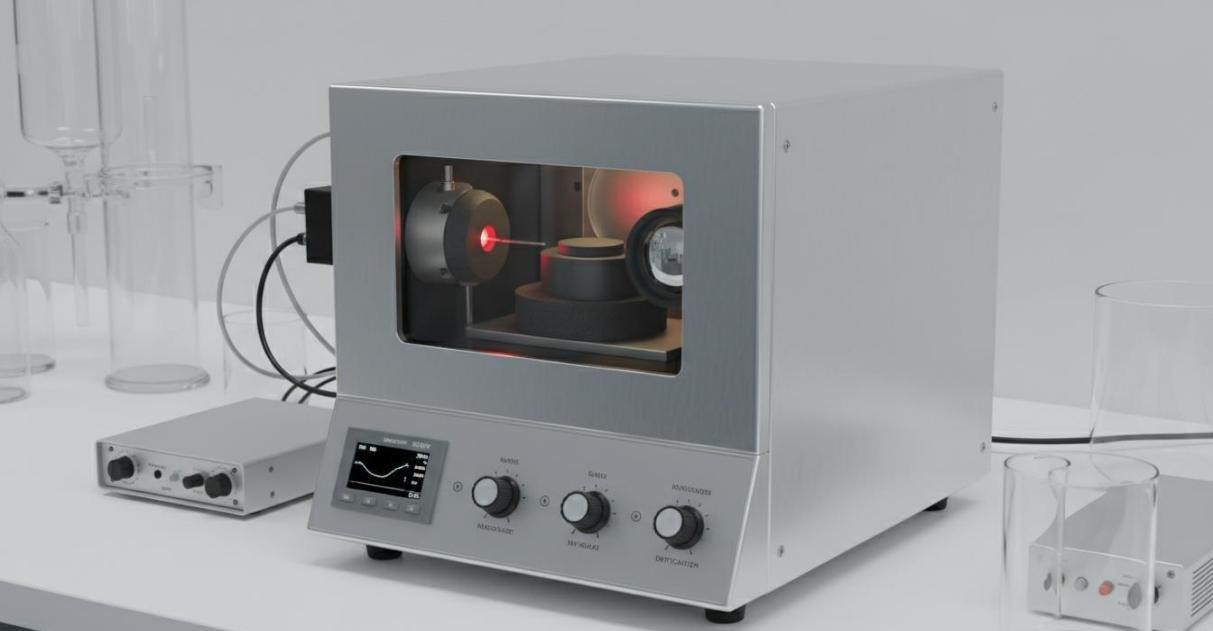 Figure 4: A laser flash thermal analyzer instrument with a sample holder, laser pulse source, and infrared detector for measuring thermal diffusivity of nanocomposite materials.
Thermal Management Solution Comparison
| Solution Type | Key Nanomaterial | Thermal K | Electrical | Application |
| Graphene TIM | Graphene + MLG | >30 W/mK | Conductive | CPU, GPU cooling |
| BNNS composite | BN nanosheets | ~6 W/mK | Insulating | Power electronics |
| Hybrid filler | Al2O3 + BNNT | 3-5 W/mK | Insulating | LED packaging |
| Nano-PCM | Cu/Al/Zn NPs | 0.3-0.4 W/mK | Insulating | Thermal buffering |
| Nanofluid | Al2O3, CuO | +15-50% | Varies | Liquid cooling |
| PBO composite | PBO fibers | 18.4 W/mK | Insulating | Lightweight TIM |
Application Areas
Our nanomaterial thermal management solutions address critical heat dissipation challenges across diverse industries:
- High-power electronics: thermal interface materials between CPUs, GPUs, and heat sinks in servers, workstations, and gaming systems, where graphene-based TIMs reduce junction temperatures by 5 to 10 degrees Celsius compared to conventional greases
- LED lighting: thermally conductive substrates and encapsulants for high-power LED modules, where efficient heat removal extends operational lifetime from thousands to hundreds of thousands of hours while maintaining color quality
- Electric vehicle battery packs: phase change materials with nanoparticle enhancers for cell-to-cell thermal equalization, preventing thermal runaway propagation and extending cycle life through reduced temperature excursions
- Power electronics: electrically insulating thermal composites for IGBT and MOSFET modules, where boron nitride-filled systems replace aluminum oxide substrates with improved thermal performance and reduced weight
- Renewable energy: nanofluid-enhanced heat transfer in solar thermal collectors and nanoparticle-supported composite PCMs for multi-temperature thermal energy storage systems, improving overall solar-to-thermal conversion efficiency
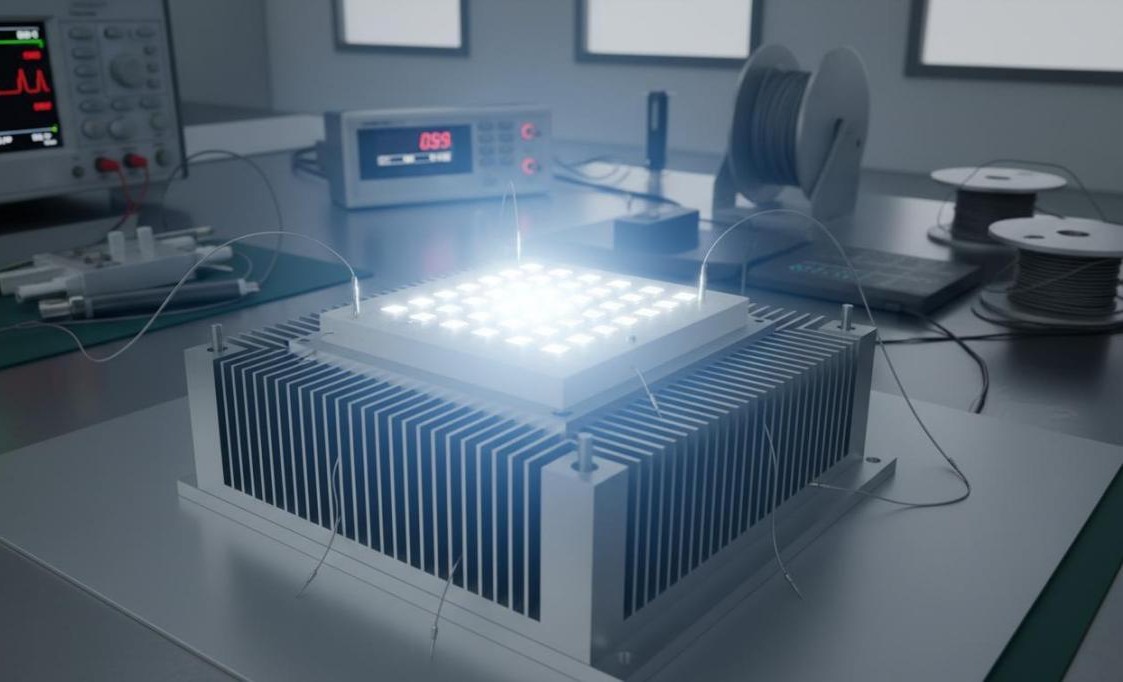 Figure 5: A high-power LED module mounted on an aluminum nitride substrate and heat sink with thermocouple sensors attached for thermal performance evaluation.
Characterization and Validation
All thermal management solutions undergo rigorous characterization to verify performance claims and predict behavior under actual operating conditions. Our thermal characterization laboratory is equipped with:
- Laser flash analysis for measuring thermal diffusivity of solid samples from room temperature to 600 degrees Celsius, from which thermal conductivity is calculated using independently measured density and specific heat capacity
- Guarded hot plate apparatus for steady-state thermal conductivity measurement of bulk composite samples according to ASTM C177
- ASTM D5470 thermal resistance test fixture for measuring TIM thermal impedance under controlled pressure and temperature conditions that replicate actual assembly environments
- Hot disk transient plane source thermal analyzer for simultaneous measurement of thermal conductivity, thermal diffusivity, and specific heat of liquids and solids
- Infrared thermography for mapping surface temperature distributions on heat-generating assemblies, visualizing thermal spreading and identifying hotspots
- Thermal cycling chambers for accelerated aging tests that subject materials to repeated temperature excursions between -40 and 150 degrees Celsius, quantifying thermal performance degradation over simulated service life
If you are interested in our products or services, please don't hesitate to contact us.