

Products
- High-Quality Graphene
- CVD Graphene, Graphene-Like Materials
- Graphene-Like Series
- Defect-Free Single-Crystal Graphene and Graphene-Like Materials (Mechanical Exfoliation)
- Quantum Dot Series
- Aggregation-Induced Emission (AIE)
- Near-Infrared II (NIR-II) Fluorescent Dyes
- Graphdiyne
- Two-Dimensional Transition Metal Carbides/Nitrides/Borides (MXene)
- Metal Nanomaterials and Other Functional Bio-Nanomaterials
- Metal-Organic Frameworks (MOF)
- Covalent Organic Frameworks (COF)
- Two-Dimensional Layered Metal Oxides (LDH)
- Carbon Nanotube Powders, Pastes
- Carbon Nanotube Arrays and Special Carbon Nanotube Materials
- High-Quality Metallic and Semiconducting High-Purity Single-Walled Carbon Nanotubes
- Carbon Nanotube Sponges
- Mesoporous Carbon and Carbon Nanomaterials
- High-Quality Fullerenes
- One-Dimensional Nanomaterials
- Molecular Sieves
- Inorganic Nanomaterials
- Perovskite Materials
- Highly Oriented Pyrolytic Graphite (HOPG)
- Organic Materials
- Single-Atom Catalysts
- Thermoelectric Materials
- Sodium Storage Materials
- Industrial-Grade Nanomaterials
- Solid-State Lithium Batteries
- Hydrogel Series and Consumables
Online Inquiry
Carbon Nanotube Powders, Pastes
In 1991, Sumio Iijima published a transmission electron micrograph that changed materials science forever. The image showed tiny hollow cylinders, each only nanometers in diameter yet micrometers in length, composed entirely of rolled-up graphene sheets. These were carbon nanotubes, and they immediately captured the imagination of researchers worldwide because they promised a seemingly impossible combination of properties: electrical conductivity exceeding that of copper, tensile strength surpassing steel by orders of magnitude, thermal conductivity greater than diamond, and all of this in a material lighter than aluminum. Three decades later, carbon nanotubes have matured from laboratory curiosities into industrial raw materials, finding their way into lithium-ion batteries, conductive coatings, thermal interface materials, structural composites, and electromagnetic shielding products.
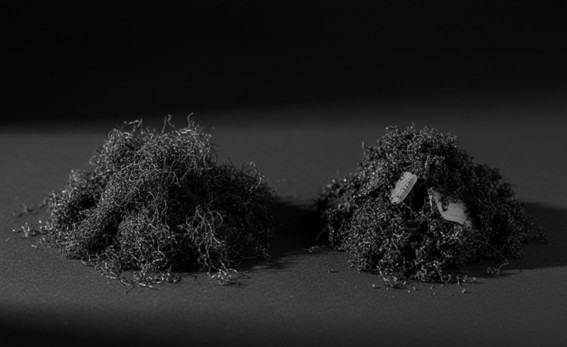 Figure 1: Carbon nanotube powder in both loose fluffy and compressed forms, showing the characteristic deep black color and fibrous texture of high-purity CVD-synthesized nanotubes.
At Eata Nanomaterials, we supply carbon nanotubes in the two forms that researchers and industrial users actually need: as dry powders for maximum formulation flexibility, and as pre-dispersed pastes for immediate integration into existing processing workflows. Our catalog spans single-walled nanotubes for applications demanding the highest aspect ratio and specific surface area, multi-walled nanotubes for cost-effective conductivity and mechanical reinforcement, and functionalized variants with carboxyl, hydroxyl, or amine surface groups for aqueous dispersion and covalent coupling chemistry. Every batch is synthesized by chemical vapor deposition, purified to remove amorphous carbon and residual catalyst, and characterized by Raman spectroscopy, thermogravimetric analysis, and electron microscopy before it leaves our facility.
Featured Products
| Product Category | High-Volume Search Terms | Primary Applications |
| SWCNT Pristine | 1-2 nm diameter, >95% purity, SSA >380 m2/g, aspect ratio 1000-10000, CVD, metallic/semiconducting | Transparent conductive film, OFET, battery conductive network, sensor, composites |
| MWCNT Pristine | 10-50 nm OD, >95% purity, SSA 200-300 m2/g, length 1-30 um, 98 S/cm, CVD-grown | Conductive polymer composite, EMI shielding, battery electrode, antistatic coating |
| COOH-Functionalized CNT | Acid oxidation, 2-7 wt% COOH, hydrophilic, zeta potential -30 to -70 mV, water dispersible | Aqueous dispersion, polymer composite, biosensor, drug delivery, covalent coupling |
| OH-Functionalized CNT | Hydroxyl groups, polar polymer compatibility, mild oxidation, H-bonding | Aqueous ink, polar matrix composite, hydroxyl-coupling chemistry, coating |
| Nh3-Functionalized CNT | Amine terminated, antibody conjugation, EDC/NHS coupling, biocompatible | Biosensor scaffold, drug delivery, amine-reactive crosslinking, bioconjugation |
| CNT Conductive Paste | 10-20 wt% CNT, aqueous, NMP, epoxy-compatible, screen printable, slot-die coating | Battery electrode coating, circuit printing, EMI shielding paste, thermal paste |
| Short CNT | 1-4 um length, mechanically milled, improved dispersion, polymer integration, lower aspect ratio | Polymer composite, biomedical ink, drug delivery formulation, 3D printing |
| DWCNT | Double-walled, 4 nm OD, chemical stability, intermediate between SWCNT and MWCNT | Reinforcement, sensing, nanomechanical device, field emission, hybrid material |
| High-Purity >99% CNT | Ultra-low ash <1%, residual catalyst <0.5%, TGA verified, semiconductor grade | Precision electronics, biomedical implant, sensitive electrochemistry, fundamental research |
Carbon Nanotube Products in Our Catalog
Single-Walled Carbon Nanotubes: Maximum Aspect Ratio
Single-walled carbon nanotubes consist of a single rolled graphene sheet, typically 1-2 nm in diameter and several micrometers in length, giving them aspect ratios of 1,000 to 10,000. Depending on their chirality, individual SWCNTs can be either metallic or semiconducting, making them uniquely valuable for transparent conductive films, organic field-effect transistors, and fundamental nanoelectronics research. Our SWCNTs are produced by catalytic chemical vapor deposition using optimized catalyst formulations that maximize yield and minimize amorphous carbon byproduct.
- Diameter: 1-2 nm outer diameter, verified by HRTEM and Raman spectroscopy.
- Purity grades: 90%+, 95%+, and 99%+ carbon content, with TGA confirmation.
- Specific surface area: >380 m2/g for pristine 95% grade.
- Raman G/D ratio: >9 for high-quality semiconducting/metallic mix.
- Available as: pristine powder, COOH-functionalized, OH-functionalized, Nh3-functionalized.
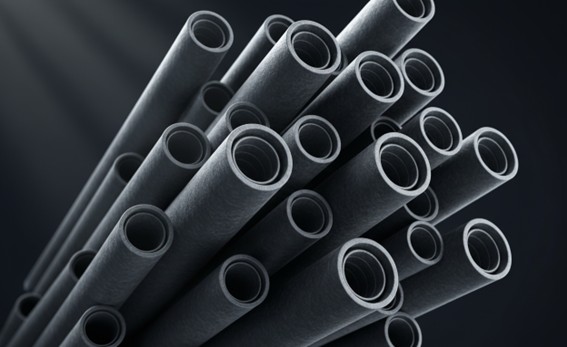 Figure 2: Bundle of multi-walled carbon nanotubes showing the characteristic concentric cylindrical graphene shells with hollow cores and nested wall structure.
Multi-Walled Carbon Nanotubes: Industrial Workhorse
Multi-walled carbon nanotubes contain multiple concentric graphene cylinders, with outer diameters typically ranging from 5 to 50 nm. MWCNTs are essentially metallic regardless of chirality, easier to disperse than SWCNTs, and substantially more cost-effective per gram. These attributes make MWCNTs the material of choice for industrial-scale applications in conductive composites, battery electrodes, electromagnetic shielding, and structural reinforcement.
- Outer diameter: 8-15 nm (standard), 15-30 nm (large), or 30-50 nm (bamboo).
- Length: 1-3 um (short), 5-20 um (standard), 10-30 um (long).
- Purity: >92%, >95%, >98%, or >99.9% carbon content.
- Electrical conductivity: >98 S/cm for purified powder.
- Tap density: 0.12-0.45 g/cm3 depending on diameter and functionalization.
Functionalized Carbon Nanotubes: Chemistry-Ready Surfaces
Pristine carbon nanotubes are hydrophobic and difficult to disperse in water or polar solvents. Functionalization addresses this by adding reactive groups to the nanotube surface. Our functionalized CNTs are produced by controlled acid oxidation followed by specific chemical treatments to introduce carboxyl (-COOH), hydroxyl (-OH), or amine (-Nh3) groups. These surface modifications enable aqueous dispersion, covalent coupling to polymers and biomolecules, and enhanced interfacial bonding in composite materials.
- COOH-CNT: 2-7 wt% carboxyl content, water dispersible, zeta potential -30 to -70 mV.
- OH-CNT: hydroxyl functionalized, compatible with polar polymer matrices.
- Nh3-CNT: amine terminated, 99%+ purity, for bioconjugation and crosslinking.
- Dispersion: 0.1-1 mg/mL in water with brief sonication for COOH/OH variants.
Carbon Nanotube Pastes: Ready-to-Use Formulations
For customers who need carbon nanotubes in a form that can be integrated directly into existing manufacturing processes, we offer pre-dispersed CNT pastes. These formulations contain carbon nanotubes at 10-20 weight percent, uniformly dispersed in aqueous, N-methyl-2-pyrrolidone (NMP), or epoxy-compatible carrier media. The pastes eliminate the time-consuming and equipment-intensive dispersion step, reducing processing time and improving batch-to-batch consistency.
- Aqueous paste: 10-20 wt% CNT, water-based, for battery electrodes and coating.
- NMP paste: high concentration, for Li-ion battery cathode slurry.
- Epoxy-compatible paste: for conductive adhesive and composite applications.
- Solvent-free paste: for formulations where solvent content must be minimized.
 Figure 3: Carbon nanotube conductive paste being spread onto a substrate surface, demonstrating the glossy viscous texture and uniform coverage achievable with pre-dispersed CNT formulations.
Short Carbon Nanotubes: Enhanced Dispersibility
For applications where pristine nanotube length creates dispersion challenges, we offer short carbon nanotubes produced by controlled mechanical milling or oxidative scissoring. These shortened tubes retain the essential electrical and mechanical properties of longer nanotubes but integrate far more readily into polymer matrices, biomedical formulations, and 3D printing resins.
- Length: 1-4 um, approximately 5-10x shorter than standard CNTs.
- Improved dispersion: 10-100x easier to disperse than standard-length tubes.
- Available: short COOH-CNT and short OH-CNT for aqueous and polymer systems.
Where Carbon Nanotubes Deliver Competitive Advantage
The extraordinary property profile of carbon nanotubes translates into transformative capabilities across a broad spectrum of application domains.
- Energy storage: CNT conductive additives in Li-ion battery electrodes reduce internal resistance and improve cycling stability; CNT-based supercapacitor electrodes achieve high power density through the exceptional surface area and conductivity of nanotube networks.
- Conductive composites: CNT-reinforced polymers achieve antistatic, electrostatic discharge (ESD), and electromagnetic interference (EMI) shielding performance at loadings as low as 0.5-5 wt%, far below what carbon black requires.
- Thermal management: vertically aligned CNT arrays provide thermal interface materials with conductivities exceeding 100 W/mK; CNT-enhanced pastes and greases improve heat dissipation in power electronics.
- Structural reinforcement: CNT-modified polymers and composites show dramatic improvements in tensile strength, elastic modulus, and fracture toughness at nanotube loadings below 2 wt%.
- Flexible and printed electronics: CNT inks enable screen-printed, inkjet-printed, and gravure-printed conductive traces on polymer, paper, and textile substrates for wearable and foldable electronics.
- Sensors and biosensors: the high surface-to-volume ratio and electrochemical activity of CNTs enable gas sensors with parts-per-billion detection limits and biosensors for glucose, DNA, and protein detection.
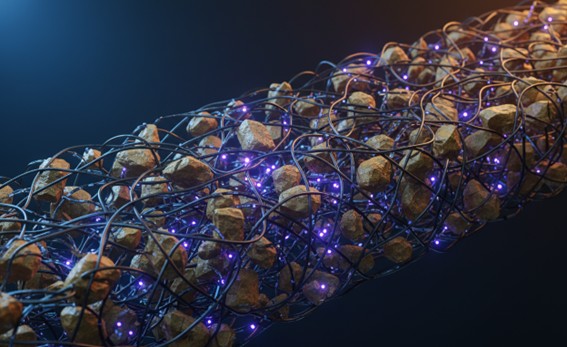 Figure 4: Carbon nanotubes forming a conductive network throughout a battery electrode matrix, providing electron transport pathways between active material particles while enabling ion diffusion.
Analytical Characterization: Ensuring Consistency
We characterize every batch of carbon nanotubes with the analytical rigor that demanding applications require. The data accompanies your order as a batch-specific report.
- Raman spectroscopy: D-band (~1350 cm-1), G-band (~1580 cm-1), 2D-band, G/D ratio for quality assessment.
- Thermogravimetric analysis (TGA): carbon content, ash residue, oxidation temperature profile.
- Scanning electron microscopy (SEM): tube morphology, diameter, length, and bundle structure.
- Transmission electron microscopy (TEM): wall count for MWCNTs, diameter confirmation for SWCNTs.
- BET surface area: N2 adsorption at 77 K for SSA determination.
- X-ray photoelectron spectroscopy (XPS): elemental composition, oxygen content, functional group quantification.
- Electrical conductivity: four-point probe measurement on compressed powder pellet.
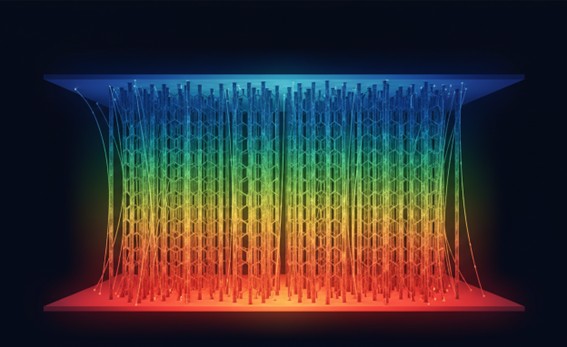 Figure 5: Vertically aligned carbon nanotubes serving as thermal conduction pathways between a heat source and a heat sink, illustrating the exceptional heat transfer capability of CNT-based thermal interface materials.
Custom Carbon Nanotube Products and Formulations
Standard CNT products cover the majority of research and industrial needs, but specialized applications often require tailored materials. Our custom service offers non-standard diameters and length distributions, specific surface functionalization densities and chemistries, custom solvent and resin-based paste formulations with target viscosity and solids loading, and metal-decorated CNTs (Pt, Pd, Au) for catalytic applications. We have also developed tailored CNT dispersions for specific polymer systems and production-scale CNT masterbatches for plastic compounders.
Describe your target diameter, length, purity, functionalization, paste specification, or application requirement. Our materials scientists will propose a solution, provide a feasibility assessment, and deliver a characterized batch.
Request a Data Sheet or Start a Custom Project
Browse our carbon nanotube powder and paste catalog, request detailed characterization data, or describe the specific CNT specification your research or production requires.
| Catalog Number | Product Name | Order | Quantity |
|---|---|---|---|
| CNPP-0001 | Hydroxylated MWCNTs (Short) 10-20 nm |
-
+
|
|
| CNPP-0002 | Carboxylated MWCNTs (Short) 30-50 nm |
-
+
|
|
| CNPP-0003 | Hydroxylated MWCNTs (Long) |
-
+
|
|
| CNPP-0004 | High Purity SWCNTs (Short) |
-
+
|
|
| CNPP-0005 | Graphitized MWCNTs (Long) 8-15 nm |
-
+
|
|
| CNPP-0006 | Hydroxylated MWCNTs (Short), >95% |
-
+
|
|
| CNPP-0007 | Hydroxylated MWCNTs (Long) 20-30 nm |
-
+
|
|
| CNPP-0008 | Carboxylated MWCNTs (Short) 4-6 nm |
-
+
|
|
| CNPP-0009 | High Concentration MWCNT Water Slurry (~14 wt%) |
-
+
|
|
| CNPP-0010 | Large Inner Diameter Thin-Wall MWCNTs |
-
+
|
For Research or Industrial Raw Materials, Not For Personal Medical Use!