

Products
- High-Quality Graphene
- CVD Graphene, Graphene-Like Materials
- Graphene-Like Series
- Defect-Free Single-Crystal Graphene and Graphene-Like Materials (Mechanical Exfoliation)
- Quantum Dot Series
- Aggregation-Induced Emission (AIE)
- Near-Infrared II (NIR-II) Fluorescent Dyes
- Graphdiyne
- Two-Dimensional Transition Metal Carbides/Nitrides/Borides (MXene)
- Metal Nanomaterials and Other Functional Bio-Nanomaterials
- Metal-Organic Frameworks (MOF)
- Covalent Organic Frameworks (COF)
- Two-Dimensional Layered Metal Oxides (LDH)
- Carbon Nanotube Powders, Pastes
- Carbon Nanotube Arrays and Special Carbon Nanotube Materials
- High-Quality Metallic and Semiconducting High-Purity Single-Walled Carbon Nanotubes
- Carbon Nanotube Sponges
- Mesoporous Carbon and Carbon Nanomaterials
- High-Quality Fullerenes
- One-Dimensional Nanomaterials
- Molecular Sieves
- Inorganic Nanomaterials
- Perovskite Materials
- Highly Oriented Pyrolytic Graphite (HOPG)
- Organic Materials
- Single-Atom Catalysts
- Thermoelectric Materials
- Sodium Storage Materials
- Industrial-Grade Nanomaterials
- Solid-State Lithium Batteries
- Hydrogel Series and Consumables
Online Inquiry
Quantum Dot Series
When Size Becomes the Most Important Design Parameter
There is something almost magical about quantum dots. Take a crystal of cadmium selenide, shrink it to a few nanometers, and suddenly its color changes. Not because of a different composition, but purely because of size. A 3 nm CdSe dot glows bright green. A 6 nm dot of the exact same material shines deep red. This is quantum confinement at work: when a semiconductor crystal becomes smaller than its exciton Bohr radius, the continuous energy bands of the bulk material collapse into discrete atomic-like levels, and the bandgap widens in proportion to the inverse square of the particle diameter. The smaller the dot, the bluer the emission. The larger the dot, the redder the shift. No other material technology offers such precise optical tunability from a single chemical platform.
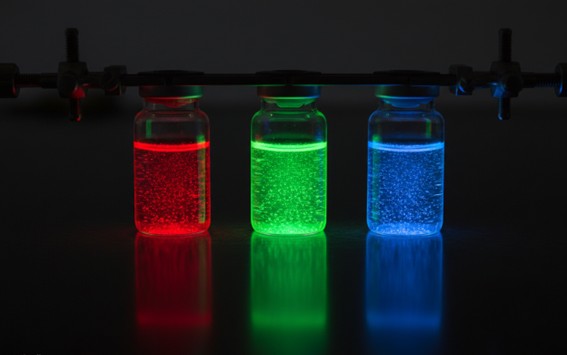 Figure 1: Colloidal quantum dot dispersions in glass vials exhibiting vivid size-tunable fluorescence under UV illumination — red, green, and blue emission from the same material platform.
At Eata Nanomaterials, our Quantum Dot Series spans the full spectrum of colloidal semiconductor nanocrystals — cadmium-based visible emitters, lead chalcogenide infrared absorbers, cadmium-free InP and CuInS2 alternatives for RoHS-sensitive applications, perovskite nanocrystals with near-unity photoluminescence quantum yield, and transition-metal-doped systems with extraordinary thermal stability. Every batch is synthesized by hot-injection organometallic chemistry in our dedicated Schlenk-line facility, purified by selective precipitation, and characterized by UV-Vis absorption, photoluminescence spectroscopy, transmission electron microscopy, and X-ray diffraction before it leaves our doors. Whether you are building next-generation displays, quantum-dot-sensitized solar cells, single-photon sources, or in vivo imaging agents, the quality of your starting nanocrystals determines the performance ceiling of your entire system.
Featured Products
| Product Category | High-Volume Search Terms / Specs | Key Application Areas |
| CdSe/ZnS Core/Shell QDs | 520-680 nm emission, PL QY 50-70%, oleic acid or amine ligands, FWHM <35 nm, dispersible in toluene or hexane | Cell tracking, multiplexed bioassays, LED color conversion, fluorescence labeling |
| CdS/ZnS Blue QDs | 420-520 nm emission, ultra-narrow FWHM <30 nm, blue-green emitter, high color purity | Micro-LED display, flow cytometry calibration, blue-channel solid-state lighting |
| CdSeTe/ZnS NIR-I QDs | 700-880 nm emission, PL QY >70%, organic or aqueous solvent, deep-tissue penetration | NIR bioimaging, tumor margin delineation, in vivo fluorescence, photodynamic therapy |
| InP/ZnS Cadmium-Free QDs | 520-750 nm emission, RoHS compliant, heavy-metal-free, batch variance <0.1%, high purity 99.9% | Consumer electronics display, eco-friendly LED, medical diagnostics, green certification products |
| PbS/CdS Core/Shell NIR-II QDs | 900-1600 nm emission, NIR-II window, enhanced charge separation, PCE boost in QDSC | Quantum dot solar cells, SWIR photodetectors, night vision, combat imaging |
| Perovskite QDs (CsPbX3) | Near-unity PL QY, narrow emission FWHM 12-40 nm, short radiative lifetime, solution-processable | Next-gen QLED display, backlight unit, visible-light communication, photocatalysis |
| CuInS2/ZnS (CIS) QDs | 540-700 nm emission, cadmium-free, PL QY 70-85%, large Stokes shift >200 nm, low toxicity | Indoor lighting, white LED with high CRI, bioimaging, environmentally friendly devices |
| Mn-Doped ZnSeS/ZnS QDs | Pure dopant emission ~580-600 nm, PL QY up to 50%, thermal stability to 500 K, long lifetime 600+ us | High-temperature LED applications, anti-counterfeiting, temperature-sensing phosphors |
| Cu-Doped ZnInS/ZnS QDs | Tunable 500-700 nm, super-large Stokes shift, white LED CRI up to 96, luminous efficiency 70-78 lm/W | Warm-white solid-state lighting, indoor illumination, high-CRI display backlight |
| Functionalized QDs | Amine -NH2, carboxyl -COOH, PEG, streptavidin surface groups, aqueous dispersible, bioconjugation-ready | Lateral flow assay, microarray diagnostics, targeted drug delivery, protein labeling |
Products in the Quantum Dot Series
CdSe/ZnS Core/Shell Quantum Dots: The Industry Benchmark
Cadmium selenide cores overcoated with zinc sulfide shells remain the workhorse of colloidal quantum dot technology. The ZnS shell passivates surface trap states that would otherwise quench radiative recombination, pushing photoluminescence quantum yields above 70 percent while preserving the narrow emission linewidth that makes QDs so attractive for display and bioimaging applications. Our CdSe/ZnS dots are synthesized by hot-injection organometallic chemistry in coordinating solvents under inert atmosphere, followed by size-selective precipitation to achieve tight diameter distributions.
- Emission range: 520 nm (green) to 680 nm (deep red), tunable by core diameter.
- Typical PL QY: 50 to 70 percent, depending on surface ligand and shell thickness.
- FWHM: <35 nm full width at half maximum for single-dot ensemble emission.
- Ligand options: oleic acid, oleylamine, carboxyl-functionalized, amine-functionalized, PEGylated.
- Solvent compatibility: toluene, hexane, chloroform, or aqueous dispersion after ligand exchange.
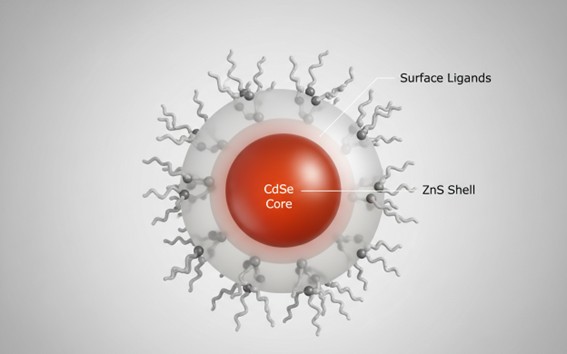 Figure 2: Schematic of a CdSe/ZnS core-shell quantum dot showing the semiconductor core, protective ZnS shell, and surface organic ligands that enable colloidal dispersion.
Lead Chalcogenide NIR Quantum Dots: Beyond the Visible
When your application demands sensitivity in the near-infrared or short-wave infrared windows — whether for deep-tissue imaging, quantum-dot-sensitized solar cells, or SWIR photodetection — lead sulfide and lead selenide quantum dots are the materials of choice. Their small effective masses and large exciton Bohr radii push the quantum confinement regime to substantially larger particle sizes than Cd-based systems, enabling strong size-tunable absorption and emission well into the 1600 nm range with synthesis routes that are by now highly mature.
- PbS QDs: oleic acid capped, 900-1600 nm emission, 10 mg/mL toluene dispersion.
- PbS/CdS core/shell: enhanced charge separation, improved stability in photovoltaic devices.
- PbSe QDs: narrower bandgap than PbS, extending further into the infrared.
Cadmium-Free Quantum Dots: RoHS-Compliant Performance
Our cadmium-free series centers on InP/ZnS for visible emission and CuInS2/ZnS for yellow-to-red wavelengths, both synthesized with the same rigor as our Cd-based products.
- InP/ZnS: emission 520-750 nm, PL QY competitive with Cd-based systems, purity >99.9 percent.
- CuInS2/ZnS (CIS): alloyed composition-tunable emission 540-700 nm, PL QY 70-85 percent.
- AgInS2/ZnS (AIS): visible emission, cadmium-free, low toxicity profile.
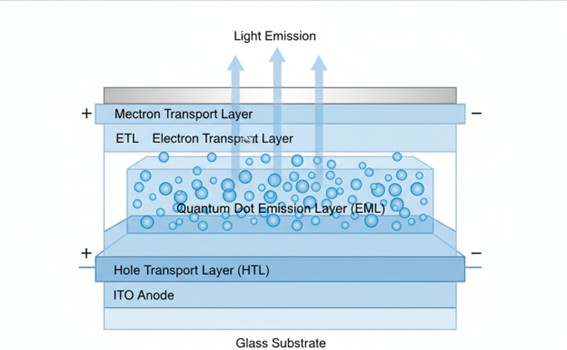 Figure 3: Cross-sectional diagram of a quantum dot light-emitting diode (QLED) showing the layer architecture from ITO anode through hole transport, quantum dot emission, and electron transport layers.
Perovskite Quantum Dots: Near-Unity Efficiency
Cesium lead halide perovskite quantum dots have redefined what is possible in colloidal nanocrystal photophysics. Their photoluminescence quantum yields approach 100 percent, their emission linewidths are narrower than those of CdSe QDs, and their short radiative lifetimes make them ideal for high-speed optoelectronic applications. CsPbX3 dots are synthesized by hot injection of cesium oleate into lead halide precursors at moderate temperatures, with halide composition controlling the bandgap across the entire visible spectrum.
- CsPbCl3: blue emission, 410-480 nm, for blue-channel display and lighting.
- CsPbBr3: green emission, 510-530 nm, highest stability among halide perovskites.
- CsPbI3: red emission, 650-700 nm, narrow FWHM ~35 nm.
- Mixed halide CsPb(Cl/Br/I)3: continuous composition tuning across the visible.
- Form factors: toluene dispersion, thin-film, or patterned by inkjet and spray coating.
Transition-Metal-Doped Quantum Dots: Thermal Stability Redefined
Standard band-edge-emitting QDs suffer from thermal quenching: as temperature rises, non-radiative recombination channels open and photoluminescence drops. Doped quantum dots solve this by localizing emission on an atomic dopant impurity within a wide-bandgap host, producing enormous Stokes shifts that eliminate self-absorption and photoluminescence that persists to temperatures above 500 K.
- Mn:ZnSeS/ZnS: pure Mn2+ dopant emission at ~580 nm, PL QY up to 50 percent, lifetime >600 us.
- Cu:ZnInS/ZnS: tunable 500-700 nm emission, super-large Stokes shift, CRI up to 96 in white LED.
- Cu:ZnSeS/ZnS: pure Cu-related PL at ~500 nm, aqueous dispersible, Pb2+ sensing capability.
Surface-Functionalized Quantum Dots for Bioconjugation
Raw oleic acid-capped QDs are hydrophobic and biologically inert. For imaging, diagnostics, and therapeutic applications, the surface must be engineered with functional groups that enable conjugation to antibodies, peptides, nucleic acids, or small-molecule drugs. We offer a comprehensive range of surface-functionalized QDs, each purified and characterized for direct use in bioconjugation workflows.
- Amine (-NH2): for EDC/NHS coupling to carboxyl-bearing biomolecules, intracellular labeling.
- Carboxyl (-COOH): for carbodiimide-mediated conjugation to amine-bearing proteins and antibodies.
- PEG: stealth coating reducing opsonization, >72 hour circulation time in vivo.
- Streptavidin: for direct binding to biotinylated probes, lateral flow assays, microarrays.
Where Our Quantum Dots Make the Difference
The breadth of applications served by our Quantum Dot Series reflects the versatility of these nanocrystals. Representative domains where Eata Nanomaterials customers are actively deploying our products include:
- Display technology: QD-enhanced LCD backlights, electroluminescent QLED pixels, micro-LED color conversion layers — all demanding narrow FWHM and high QY for wide color gamut coverage.
- Solid-state lighting: warm-white LEDs combining blue InGaN chips with yellow-to-red CIS or Cu-doped QDs, achieving CRI above 90 with luminous efficiency exceeding 70 lm/W.
- Biomedical imaging: NIR-I and NIR-II emitting QDs for deep-tissue fluorescence imaging, single-dot tracking in live cells, and super-resolution microscopy beyond the diffraction limit.
- Quantum-dot solar cells: PbS and CIS QDs as sensitizers in liquid-junction and solid-state architectures, harvesting infrared photons inaccessible to silicon.
- Photodetection and sensing: PbS SWIR detectors, Cu:ZnSeS QD-based Pb2+ ion sensors, fluorescent biosensors for diagnostic assays.
- Quantum information: single-photon emission from single QDs, entangled photon pair generation, and spin-qubit manipulation in charged quantum dots.
- Security and anti-counterfeiting: Mn-doped QDs with long luminescence lifetimes enabling time-gated authentication that organic fluorophores cannot replicate.
Characterization That Separates Us from Resellers
We synthesize, we do not merely trade. Every batch of quantum dots undergoes comprehensive in-house characterization before release. The data accompanies your order, not as a generic certificate but as a batch-specific report generated from instruments we operate and calibrate ourselves.
- UV-Vis absorption spectroscopy: first excitonic peak position confirms nanocrystal diameter and size distribution.
- Photoluminescence spectroscopy: emission peak, FWHM, and PL quantum yield measured against a calibrated standard.
- Time-resolved photoluminescence: fluorescence lifetime decay curves for understanding recombination dynamics.
- Transmission electron microscopy: direct imaging of particle size, shape, monodispersity, and core/shell morphology.
- X-ray diffraction: crystal phase confirmation (zinc blende, wurtzite, perovskite), crystallite size by Scherrer analysis.
- X-ray photoelectron spectroscopy: elemental composition, surface ligand identification, oxidation state analysis.
- Dynamic light scattering: hydrodynamic diameter in dispersion, polydispersity index, colloidal stability assessment.
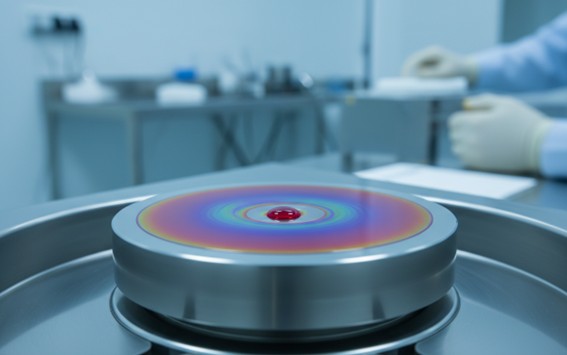 Figure 4: A spin coater in a cleanroom environment depositing a uniform quantum dot thin film onto a substrate, with characteristic interference colors indicating controlled film thickness.
Custom Quantum Dot Synthesis: Your Specifications, Our Chemistry
Catalog quantum dots cover the most common needs, but frontier research and product development routinely push beyond standard offerings. Our custom synthesis service addresses precisely that gap. We have synthesized alloyed-core CdSSe/ZnS dots with emission wavelengths intermediate between pure CdS and CdSe, produced gradient-alloy shells that minimize lattice strain at the core-shell interface, engineered dual-ligand surfaces that balance hydrophobicity and biocompatibility, and grown PbS/CdS dots with precisely tuned shell thickness for optimal charge extraction in solar cell devices.
Whether you need a non-standard emission wavelength, a specific surface chemistry for your conjugation protocol, a solvent system compatible with your processing line, or a tailored shell architecture for enhanced stability, describe your target specification and our synthetic chemists will design a route, provide a quotation, and deliver a characterized prototype batch for your evaluation.
Request a Product Data Sheet or Custom Quotation
Browse our Quantum Dot Series catalog, request detailed characterization data for any product, or describe your custom nanocrystal specification. Our team of synthetic chemists and materials scientists is available to advise on product selection, surface functionalization strategies, and integration protocols for your specific application.
| Catalog Number | Product Name | Order | Quantity |
|---|---|---|---|
| QDS-0001 | Single-Layer WS₂ Quantum Dot Powder (<10 nm) |
-
+
|
|
| QDS-0002 | Dense SiO₂-Coated Upconversion Nanoparticles (Yellow-Green Emission, ~50 nm) |
-
+
|
|
| QDS-0003 | Bare Surface Upconversion Nanoparticles (Purple-Blue Emission, ~25 nm) |
-
+
|
|
| QDS-0004 | Blue-Emitting Silicon Quantum Dot Dispersion (Aqueous) |
-
+
|
|
| QDS-0005 | Oil-Dispersible Core-Shell Upconversion Nanoparticles (Near-Infrared Emission, 804 nm) |
-
+
|
|
| QDS-0006 | Oil-Dispersible Core-Shell Upconversion Nanoparticles (Purple-Blue Emission, 365/475 nm) |
-
+
|
|
| QDS-0007 | PEG-COOH Modified Upconversion Nanoparticles (Yellow-Green Emission, ~35 nm) |
-
+
|
|
| QDS-0008 | Blue-Emitting Silicon Quantum Dot Powder (2-10 nm) |
-
+
|
|
| QDS-0009 | Bare Surface Upconversion Nanoparticles (Yellow-Green Emission, ~25 nm) |
-
+
|
|
| QDS-0010 | PEG-COOH Modified Upconversion Nanoparticles (Purple-Blue Emission, ~35 nm) |
-
+
|
For Research or Industrial Raw Materials, Not For Personal Medical Use!