

Products
- High-Quality Graphene
- CVD Graphene, Graphene-Like Materials
- Graphene-Like Series
- Defect-Free Single-Crystal Graphene and Graphene-Like Materials (Mechanical Exfoliation)
- Quantum Dot Series
- Aggregation-Induced Emission (AIE)
- Near-Infrared II (NIR-II) Fluorescent Dyes
- Graphdiyne
- Two-Dimensional Transition Metal Carbides/Nitrides/Borides (MXene)
- Metal Nanomaterials and Other Functional Bio-Nanomaterials
- Metal-Organic Frameworks (MOF)
- Covalent Organic Frameworks (COF)
- Two-Dimensional Layered Metal Oxides (LDH)
- Carbon Nanotube Powders, Pastes
- Carbon Nanotube Arrays and Special Carbon Nanotube Materials
- High-Quality Metallic and Semiconducting High-Purity Single-Walled Carbon Nanotubes
- Carbon Nanotube Sponges
- Mesoporous Carbon and Carbon Nanomaterials
- High-Quality Fullerenes
- One-Dimensional Nanomaterials
- Molecular Sieves
- Inorganic Nanomaterials
- Perovskite Materials
- Highly Oriented Pyrolytic Graphite (HOPG)
- Organic Materials
- Single-Atom Catalysts
- Thermoelectric Materials
- Sodium Storage Materials
- Industrial-Grade Nanomaterials
- Solid-State Lithium Batteries
- Hydrogel Series and Consumables
Online Inquiry
Covalent Organic Frameworks (COF)
In 2005, Omar Yaghi and his team at the University of Michigan achieved something that had long eluded materials chemists: they created the first covalent organic frameworks — crystalline, permanently porous materials constructed solely from light elements linked by strong covalent bonds. No metal nodes. No ionic coordination. Just carbon, hydrogen, boron, nitrogen, and oxygen, stitched together through reversible condensation reactions that allowed structural self-correction during assembly. The result was a new class of materials combining the crystalline order of zeolites with the synthetic tunability of organic chemistry.
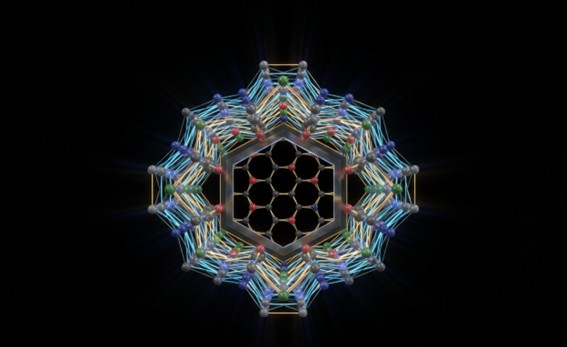 Figure 1: A two-dimensional covalent organic framework showing the highly ordered honeycomb lattice formed by organic building units connected through strong covalent bonds, with uniform hexagonal pore channels.
Unlike metal-organic frameworks that rely on metal-ligand coordination, COFs are held together by true covalent bonds — boroxine rings, boronate esters, imine linkages, hydrazone bonds, triazine rings, and more. This distinction matters enormously for certain applications. COFs are inherently lighter than MOFs because they contain no heavy metal atoms, giving them exceptionally low densities. Their thermal stability can exceed 500 C for the most robust linkages. And their all-organic composition opens pathways to applications where metal contamination is unacceptable: semiconductor devices, proton-conducting membranes, and certain biomedical formulations. At Eata Nanomaterials, we supply a comprehensive range of 2D and 3D COFs across all major linkage classes, synthesized by solvothermal, hydrothermal, room-temperature, and mechanochemical methods, each batch fully characterized for structure, porosity, and purity.
Featured Products
| COF Type | High-Volume Search Specs | Primary Applications |
| Boroxine COF-1 | BDBA self-condensation, 2D layered, 7 A pore, SSA ~711 m2/g, trigonal boroxine ring, graphite-like | Gas storage, molecular sieve, foundational research, h3 adsorption |
| Boronate Ester COF-5 | BDBA + HHTP, eclipsed AA stacking, 2.7 nm pore, SSA ~1670 m2/g, hexagonal sheets | h3 storage, CO2 capture, catalysis support, optoelectronics |
| Imine COF-LZU1 | 1,3,5-triformylbenzene + PDA, 2D eclipsed, metal ion incorporation, catalytic, Schiff base | Heterogeneous catalysis, metal coordination, Pd immobilization, Suzuki coupling |
| TpBD / TpPa Series | Beta-ketoenamine, hydrothermal synthesis, high crystallinity, ~500-1500 m2/g, enamine linkage | Water purification, dye adsorption, antimicrobial, drug delivery |
| DAAQ-COF / TFP-DAAQ | Anthraquinone redox-active, 2.3 V vs Li/Li+, battery cathode, pseudocapacitive, high capacity | Li-ion battery cathode, supercapacitor, energy storage, electrochemical device |
| Triazine CTFs | Nitrile trimerization, molten ZnCl2, high thermal stability, N-rich, tunable pore, 400C synthesis | CO2 capture, catalysis, h3 storage, proton conduction, fuel cell membrane |
| 3D COF-102/105/108 | Tetrahedral + trigonal, diamond-like topology, extremely high SSA >4000 m2/g, h3 uptake 18-19 wt% | Hydrogen storage, methane storage, gas separation, high-capacity adsorption |
| Hydrazone COF-42/43 | Hydrazide + aldehyde, H-bonding assisted, excellent stability, 620-710 m2/g, fast crystallization | Sensor, drug delivery, stable adsorption, environmental remediation |
| Olefin-Linked COFs | C=C bond, Knoevenagel condensation, irreversible, high chemical stability, sp2 carbon conjugated | Photocatalysis, semiconductor, proton conduction, fuel cell, harsh condition |
COF Products in Our Catalog
Boroxine and Boronate Ester COFs: The Originals
COF-1 and COF-5, the first covalent organic frameworks ever reported, remain important reference materials and active research platforms. COF-1 is synthesized by self-condensation of 1,4-benzenediboronic acid (BDBA) to form six-membered boroxine rings, yielding a layered hexagonal framework with 7-angstrom pores. COF-5 is produced by co-condensation of BDBA with 2,3,6,7,10,11-hexahydroxytriphenylene (HHTP), creating boronate ester linkages between trigonal building blocks and delivering surface areas exceeding 1,600 m2/g. While boroxine and boronate ester COFs have lower hydrolytic stability than their imine counterparts, they remain unmatched for fundamental studies of 2D layered porous materials.
- COF-1: BET ~711 m2/g, pore size 7 A, thermal stability to 500 C.
- COF-5: BET ~1,670 m2/g, pore size 2.7 nm, eclipsed AA stacking.
- Both available as microcrystalline powder, activated and solvent-exchanged.
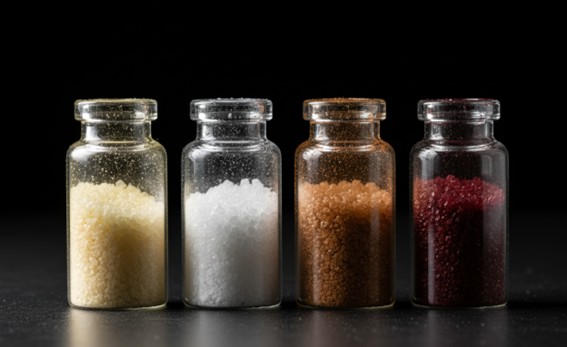 Figure 2: Crystalline covalent organic framework powder samples of different compositions in glass vials, showing the characteristic color variations from pale yellow to white to orange-brown and deep red.
Imine-Linked COFs: The Most Versatile Class
Imine linkages, formed by Schiff base condensation between aldehydes and amines, constitute the most widely used connection chemistry in COF synthesis. The C=N bond offers an optimal balance of reversibility during synthesis — enabling structural self-correction and high crystallinity — and stability in the final material. Imine COFs resist boiling water, concentrated acids, and organic solvents for days, making them suitable for catalysis, separation, and device applications that would destroy boronate-linked frameworks.
- COF-LZU1: 2D imine COF with eclipsed stacking, metal-ion chelation sites for catalysis.
- COF-366: porphyrin-containing imine COF for optoelectronic applications.
- COF-300: 3D diamond-like imine framework, BET ~1,360 m2/g, 7.8 A pore.
- Functionalized variants: Nh3, OH, SO3H, and custom substituents via linker design.
Beta-Ketoenamine COFs: Hydrothermal Robustness
The beta-ketoenamine linkage, formed by condensation of 1,3,5-triformylphloroglucinol (Tp) with aromatic diamines, introduces intramolecular O-H to N hydrogen bonding that dramatically enhances chemical stability. TpBD, TpPa-1, and TpPa-2, first developed by Banerjee and colleagues through hydrothermal synthesis, combine high crystallinity with resistance to strong acids and bases that would degrade conventional imine COFs.
- TpBD: BET ~1,500 m2/g, high chemical and thermal stability.
- TpPa-1/TpPa-2: tunable pore size via diamine linker choice.
- Synthesis: hydrothermal, room-temperature, and mechanochemical routes available.
Covalent Triazine Frameworks (CTFs): Nitrogen-Rich Architectures
Covalent triazine frameworks are synthesized by trimerization of aromatic nitriles under ionothermal conditions in molten ZnCl2 at 400 C, yielding frameworks rich in nitrogen-containing triazine rings. The high nitrogen content provides abundant binding sites for CO2, metal ions, and proton carriers, making CTFs exceptional for carbon capture and proton-conducting membrane applications.
- CTF-1: dicyanobenzene trimerization, BET ~800 m2/g.
- Modified synthesis: low-temperature polycondensation of amidines for improved crystallinity.
- N content: >20 wt%, among the highest of any porous organic material.
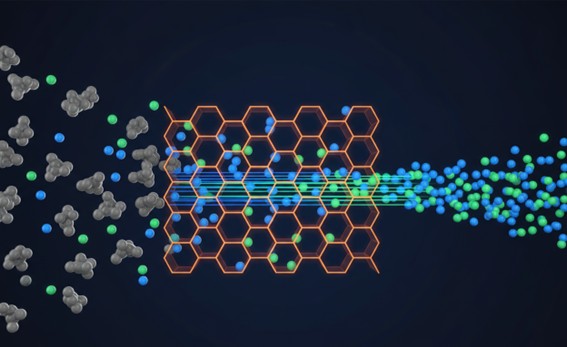 Figure 3: A covalent organic framework membrane performing selective gas separation, with smaller molecules passing through the ordered pore channels while larger molecules are blocked.
Redox-Active COFs for Energy Storage
Conventional COFs are electrochemically inert. By incorporating redox-active building blocks — anthraquinone, phenazine, viologen — into the framework backbone, COFs become active electrode materials for batteries and supercapacitors. TFP-DAAQ-COF, the first COF cathode material, delivers a redox potential of ~2.3 V versus Li/Li+ through the reversible reduction/oxidation of anthraquinone units embedded in the imine framework.
- TFP-DAAQ-COF: anthraquinone redox centers, ~2.3 V vs Li/Li+, high capacity.
- DAAQ-TFP: optimized for Li-ion battery cathode applications.
- Phenazine and viologen COFs: alternative redox platforms for aqueous energy storage.
Olefin-Linked and sp2 Carbon-Conjugated COFs
Olefin-linked COFs, formed by Knoevenagel condensation between aldehydes and benzonitriles or arylmethyl groups, feature fully conjugated C=C backbones that combine exceptional chemical stability with semiconducting properties. Unlike reversible imine or boronate linkages, olefin bonds are irreversible, yielding COFs that remain intact under the harshest chemical conditions — concentrated acid, strong base, and redox environments.
- High chemical stability: resistant to acid, base, and redox conditions.
- Conjugated backbone: semiconducting, photocatalytic, proton-conducting.
- Applications: fuel cell membranes, photocatalytic h3 evolution, organic electronics.
Application Domains Where COFs Excel
The combination of crystalline order, tunable porosity, and lightweight composition gives COFs distinctive advantages across a broad application spectrum.
- Gas storage and separation: CO2 capture with selectivity over N2 exceeding 90, h3 storage at 77 K with gravimetric capacities approaching 19 wt% for 3D COFs, and CH4 storage for vehicular applications.
- Energy storage and conversion: COF-based cathodes for Li-ion batteries, supercapacitor electrodes with pseudocapacitive charge storage, and proton-conducting membranes for fuel cells with conductivity exceeding 10-2 S/cm.
- Heterogeneous catalysis: COF-supported metal nanoparticles for Suzuki coupling, COF-anchored organocatalysts for asymmetric synthesis, and photocatalytic CO2 reduction using conjugated COFs.
- Environmental remediation: dye adsorption with capacities exceeding 1,000 mg/g, heavy metal ion capture, and oil-water separation using hydrophobic COF membranes.
- Drug delivery: pH-responsive COF carriers for controlled release, bio-MOF-like biodegradable frameworks for oral delivery, and antibiotic encapsulation in mesoporous COF cages.
- Sensing and optoelectronics: luminescent COFs for explosive and nerve agent detection, fluorescence quenching sensors for metal ions, and semiconducting COFs for organic photovoltaics.
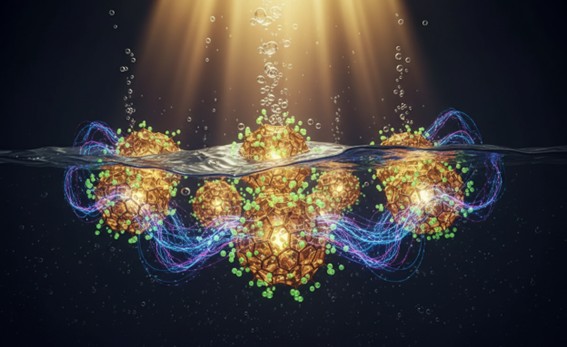 Figure 4: Covalent organic framework crystallites performing photocatalysis under visible light illumination, generating product molecules through charge transfer at the crystal surface.
Analytical Characterization: Verifying Every Framework
We characterize every COF batch with the analytical rigor that crystalline porous materials demand. The data accompanies your order as a batch-specific report.
- Powder X-ray diffraction (PXRD): crystalline phase identification, comparison to simulated pattern.
- N2 adsorption at 77 K: BET surface area, total pore volume, pore size distribution by NLDFT.
- Thermogravimetric analysis (TGA): thermal stability, solvent content, decomposition temperature.
- Scanning electron microscopy (SEM): particle morphology, size, and crystallite shape.
- Solid-state 13C NMR: linker confirmation, structural integrity assessment.
- Fourier-transform infrared (FTIR): linkage confirmation, functional group identification.
- X-ray photoelectron spectroscopy (XPS): elemental composition, bonding states.
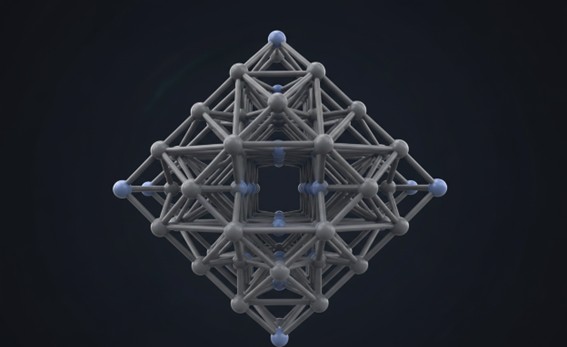 Figure 5: A three-dimensional covalent organic framework showing the extended porous network with interconnected channels running through the crystal, built entirely from organic building blocks.
Custom COF Design and Synthesis
The modular chemistry of COFs enables virtually unlimited structural customization. Our custom synthesis service leverages this design flexibility to produce frameworks tailored to specific application requirements. We have synthesized mixed-linker COFs with hierarchical pore distributions, post-synthetically modified imine COFs with sulfonic acid groups for proton conduction, metalated porphyrin COFs for biomimetic catalysis, and core-shell COF composites combining multiple functionalities. We have also developed room-temperature and mechanochemical synthesis protocols for scale-up of sensitive frameworks, and produced COF thin films on various substrates for device integration.
Describe your target pore size, linkage chemistry, functional group, or application. Our synthetic chemists will design a building-block strategy, propose a synthesis route, and deliver a purified, fully characterized batch.
Request a Data Sheet or Start a Custom Project
Browse our COF catalog, request detailed characterization data, or describe the specific framework type, linkage chemistry, or application target your research requires.
| Catalog Number | Product Name | Order | Quantity |
|---|---|---|---|
| COF-0001 | xEO_Fe2O3 Iron Oxide Nanopowder, 10-300 nm |
-
+
|
|
| COF-0002 | Aluminum Nanopowder (60 nm) |
-
+
|
|
| COF-0003 | Aluminum Nanopowder (30 nm) |
-
+
|
|
| COF-0004 | Aluminum Nanopowder (100 nm) |
-
+
|
|
| COF-0005 | xEO_Fe2O3 Iron Oxide Nanopowder |
-
+
|
|
| COF-0006 | Py-PB-COF |
-
+
|
|
| COF-0007 | Py-Py-COF |
-
+
|
|
| COF-0008 | Py-DHBD-COF |
-
+
|
|
| COF-0009 | Py-urea-COF |
-
+
|
|
| COF-0010 | Py-Bpy-COF, High purity |
-
+
|
For Research or Industrial Raw Materials, Not For Personal Medical Use!