

Magnetic Particle Surface Activation Services
Magnetic nanoparticles possess intrinsic properties that make them extraordinarily valuable for biomedical research: superparamagnetism enables rapid magnetic separation, while their high surface-area-to-volume ratio provides abundant sites for chemical functionalization. However, bare iron oxide surfaces exhibit limited chemical reactivity, nonspecific protein binding, and poor colloidal stability in biological media. Surface activation transforms these limitations into opportunities.
At Eata Nanomaterials, our magnetic particle surface activation services equip iron oxide nanoparticles with precisely defined reactive functionalities. Through carefully optimized activation protocols, we convert native oxide surfaces into versatile platforms ready for antibody coupling, nucleic acid attachment, targeting ligand display, and stimulus-responsive payload release.
 Figure 1: Iron oxide magnetic nanoparticle powder prepared for surface activation and functionalization.
Surface Chemistry and Activation Strategies
The activation pathway begins with understanding the native surface chemistry of iron oxide nanoparticles. As-synthesized magnetite and maghemite surfaces present hydroxyl groups formed through surface hydration and oxidation. These hydroxyls serve as anchor points for introducing functional molecules through condensation, coordination, or covalent coupling reactions.
We employ several complementary strategies to activate magnetic particle surfaces:
- Carboxyl activation using EDC/Sulfo-NHS chemistry to form stable NHS ester intermediates that react with primary amines on proteins, peptides, and antibodies
- Amino functionalization via APTES silanization or polyethylenimine coating, creating surfaces rich in primary amines for coupling with activated carboxyl-containing molecules
- Thiol introduction through MPTMS silanization or Traut's reagent treatment, enabling maleimide-thiol conjugation with sulfhydryl-bearing biomolecules
- Aldehyde generation through periodate oxidation of surface glycols or glutaraldehyde crosslinking, facilitating reductive amination with amine-containing ligands
- Azide/alkyne installation for bioorthogonal click chemistry, enabling highly specific coupling without interfering with native biological functionality
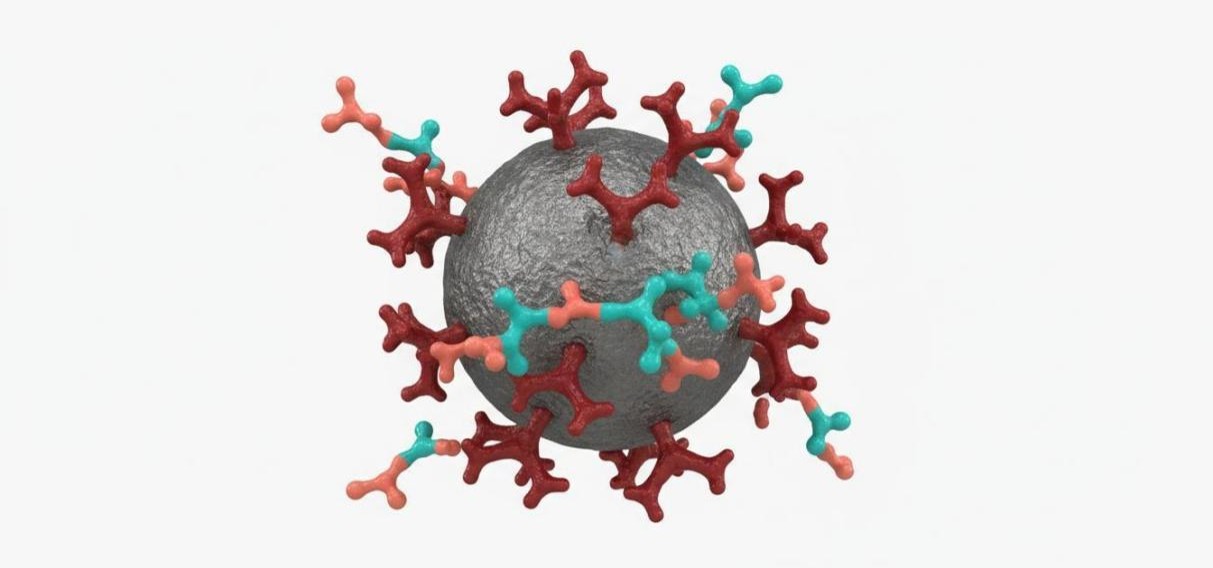 Figure 2: A molecular visualization of activation reagents interacting with functional groups on a magnetic nanoparticle surface.
EDC/NHS Carboxyl Activation Protocol
The EDC/NHS coupling system represents the most widely employed activation chemistry for magnetic particles. This two-step aqueous protocol converts surface carboxyl groups into highly reactive NHS esters that form stable amide bonds with primary amines on target biomolecules.
Our optimized EDC/NHS activation workflow proceeds as follows:
Step 1: Surface preparation: Magnetic particles are washed thoroughly in activation buffer (typically 50 mM MES, pH 6.0) to remove storage solutions and expose surface carboxyl groups. Buffers containing competing carboxylates or amines are strictly avoided.
Step 2: EDC activation: Carboxyl groups react with EDC (1-ethyl-3-(3-dimethylaminopropyl)carbodiimide) to form unstable O-acylisourea intermediates. EDC is freshly prepared immediately before use due to its susceptibility to hydrolysis.
Step 3: Sulfo-NHS stabilization: Sulfo-NHS (N-hydroxysulfosuccinimide) reacts with the O-acylisourea intermediate to produce a stable sulfo-NHS ester. This ester remains reactive toward primary amines but does not undergo rapid hydrolysis, extending the coupling window and improving conjugation efficiency.
Step 4: Biomolecule coupling: The activated particles are incubated with the target biomolecule (antibody, protein, peptide, or oligonucleotide) in coupling buffer (PBS, pH 7.2-8.5), during which primary amines on the biomolecule attack the NHS ester, forming stable amide bonds.
Step 5: Quenching: Residual NHS esters are blocked with ethanolamine, Tris, or glycine to prevent nonspecific reactions during subsequent use.
Typical activation parameters: EDC concentration 5-50 mM, Sulfo-NHS 5-20 mM, activation time 15-30 minutes, coupling time 1-4 hours at room temperature or overnight at 4 degrees Celsius.
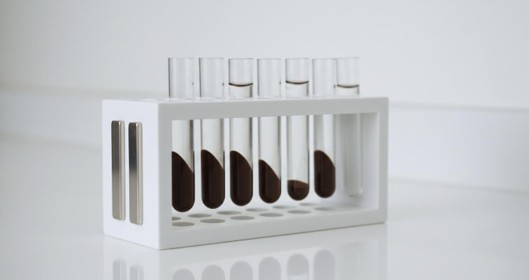 Figure 3: Magnetic separation rack efficiently concentrating activated magnetic particles against the tube walls for buffer exchange and washing.
Silica Coating for Enhanced Surface Activation
Silica coating magnetic nanoparticles prior to surface activation provides multiple advantages: enhanced chemical stability, protection of the magnetic core from oxidation and acid dissolution, and a silanol-rich surface ideal for versatile silane-based functionalization. Our silica coating services for magnetic particles include:
- Direct sol-gel silica coating via the Stober method, producing uniform silica shells with tunable thickness from 5 to 100 nanometers
- PMIDA-assisted silica coating achieving exceptionally high specific surface areas up to 203 m2/g and amino group densities of 1.1 mmol/g
- Mesoporous silica coating creating high-surface-area frameworks with controlled pore sizes for drug loading and controlled release applications
- Fluorescent silica doping incorporating organic dyes within the silica matrix for traceable multimodal imaging platforms
Following silica coating, the particle surface presents abundant silanol groups that readily react with organofunctional silanes. APTES silanization introduces amino groups, while MPTMS introduces thiol groups, dramatically expanding the bioconjugation toolkit available for downstream applications.
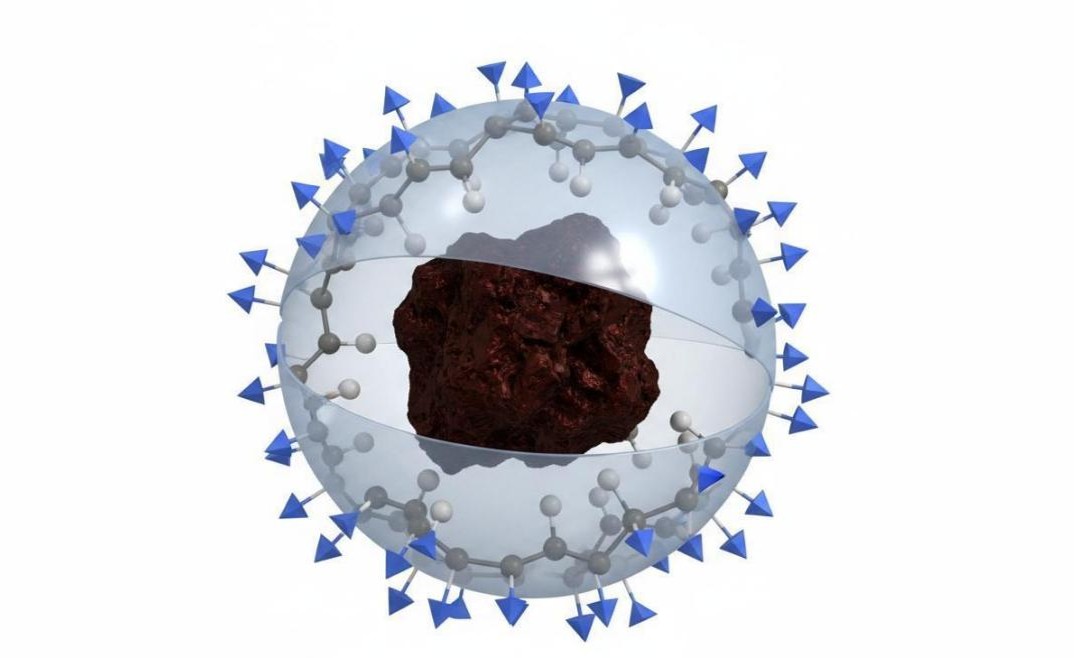 Figure 4: A silica-coated magnetic nanoparticle with APTES surface functionalization presenting reactive amino groups for bioconjugation.
Analytical Verification of Surface Activation
Rigorous characterization confirms the success of each surface activation step and ensures batch-to-batch reproducibility. Our quality control protocols include:
| Technique | Information Provided |
| Zeta Potential | Surface charge changes confirming functional group introduction; |zeta| > 30 mV indicates good colloidal stability |
| Dynamic Light Scattering | Hydrodynamic diameter changes indicating coating thickness and aggregation state |
| FTIR Spectroscopy | Characteristic vibrational modes of introduced functional groups and coupled ligands |
| X-ray Photoelectron Spectroscopy | Elemental composition and chemical states of surface atoms post-functionalization |
| Thermogravimetric Analysis | Organic content quantification and grafting density calculations |
| Magnetic Measurements (SQUID/VSM) | Saturation magnetization, coercivity, and confirmation of superparamagnetic behavior |
Research Applications of Activated Magnetic Particles
Surface-activated magnetic particles from Eata Nanomaterials enable diverse cutting-edge research applications:
- Magnetic-activated cell sorting (MACS): Antibody-functionalized magnetic particles selectively bind and isolate target cell populations from heterogeneous mixtures using external magnetic fields
- Immunoassay development: Carboxyl-activated magnetic beads serve as solid-phase supports for capture antibody immobilization in ELISA, chemiluminescence, and electrochemical assay formats
- Nucleic acid extraction: Amino-functionalized magnetic silica particles reversibly bind DNA and RNA under chaotropic salt conditions, enabling rapid nucleic acid purification from complex biological matrices
- Targeted drug delivery: Activated magnetic carriers conjugated with targeting ligands and therapeutic payloads enable magnetically guided delivery to specific tissues or cells
- Magnetic hyperthermia: Surface-functionalized particles with optimized colloidal stability and targeting capabilities enhance heat deposition efficiency at tumor sites under alternating magnetic fields
- Protein immobilization: Activated magnetic supports covalently bind enzymes and proteins while retaining catalytic activity, enabling recyclable biocatalysis and biosensing platforms
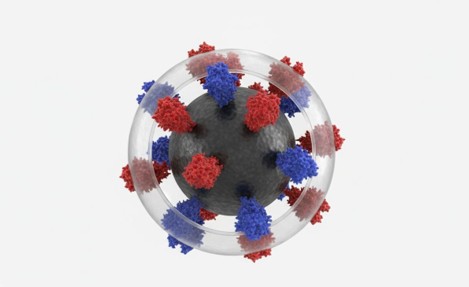 Figure 5: An activated magnetic nanoparticle displaying multiple surface functional groups available for downstream bioconjugation.
Bioconjugation Compatibility Matrix
| Surface Functionality | Compatible Biomolecules | Coupling Chemistry |
| Carboxyl (-COOH) | Antibodies, proteins, peptides, amine-modified DNA | EDC/NHS amide coupling |
| Amino (-NH2) | Carboxyl-modified proteins, NHS-ester dyes, activated antibodies | EDC/NHS or glutaraldehyde |
| Thiol (-SH) | Maleimide-modified proteins, cysteine-tagged peptides | Maleimide-thiol click |
| Aldehyde (-CHO) | Primary amine-containing molecules | Reductive amination |
| Azide (-N3) | Alkyne-modified proteins, DBCO-labeled ligands | CuAAC or SPAAC click |
Partner with Eata Nanomaterials for Magnetic Particle Activation
Whether your research demands carboxyl-functionalized beads for antibody capture, amino-rich surfaces for nucleic acid binding, or complex multifunctional architectures combining targeting, imaging, and therapeutic modalities, our magnetic particle surface activation services provide the chemical precision and analytical rigor your work requires.
Contact our technical specialists to discuss your activation requirements, review available functionalization options, and obtain a customized project proposal tailored to your research objectives.