

Products
- High-Quality Graphene
- CVD Graphene, Graphene-Like Materials
- Graphene-Like Series
- Defect-Free Single-Crystal Graphene and Graphene-Like Materials (Mechanical Exfoliation)
- Quantum Dot Series
- Aggregation-Induced Emission (AIE)
- Near-Infrared II (NIR-II) Fluorescent Dyes
- Graphdiyne
- Two-Dimensional Transition Metal Carbides/Nitrides/Borides (MXene)
- Metal Nanomaterials and Other Functional Bio-Nanomaterials
- Metal-Organic Frameworks (MOF)
- Covalent Organic Frameworks (COF)
- Two-Dimensional Layered Metal Oxides (LDH)
- Carbon Nanotube Powders, Pastes
- Carbon Nanotube Arrays and Special Carbon Nanotube Materials
- High-Quality Metallic and Semiconducting High-Purity Single-Walled Carbon Nanotubes
- Carbon Nanotube Sponges
- Mesoporous Carbon and Carbon Nanomaterials
- High-Quality Fullerenes
- One-Dimensional Nanomaterials
- Molecular Sieves
- Inorganic Nanomaterials
- Perovskite Materials
- Highly Oriented Pyrolytic Graphite (HOPG)
- Organic Materials
- Single-Atom Catalysts
- Thermoelectric Materials
- Sodium Storage Materials
- Industrial-Grade Nanomaterials
- Solid-State Lithium Batteries
- Hydrogel Series and Consumables
Online Inquiry
Inorganic Nanomaterials
Shrinking inorganic solids to the nanoscale transforms their behavior in ways that confound intuition. A ceramic that is brittle in bulk form becomes mechanically resilient when fashioned into nanoscale grains. A metal oxide that absorbs only ultraviolet light in the macroscopic world develops visible-range photocatalytic activity when its crystal size falls below the exciton Bohr radius. A particle of iron oxide that is merely magnetic in the millimeter domain becomes superparamagnetic — switching its magnetization direction in response to thermal energy alone — when its diameter drops below 20 nanometers. These are not incremental improvements; they are qualitative shifts that open entirely new application spaces for materials humanity has studied for centuries.
Eata Nanomaterials produces a comprehensive range of inorganic nanomaterials spanning metal oxides, semiconductor quantum dots, mesoporous silica, alumina, ceria, and functional ceramics. Our metal oxide portfolio includes TiO2 for photocatalysis and solar energy conversion, ZnO for UV optoelectronics and antimicrobial coatings, Fe2O3 and Fe3O4 for magnetic separation and catalysis, CuO for electrochemical sensing, CeO2 for automotive catalytic converters and polishing, and Al2O3 for ceramic reinforcement and abrasive applications. Beyond oxides, we supply colloidal quantum dots of CdSe, ZnS, and perovskite halides for displays and bioimaging, as well as noble metal nanoparticles of Au, Ag, and Pt for plasmonics and catalysis. Each material is available as a powder, aqueous dispersion, or functionalized surface coating — with full characterization data accompanying every shipment.
Metal Oxide Nanoparticles: TiO2, ZnO, Fe2O3, CuO, CeO2, Al2O3
Metal oxide nanoparticles constitute the most extensively studied and broadly applied class of inorganic nanomaterials, owing to their structural diversity, tunable bandgaps, chemical stability, and cost-effective synthesis. Our TiO2 nanoparticles, produced by the sulfate process or sol-gel methods and available in anatase and rutile phases, deliver surface areas of 50–300 m^2/g with primary particle sizes from 10 to 100 nm. The anatase phase is preferred for photocatalytic applications — photocatalytic degradation of organic pollutants, dye-sensitized solar cells, and self-cleaning coatings — due to its optimal conduction band edge position and low electron-hole recombination rate. Surface modification with noble metals (Pt, Au) or coupling with graphene oxide further enhances photocatalytic quantum efficiency.
ZnO nanoparticles occupy a unique position due to their direct wide bandgap (3.37 eV), large exciton binding energy (60 meV), and inherent biocompatibility. These attributes render ZnO suitable for UV-absorbing sunscreens, antimicrobial coatings, gas sensors, and photocatalytic systems. Our Fe2O3 (hematite) and Fe3O4 (magnetite) nanoparticles serve as catalysts for water splitting and Fenton reactions, as contrast agents for MRI, and as magnetic carriers for targeted drug delivery and cell separation. CuO nanoparticles function as p-type semiconductor materials for gas sensors and electrochemical electrodes, while CeO2 nanoparticles leverage their exceptional oxygen storage capacity and redox properties for automotive three-way catalytic converters, fuel additives, and chemical mechanical polishing. Al2O3 nanoparticles reinforce ceramic matrices, serve as abrasive particles in CMP slurries, and function as catalyst supports in petrochemical processes.
 Collection of metal oxide nanopowders in glass dishes showing the diverse colors of TiO2, ZnO, Fe2O3, CuO, and Al2O3
Semiconductor Quantum Dots: CdSe, ZnS, and Perovskite Halides
Quantum dots are nanoscale semiconductor crystals whose electronic properties are governed by quantum confinement: when the particle diameter becomes comparable to or smaller than the bulk exciton Bohr radius, the continuous energy bands of the bulk material discretize into quantized energy levels, and the bandgap increases with decreasing size. This size-tunable bandgap enables quantum dots to emit light across the entire visible spectrum simply by adjusting their diameter — a property exploited in next-generation displays, solar concentrators, and biological imaging probes.
Our CdSe/ZnS core-shell quantum dots feature a CdSe core encapsulated by a wider-bandgap ZnS shell that passivates surface trap states, delivering photoluminescence quantum yields exceeding 85% with narrow emission linewidths (full width at half maximum below 30 nm). Emission wavelengths span 480–650 nm corresponding to core diameters of 2–6 nm. For visible-light-driven photocatalysis and LED applications, we supply lead halide perovskite quantum dots (CsPbX3, where X = Cl, Br, I or mixed halides) with photoluminescence quantum yields approaching 90% and high defect tolerance that simplifies synthesis and processing. All quantum dot products are supplied as colloidal dispersions in toluene or hexane, or as thin films on glass substrates.
 Semiconductor quantum dot nanoparticle emitting a spectrum of colors due to size-tunable quantum confinement effects
Mesoporous Silica and Alumina Nanoparticles
Silica (SiO2) and alumina (Al2O3) nanoparticles represent workhorse inorganic materials whose utility expands dramatically at the nanoscale. Our mesoporous silica nanoparticles (MSNs), synthesized through surfactant-templated sol-gel processes, feature highly ordered pore structures — hexagonal MCM-41, cubic MCM-48, or large-pore SBA-15 — with surface areas reaching 1200 m^2/g, pore volumes up to 1.5 cm^3/g, and pore diameters tunable from 2 to 10 nm. These characteristics make MSNs exceptional platforms for drug delivery, where the mesopores encapsulate therapeutic molecules and the silica surface functionalized with targeting ligands directs the carrier to specific cells or tissues. The biocompatibility and biodegradability of silica further support translational biomedical research.
Alumina nanoparticles, available as gamma-phase (high surface area, catalytically active) or alpha-phase (thermally stable, mechanically hard), serve as abrasive particles in chemical mechanical planarization (CMP) slurries for semiconductor wafer polishing, as catalyst supports in hydrotreating and hydrocracking, and as reinforcing fillers in ceramic matrix composites. Ceria (CeO2) nanoparticles complement alumina in CMP applications, particularly for dielectric film polishing, due to their unique tribochemical properties. The coexisting Ce(III)/Ce(IV) redox couple at the nanoscale creates oxygen vacancies and defect sites that enhance chemical reactivity during polishing, enabling superior surface finish at lower mechanical stress.
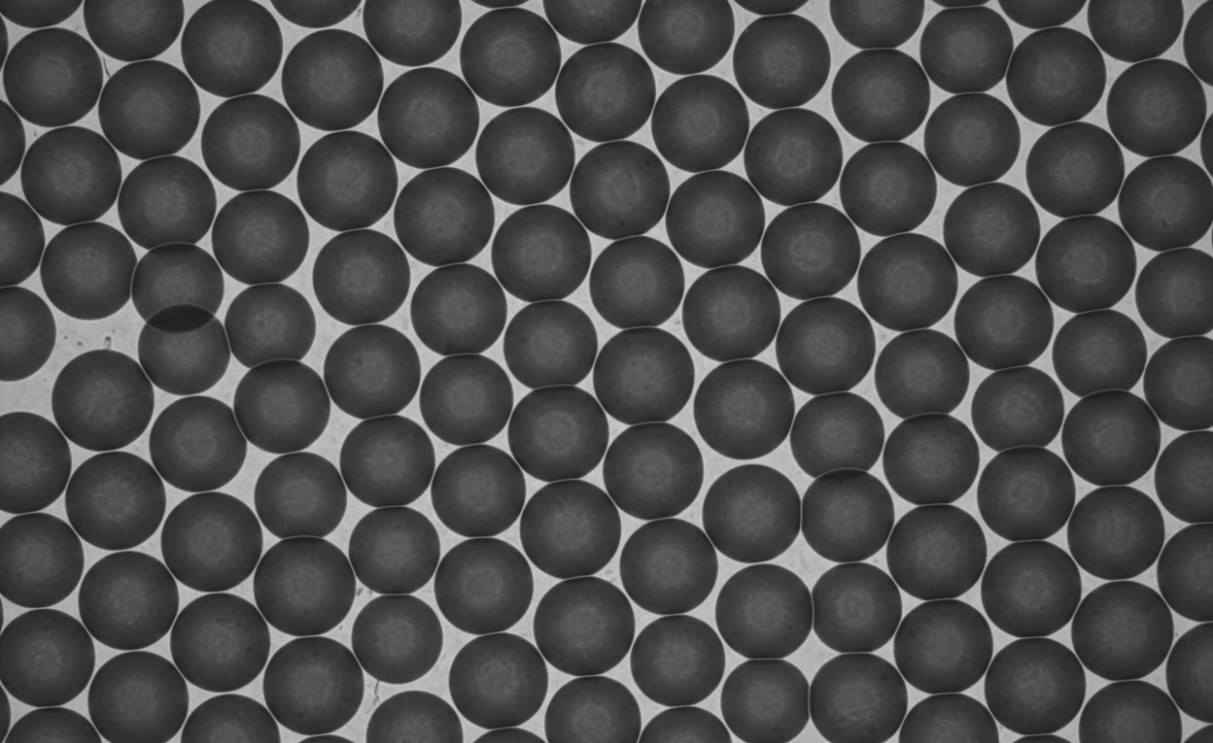 Transmission electron micrograph of monodisperse spherical silica nanoparticles arranged in a hexagonal close-packed pattern
Noble Metal Nanoparticles: Au, Ag, and Pt
Noble metal nanoparticles — gold, silver, and platinum — derive their technological value from localized surface plasmon resonance (LSPR), a collective oscillation of conduction electrons that produces intense absorption and scattering peaks in the visible to near-infrared range. For gold nanoparticles, the LSPR peak shifts from 520 nm for 3 nm spheres to beyond 700 nm for larger particles or anisotropic shapes such as nanorods, enabling precise tuning of optical response for sensing, imaging, and photothermal therapy applications. Our gold nanoparticles are synthesized by the citrate reduction method or seed-mediated growth, with diameters from 3 to 200 nm and optional surface functionalization with carboxyl, amine, PEG, or antibody conjugates.
Silver nanoparticles exhibit the strongest LSPR intensity among noble metals and serve as the active component in plasmon-enhanced Raman scattering (SERS) substrates capable of detecting single molecules, as well as in antimicrobial coatings for medical devices and textiles. Platinum nanoparticles function as high-activity catalysts for fuel cell electrodes, automotive catalytic converters, and organic synthesis reactions where their high surface-to-volume ratio maximizes catalytic site exposure. We supply all noble metal nanoparticles as aqueous or organic dispersions with narrow size distributions (polydispersity index below 0.2) and customizable surface chemistry.
 Glass vials containing gold nanoparticle dispersion showing ruby-red color from surface plasmon resonance and silver nanoparticle solution
Synthesis Methods: Sol-Gel, Hydrothermal, and Chemical Precipitation
The synthesis method profoundly influences the properties of inorganic nanomaterials. Our sol-gel processes produce metal oxide nanoparticles with precise control over particle size, crystallinity, and surface chemistry through controlled hydrolysis and condensation of metal alkoxide or salt precursors in alcohol-water mixtures. Surfactants and capping agents direct morphology toward spheres, rods, or plates, while calcination temperature tunes crystalline phase. Hydrothermal and solvothermal methods — conducting reactions in aqueous or organic solvents above 100 C under autogenous pressure — yield highly crystalline products with narrow size distributions, particularly effective for TiO2, ZnO, and iron oxide nanoparticles.
Chemical precipitation offers a scalable route to metal oxide and hydroxide nanoparticles through controlled nucleation and growth from supersaturated solutions. Co-precipitation of multiple metal salts enables the synthesis of complex oxides, doped structures, and core-shell architectures in a single step. For magnetic nanoparticles, thermal decomposition of metal acetylacetonates or oleates in high-boiling organic solvents produces monodisperse spheres with exceptional crystallinity and tunable sizes from 5 to 50 nm. We select the synthesis method based on the target material, required specifications, and intended application, ensuring that each product delivers the structural and chemical attributes demanded by its use case.
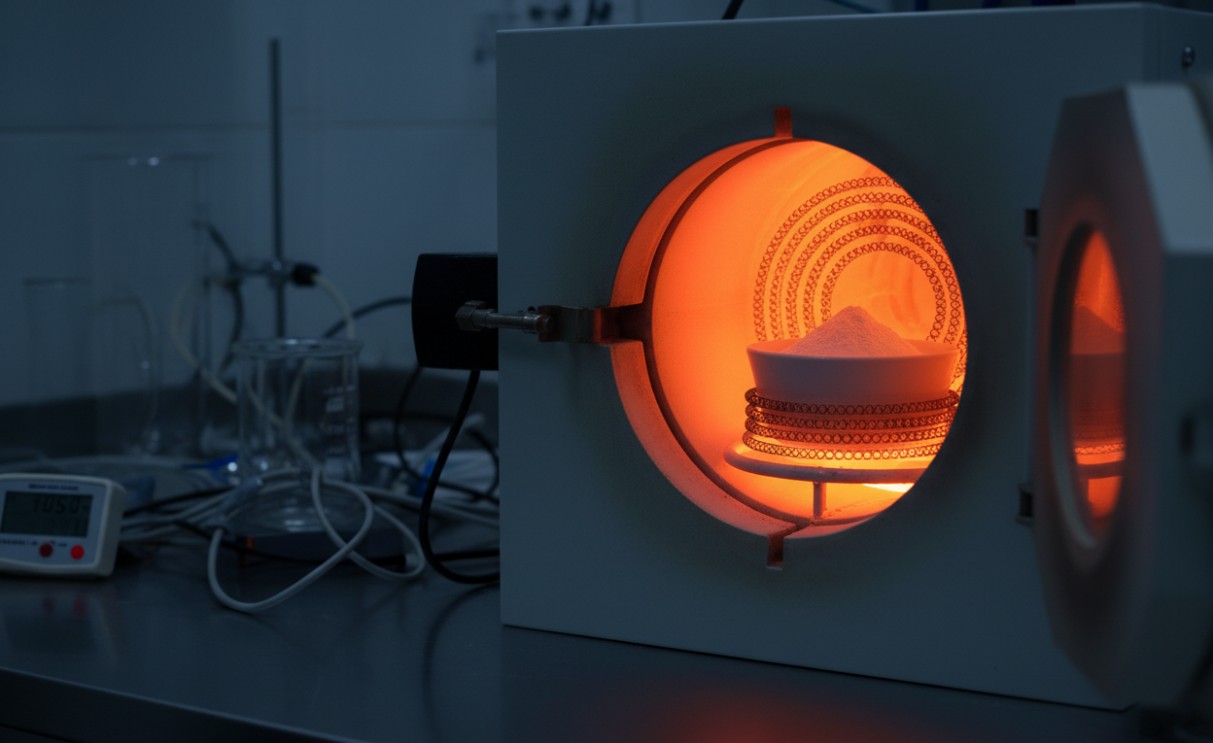 High-temperature laboratory furnace with alumina nanopowder in a ceramic crucible during calcination processing
Featured Products
| Products | Specifications | Applications |
| TiO2 nanoparticles | Phase: anatase/rutile; Size: 10-100 nm; SSA: 50-300 m^2/g | Photocatalysis, DSSC, sunscreens |
| ZnO nanoparticles | Bandgap: 3.37 eV; Wurtzite; Size: 20-200 nm | UV absorption, antimicrobial, sensors |
| Fe3O4 nanoparticles | Size: 5-50 nm; Superparamagnetic; Sat. M: >60 emu/g | MRI, drug delivery, catalysis |
| CdSe/ZnS quantum dots | Core-shell; QY: >85%; Emission: 480-650 nm | Displays, bioimaging, solar |
| Mesoporous SiO2 | Pore: 2-10 nm; SSA: up to 1200 m^2/g | Drug delivery, catalysis |
| Al2O3 nanoparticles | Gamma/alpha phase; Size: 20-500 nm | CMP, ceramics, catalyst support |
| CeO2 nanoparticles | Fluorite; Ce3+/Ce4+ redox; Size: 10-200 nm | Catalysis, CMP, fuel additive |
| Au/Ag nanoparticles | Diameter: 3-200 nm; LSPR tunable; PDI <0.2 | SERS, photothermal, antimicrobial |
Application Landscape
Photocatalysis: TiO2 and ZnO nanoparticles degrade organic pollutants in water and air under UV or visible light, while iron oxides drive photo-Fenton reactions for recalcitrant contaminant removal.
Energy Conversion and Storage: TiO2 serves in dye-sensitized solar cells and battery anodes; CeO2 supports solid oxide fuel cells; quantum dots enhance photovoltaic and LED efficiency.
Catalysis: Pt, Pd, and CeO2 nanoparticles accelerate reactions in automotive converters, fuel cells, and petrochemical processing; Al2O3 and SiO2 function as high-surface-area catalyst supports.
Biomedical Imaging and Therapy: Iron oxide nanoparticles enable MRI contrast and magnetic hyperthermia; gold nanoparticles support photothermal therapy and biosensing; quantum dots deliver targeted bioimaging.
Gas Sensing: ZnO, SnO2, and CuO nanoparticles detect trace gases at ppb concentrations through surface resistance changes, serving environmental monitoring and industrial safety applications.
Semiconductor Polishing: SiO2, CeO2, and Al2O3 nanoparticles function as abrasives in CMP slurries, achieving nanometer-scale surface flatness for wafer processing.
Quality Control and Characterization
Every batch of inorganic nanomaterials undergoes comprehensive characterization before release. Powder X-ray diffraction (XRD) identifies crystalline phase and estimates crystallite size via the Scherrer equation. Transmission electron microscopy (TEM) documents particle morphology, size, and aggregation state. Dynamic light scattering (DLS) measures hydrodynamic diameter and polydispersity index in dispersion. Nitrogen adsorption-desorption isotherms determine BET surface area and pore size distribution for mesoporous materials. UV-Vis spectroscopy records optical absorption spectra and quantifies plasmon peak position for metal nanoparticles. Thermogravimetric analysis evaluates thermal stability and quantifies residual organic content. For magnetic nanoparticles, vibrating sample magnetometry measures saturation magnetization and coercivity. All data are compiled into a certificate of analysis provided with every shipment.
Custom Synthesis and Surface Functionalization
We offer extensive customization services for inorganic nanomaterials to meet specialized research and industrial requirements. Our capabilities include metal ion doping — incorporating Ag, Cu, N, or S into TiO2 to extend photocatalytic activity into the visible range; surface functionalization with silanes, carboxylic acids, or polymers to improve dispersion stability and biocompatibility; core-shell architecture fabrication such as Fe3O4@SiO2 for magnetic separation with protected surfaces; morphology control to produce nanorods, nanoplates, or nanocubes instead of spherical particles; and scale-up from gram-level laboratory batches to kilogram and metric-ton industrial production. Whether your project requires a novel composition, a specific surface chemistry, or a tailored particle morphology, our synthesis team is prepared to develop and deliver materials that match your exact specifications.
Contact Us— Reach out to Eata Nanomaterials to discuss your inorganic nanomaterial requirements, request product samples, or explore a custom synthesis engagement tailored to your research or industrial application.
| Catalog Number | Product Name | Order | Quantity |
|---|---|---|---|
| INON-0001 | PVP-Modified Titanium Dioxide Nanoparticles (Aqueous Dispersion) |
-
+
|
|
| INON-0002 | Cerium Oxide Nanocubes (CeO₂) |
-
+
|
|
| INON-0003 | Zinc Oxide Nanorod and Nanosheet Mixture |
-
+
|
|
| INON-0004 | Tungsten Carbide Nanoparticles (WC) |
-
+
|
|
| INON-0005 | Fluorescent Silica Nanoparticles (FITC-Labeled, Green Emission) |
-
+
|
|
| INON-0006 | Single-Pass AAO Template (50 nm Pore Diameter), 2 cm x 2 cm (square) |
-
+
|
|
| INON-0007 | V-Type AAO Template (90 nm Top / 40 nm Bottom) |
-
+
|
|
| INON-0008 | Gallium Nitride Nanoparticles (GaN) |
-
+
|
|
| INON-0009 | Hollow Mesoporous Manganese Dioxide Nanoparticles |
-
+
|
|
| INON-0010 | Bismuth Oxychloride Nanoplates (BiOCl) |
-
+
|
For Research or Industrial Raw Materials, Not For Personal Medical Use!