

Products
- High-Quality Graphene
- CVD Graphene, Graphene-Like Materials
- Graphene-Like Series
- Defect-Free Single-Crystal Graphene and Graphene-Like Materials (Mechanical Exfoliation)
- Quantum Dot Series
- Aggregation-Induced Emission (AIE)
- Near-Infrared II (NIR-II) Fluorescent Dyes
- Graphdiyne
- Two-Dimensional Transition Metal Carbides/Nitrides/Borides (MXene)
- Metal Nanomaterials and Other Functional Bio-Nanomaterials
- Metal-Organic Frameworks (MOF)
- Covalent Organic Frameworks (COF)
- Two-Dimensional Layered Metal Oxides (LDH)
- Carbon Nanotube Powders, Pastes
- Carbon Nanotube Arrays and Special Carbon Nanotube Materials
- High-Quality Metallic and Semiconducting High-Purity Single-Walled Carbon Nanotubes
- Carbon Nanotube Sponges
- Mesoporous Carbon and Carbon Nanomaterials
- High-Quality Fullerenes
- One-Dimensional Nanomaterials
- Molecular Sieves
- Inorganic Nanomaterials
- Perovskite Materials
- Highly Oriented Pyrolytic Graphite (HOPG)
- Organic Materials
- Single-Atom Catalysts
- Thermoelectric Materials
- Sodium Storage Materials
- Industrial-Grade Nanomaterials
- Solid-State Lithium Batteries
- Hydrogel Series and Consumables
Online Inquiry
Carbon Nanotube Sponges
Imagine a solid material so light it can rest on a flower petal without bending it, so elastic it rebounds from 95% compression as though nothing happened, and so riddled with pores that over 99% of its volume is empty space. Carbon nanotube sponges — self-assembled three-dimensional networks of interconnected multi-walled nanotubes — bring this remarkable combination of properties into the laboratory and the factory floor. Through chemical vapor deposition (CVD) using ferrocene catalyst and carbon precursors such as dichlorobenzene or acetylene, nanotubes nucleate, elongate, and entangle into a hierarchical scaffold where individual tubes bond at contact points, creating a freestanding monolithic body that behaves as a single coherent material rather than a loose powder.
At Eata Nanomaterials, we synthesize CNT sponges with bulk densities as low as 2 mg/cm^3 — roughly one-fifth the density of air at sea level — yet these featherweight structures withstand thousands of compression cycles, absorb organic solvents at ratios approaching 180 times their own mass, block electromagnetic interference exceeding 75 dB, and insulate thermally with conductivity below 15 mW/mK. The secret lies in the architecture: the nanotube skeleton provides mechanical resilience and electrical continuity, while the vast interconnected pore space stores fluids, traps radiation, and arrests heat flow. Whether your work involves environmental remediation, thermal management, electromagnetic shielding, or flexible sensing, our CNT sponges provide a ready-to-use platform that few alternative materials can match.
Three-Dimensional Architecture and CVD Synthesis
Under the transmission electron microscope, a CNT sponge reveals its internal grammar: multi-walled nanotubes 30–50 nm in diameter and tens of micrometers long, randomly oriented and physically interlocked at junction points. These junctions form naturally during CVD growth as neighboring tubes come into contact and develop carbon-carbon bonds or amorphous carbon welds that lock the network in place. The resulting pore structure spans multiple length scales — macropores tens of microns across permit rapid fluid infiltration, while mesopores between entangled tube bundles contribute to enormous surface areas accessible for adsorption and catalysis.
Our synthesis platform employs floating-catalyst CVD in horizontal tube furnaces. Ferrocene vapor mixed with a carbon source — typically 1,2-dichlorobenzene or acetylene — decomposes at 800–1200 C in a hydrogen-argon carrier stream. The as-grown sponge is collected as a free-standing monolith from the cool zone downstream. Post-synthesis, we optionally deposit conformal amorphous carbon coatings onto tube surfaces and junctions by introducing a controlled acetylene pulse at lower temperature. This treatment thickens the nanotube struts, welds junctions more robustly, and dramatically narrows stress-strain hysteresis — reducing energy loss coefficients from over 75% to below 20% — yielding a superelastic material that recovers almost instantaneously even after extreme deformation.
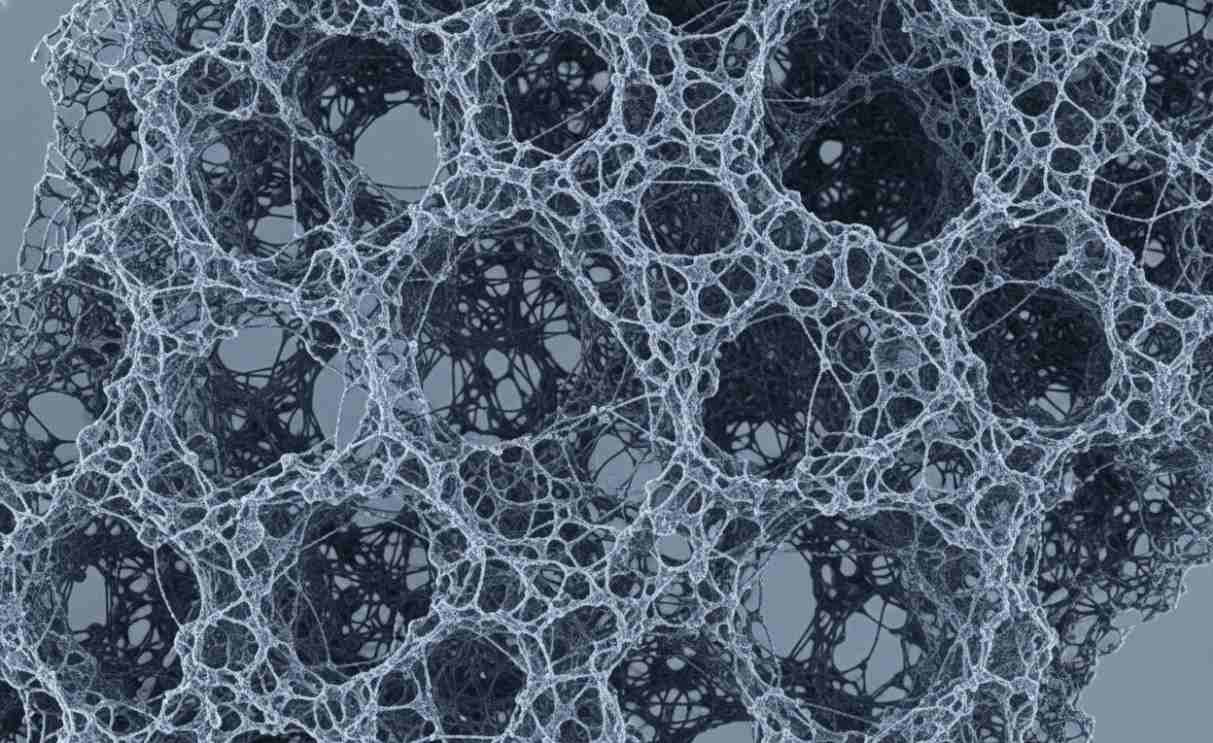 Scanning electron micrograph showing the interconnected three-dimensional network structure of a carbon nanotube sponge
Superelasticity and Cyclic Mechanical Stability
No conventional foam survives what a CNT sponge endures with ease. Our amorphous-carbon-reinforced sponges recover 95% of their original height after compression to 96% strain, and maintain this performance through over 1000 loading-unloading cycles with stress retention above 85%. The stress-strain profile under uniaxial compression divides naturally into three regions: a linear elastic zone at low strain where the nanotube skeleton bends, a plateau where pore walls buckle cooperatively, and a densification regime at high strain where opposing surfaces meet and the modulus rises sharply.
Unlike polymeric foams that suffer permanent creep and stress relaxation, CNT sponges show frequency-invariant electromechanical stability under cyclic compression — a property tracked over 3.5 million cycles in published studies without catastrophic failure. The elastic modulus scales predictably with bulk density, ranging from a few kilopascals for our lightest specimens (2 mg/cm^3) to hundreds of kilopascals for densified blocks. Researchers exploit this tunable compliance by specifying density and carbon coating thickness to match the mechanical requirements of their application, from soft tissue-mimicking scaffolds to stiff structural fillers.
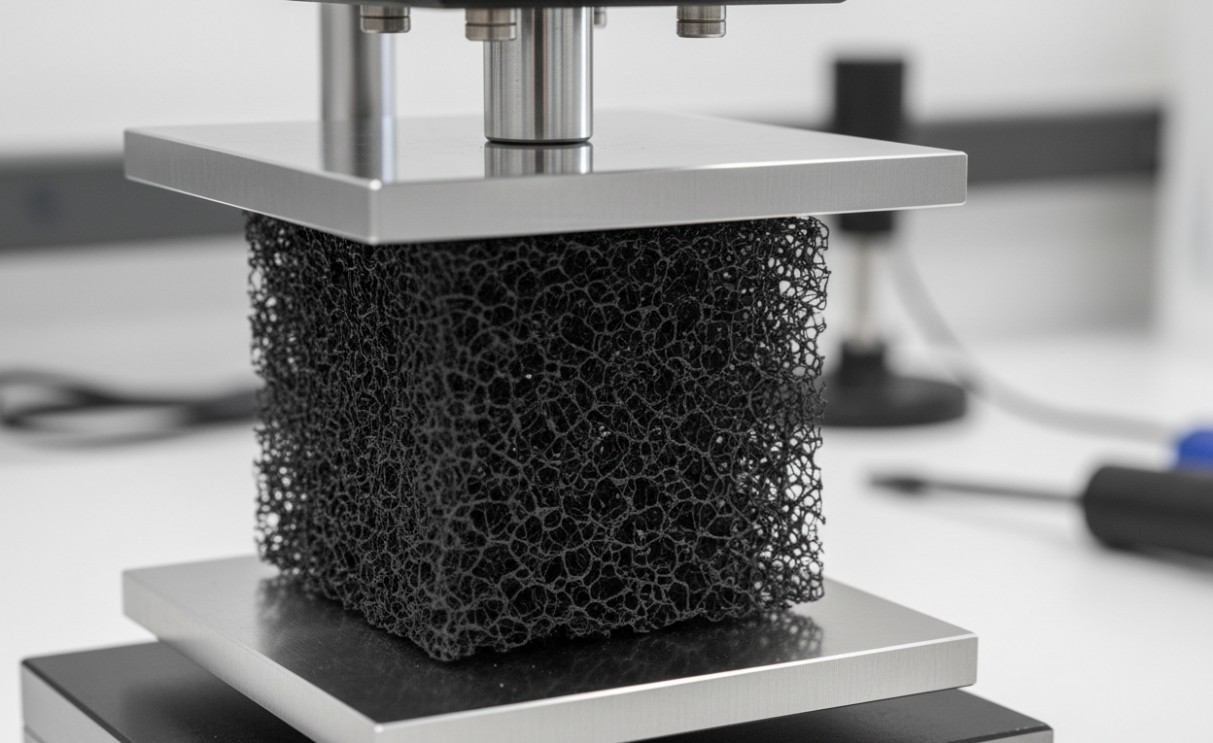 Carbon nanotube sponge undergoing controlled compression between parallel plates to characterize superelastic mechanical response
Oil and Organic Solvent Sorption
The hydrophobic-oleophilic surface of pristine CNT sponges — water contact angles exceeding 150 degrees — makes them natural candidates for selective liquid absorption. When placed on an oil-water interface, the sponge draws hydrocarbons into its pore network while repelling water entirely. Absorption capacities range from 8 times the sponge weight for light oils such as gasoline to 180 times for dense chlorinated solvents, depending on liquid viscosity, density, and the sponge's pore volume. After saturation, absorbed liquids are recovered by simple mechanical squeezing or heat treatment, and the regenerated sponge retains most of its original capacity across many reuse cycles.
Magnetic functionality further extends practical utility. By incorporating iron nanoparticles during synthesis or infiltrating carbonyl iron powder into the sponge matrix, the resulting magnetic CNT sponge can be guided to spill sites and retrieved with a magnet after absorption — eliminating the need for physical nets or manual collection in open-water environments. We supply both pristine hydrophobic sponges and magnetic variants, available as monolithic blocks, discs, or granules tailored to your containment scenario.
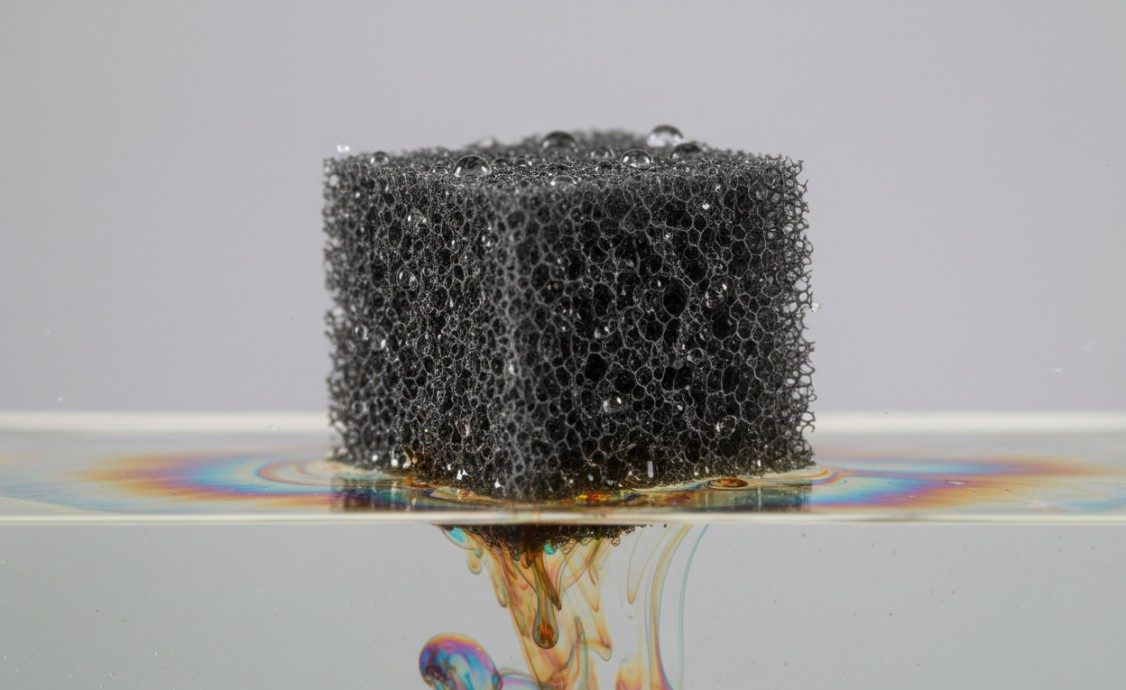 Carbon nanotube sponge floating on water surface while selectively absorbing a layer of colored oil from the water-oil interface
Electromagnetic Interference Shielding
The interconnected conductive pathway within a CNT sponge forms an effective electromagnetic shield. Incident radiation undergoes repeated reflection, absorption, and dissipation as it encounters the nanotube network, with total shielding effectiveness reaching 75.7 dB in the X-band (8.2–12.4 GHz) — sufficient to attenuate electromagnetic energy by more than five orders of magnitude. This performance derives from a synergy between Ohmic losses in the conductive carbon framework and dielectric relaxation at defect sites and tube-tube junctions.
Coating the sponge with silicon carbide via low-temperature CVD further enhances both thermal durability and shielding performance. SiC-coated CNT sponges withstand temperatures exceeding 700 C in air and 1000 C in argon while maintaining their porous architecture, making them uniquely suited for protecting aerospace electronics and high-temperature instrumentation where polymer-based shields decompose. The lightweight nature of these sponges — densities of 15–32 mg/cm^3 even after SiC coating — means that substantial electromagnetic protection adds minimal mass, a decisive advantage in weight-critical systems.
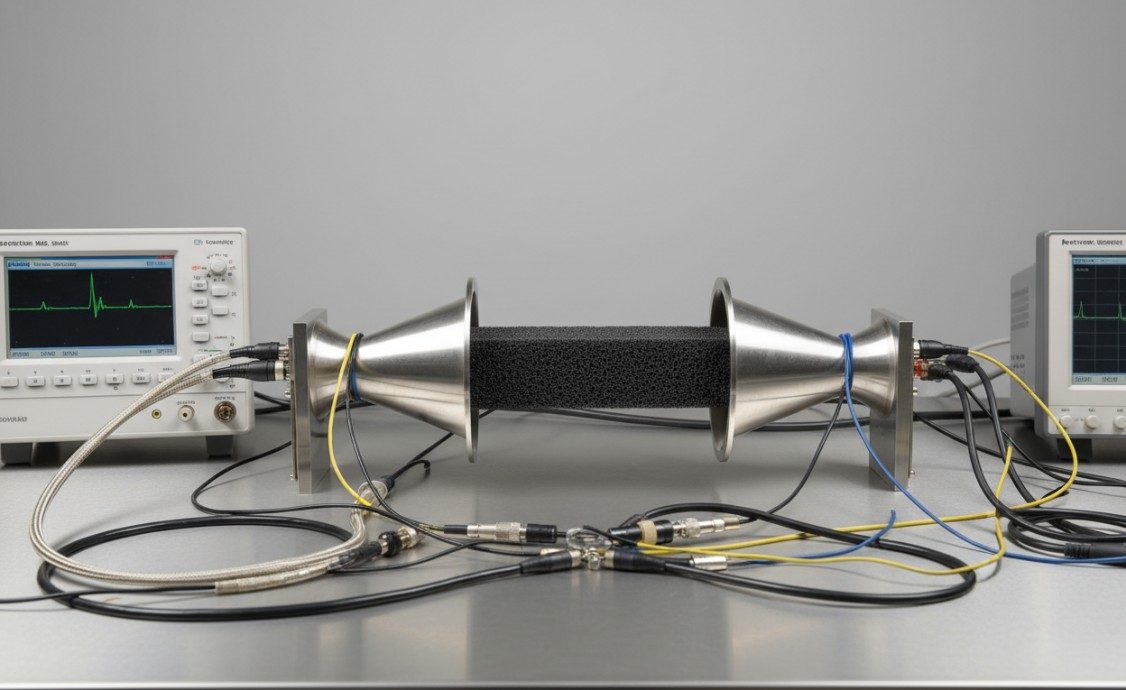 Electromagnetic interference shielding measurement setup with CNT sponge sample mounted between waveguide horns and connected to test equipment
Thermal Insulation and Fire Resistance
Paradoxically, a material built from one of the best thermal conductors in nature — the individual carbon nanotube — emerges as an outstanding thermal insulator when assembled into a sponge. The explanation lies in architecture rather than composition. The extreme porosity of a CNT sponge restricts the cross-sectional area available for heat conduction, while nanoscale point contacts between neighboring tubes introduce high thermal contact resistance that suppresses phonon transport. Our lightest sponges exhibit thermal conductivities of 9.6–10.5 mW/mK, comparable to or below that of silica aerogels, and among the lowest values reported for any solid material.
Beyond low conductivity, CNT sponges demonstrate remarkable fire retardancy. In vertical burning tests, the sponge chars but does not propagate flame; in thermogravimetric analysis, weight loss in air remains minimal below 500 C. Combined with mechanical flexibility absent in brittle silica aerogels, these properties position CNT sponges as next-generation thermal insulation for battery packs, cryogenic pipelines, and building envelopes where both fire safety and thermal performance are non-negotiable.
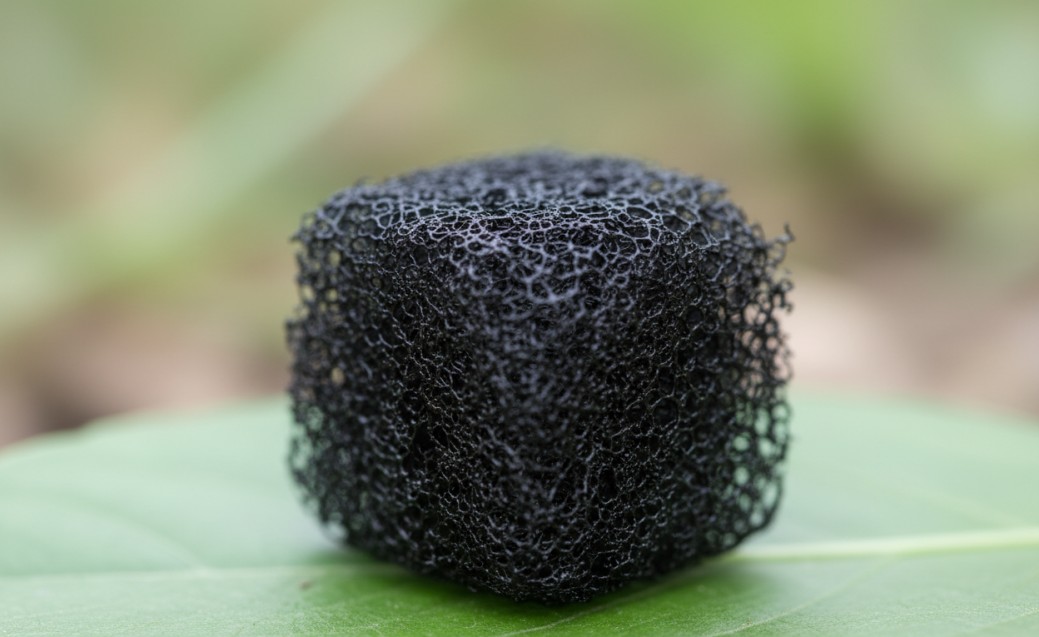 Ultra-lightweight carbon nanotube aerogel cube resting on a green leaf, demonstrating extreme low density
Featured Products
| Products | Specifications | Applications |
| CNT sponge | Density: 2–10 mg/cm^3; Porosity: >99% | Oil sorption, insulation, EMI shielding |
| Superelastic CNT sponge | Recovery: 95% at 96% strain; Cycles: >1000 | Flexible sensors, cushioning |
| CNT sponge oil sorption | Capacity: 8–180x weight; WCA: >150 degrees | Spill cleanup, water purification |
| SiC-coated CNT sponge | EMI SE: >75 dB; T_max: 700 C (air) | Aerospace EMI shielding |
| CNT aerogel | Density: 2.1 mg/cm^3; Lambda: 9.6–14.5 mW/mK | Thermal insulation, fire barrier |
| Magnetic CNT sponge | Fe-filled; Retrievable by magnet | Remote spill recovery |
| AC-reinforced CNT sponge | Energy loss: <20%; Hysteresis: narrow | Vibration damping, cycling |
| CNT sponge sensor | Gauge factor: >20; Compressible conductor | Pressure, strain monitoring |
Application Domains
Environmental Remediation: Selective absorption of oils, organic solvents, and chemical spills from water surfaces; magnetic variants enable remote retrieval from large water bodies.
EMI Shielding: Lightweight electromagnetic interference shields for aerospace, telecommunications, and precision electronic instruments operating at elevated temperatures.
Thermal Insulation: Fire-safe thermal barriers for energy storage systems, cryogenic equipment, and construction applications requiring mechanical robustness.
Piezoresistive Sensors: The reversible resistance change under compression enables pressure and strain sensing with gauge factors exceeding 20, suitable for wearable devices and structural health monitoring.
Energy Storage Scaffolds: Three-dimensional conductive frameworks host active materials in supercapacitors and batteries, improving charge transport and accommodating volume changes during cycling.
Catalytic Supports: High surface area and thermal stability make CNT sponges ideal substrates for catalyst deposition in chemical synthesis and exhaust treatment systems.
Quality Control and Characterization
Every sponge lot undergoes a standardized characterization protocol before release. Scanning electron microscopy documents the three-dimensional pore architecture and nanotube junction density. Raman spectroscopy measures the I_D/I_G ratio to confirm structural quality of the nanotube building blocks. Thermogravimetric analysis determines carbon purity and quantifies residual iron catalyst content. Mercury intrusion porosimetry or nitrogen adsorption provides pore size distribution and specific surface area. For mechanical batches, uniaxial compression testing yields the stress-strain curve, elastic modulus, and recovery percentage. Thermal conductivity is measured by the guarded heat flow method, while EMI shielding effectiveness is determined in our waveguide test fixture across the X-band. All data accompany the shipment in a detailed certificate of analysis.
Custom Fabrication and Collaborative Development
We welcome projects that modify our standard sponge platform for specialized requirements. Previous collaborations have produced SiC-coated sponges for extreme-temperature EMI shielding, PEDOT:PSS-wrapped sponges for thermoelectric sensing, hydrophobically modified silica-CNT composite aerogels for selective gas adsorption, and density-graded sponges with layered porosity for acoustic damping. Whether you need a specific bulk density, a particular pore size distribution, surface functionalization with carboxyl or amine groups, or incorporation of magnetic or catalytic nanoparticles, our engineering team will adapt the CVD recipe and post-processing steps to your specifications.
Get in Touch— Reach out to Eata Nanomaterials to discuss your carbon nanotube sponge requirements, request samples for evaluation, or explore a custom fabrication project tailored to your research or industrial application.
| Catalog Number | Product Name | Order | Quantity |
|---|---|---|---|
| CNS-0001 | Carbon Nanotube Sponge (1 cm × 1 cm × ~0.1 cm) |
-
+
|
|
| CNS-0002 | Carbon Nanotube Sponge (2 cm × 2 cm × ~0.1 cm) |
-
+
|
|
| CNS-0003 | Carbon Nanotube Sponge (1 cm × 2 cm × ~0.1 cm) |
-
+
|
|
| CNS-0004 | Carbon Nanotube Sponge (2 cm × 1 cm × ~0.1 cm) |
-
+
|
|
| CNS-0005 | Carbon Nanotube Sponge (5 cm × 1 cm × ~0.1 cm) |
-
+
|
|
| CNS-0006 | Carbon Nanotube Sponge (10 cm × 5 cm × ~0.1 cm) |
-
+
|
|
| CNS-0007 | Carbon Nanotube Sponge (5 cm × 5 cm × ~0.1 cm) |
-
+
|
For Research or Industrial Raw Materials, Not For Personal Medical Use!