

Products
- High-Quality Graphene
- CVD Graphene, Graphene-Like Materials
- Graphene-Like Series
- Defect-Free Single-Crystal Graphene and Graphene-Like Materials (Mechanical Exfoliation)
- Quantum Dot Series
- Aggregation-Induced Emission (AIE)
- Near-Infrared II (NIR-II) Fluorescent Dyes
- Graphdiyne
- Two-Dimensional Transition Metal Carbides/Nitrides/Borides (MXene)
- Metal Nanomaterials and Other Functional Bio-Nanomaterials
- Metal-Organic Frameworks (MOF)
- Covalent Organic Frameworks (COF)
- Two-Dimensional Layered Metal Oxides (LDH)
- Carbon Nanotube Powders, Pastes
- Carbon Nanotube Arrays and Special Carbon Nanotube Materials
- High-Quality Metallic and Semiconducting High-Purity Single-Walled Carbon Nanotubes
- Carbon Nanotube Sponges
- Mesoporous Carbon and Carbon Nanomaterials
- High-Quality Fullerenes
- One-Dimensional Nanomaterials
- Molecular Sieves
- Inorganic Nanomaterials
- Perovskite Materials
- Highly Oriented Pyrolytic Graphite (HOPG)
- Organic Materials
- Single-Atom Catalysts
- Thermoelectric Materials
- Sodium Storage Materials
- Industrial-Grade Nanomaterials
- Solid-State Lithium Batteries
- Hydrogel Series and Consumables
Online Inquiry
Graphdiyne
Graphene revolutionized materials science by demonstrating what a single layer of sp2-hybridized carbon atoms could do. But what if you could introduce a different kind of carbon bond into that same two-dimensional plane — bonds that create pores, tune the bandgap, and unlock chemical reactivity that pure graphene simply does not possess? That is the premise of graphdiyne (GDY), the only recently synthesized all-carbon 2D material that incorporates both sp and sp2 hybridized carbon atoms in a single, highly conjugated network. First realized in 2010 by Li Yuliang and colleagues through copper-mediated acetylenic coupling of hexaethynylbenzene monomers, graphdiyne consists of benzene rings stitched together by diyne linkages (-C≡C-C≡C-). The result is a honeycomb lattice punctuated by uniformly distributed nanopores roughly 2.5 angstroms in diameter, with a natural bandgap of 0.46 eV and theoretical charge carrier mobilities reaching 10^4 to 10^5 cm2 V-1 s-1 at room temperature.
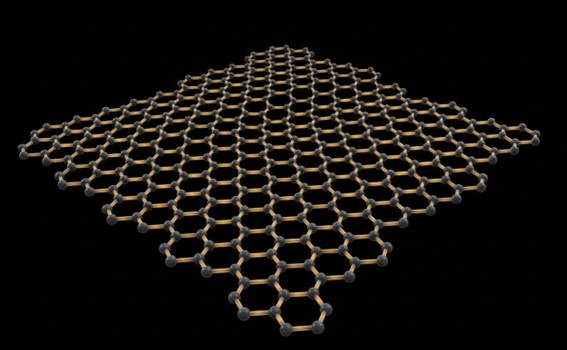 Figure 1: A single-layer graphdiyne sheet showing the hexagonal porous network formed by benzene rings connected through diacetylene linkages, with uniformly distributed nanopores across the 2D carbon lattice.
In the decade and a half since its first synthesis, graphdiyne has attracted the attention of more than 500 research groups across over 60 countries, and it was identified as a top research frontier by the Chinese Academy of Sciences and Clarivate in their joint Research Fronts report. Unlike graphene, which is a zero-gap semi-metal, graphdiyne is an intrinsic semiconductor. Unlike graphene oxide, which sacrifices conductivity for dispersibility, graphdiyne maintains a fully conjugated pi-electron system while offering ample sites for functionalization through its alkyne bonds. And unlike carbon nanotubes, which are constrained to one-dimensional architectures, graphdiyne is intrinsically planar, making it compatible with thin-film device processing, membrane fabrication, and layered heterostructure assembly. At Eata Nanomaterials, we supply graphdiyne and its functionalized derivatives in a variety of nanostructures — from nanosheets and nanotubes to 3D frameworks and freestanding films — each characterized by the analytical rigor that serious materials research demands.
Featured Products
| Product Category | High-Volume Search Terms | Primary Applications |
| Graphdiyne Nanosheets | 2D GDY nanosheets, Glaser coupling, Cu foil synthesis, few-layer, exfoliated, lateral size 1-10 um, Raman D/G band | Battery anode, supercapacitor electrode, membrane fabrication, catalytic support |
| Graphdiyne Films on Cu Foil | Large-area GDY film, as-grown on copper, thickness 10-100 nm, uniform coverage, in-situ growth | Direct device fabrication, photocathode, PEC water splitting, composite electrode |
| Graphdiyne Nanotubes (GNTs) | AAO template synthesis, 1D morphology, hollow structure, high aspect ratio, field emission | Field emitter, chemical sensor, catalytic nanoreactor, drug delivery vehicle |
| 3D Graphdiyne Framework | Freestanding 3D GDY, diatomite template, high specific surface area >500 m2/g, porous scaffold | Lithium-ion battery anode, 3D catalyst support, gas storage, energy storage |
| Graphdiyne Quantum Dots | GDY QDs, 0D nanoparticles, blue-green fluorescence, N,S-doped, water-dispersible, <10 nm | Bioimaging, fluorescent sensing, photodynamic therapy, electrochemiluminescence |
| GDY-Noble Metal Composites | GDY/Pt, GDY/Pd, GDY/Au, atomic catalysts, zero-valence metal, diacetylene-metal interaction | CO2 reduction, HER, ORR, OWS, fuel cell electrocatalysis, solar energy conversion |
| Functionalized GDY | Hydrogenated GDY, fluorinated GDY, N-doped GDY, organic group insertion, bandgap tuning | Semiconductor device, bandgap engineering, environmental remediation, selective catalysis |
| GDY Nanowalls | Vertically aligned, ordered stripe arrays, 2D substrate, high-density growth, controlled morphology | Photodetector, gas sensor, solar cell electrode, supercapacitor, electronic device |
| Holey Graphdiyne (HGDY) | Ultrathin HGDY nanosheets, Pd/Cu co-catalyzed, 3D foam framework, enlarged pores, high SSA | Electrocatalysis, battery electrode, charge transfer enhancement, ORR catalysis |
Graphdiyne Products in Our Catalog
Graphdiyne Nanosheets: The 2D Foundation
Graphdiyne nanosheets represent the archetypal two-dimensional form of this carbon allotrope. Synthesized by copper-surface-mediated Glaser-Hay coupling of hexaethynylbenzene (HEB) monomers on polished copper foil, our nanosheets are subsequently transferred to your target substrate or dispersed as individual flakes through controlled liquid-phase exfoliation. The resulting material retains the full structural integrity of the parent GDY lattice: uniformly distributed 2.5-angstrom pores, a conjugated pi-electron system spanning both sp and sp2 carbon centers, and active alkyne sites available for chemical functionalization.
- Lateral dimensions: 1-10 um, tunable by growth time and HEB concentration.
- Layer count: few-layer to multi-layer, confirmed by AFM thickness profiling.
- Pore size: ~2.5 angstroms (uniform), verified by nitrogen adsorption isotherms.
- Bandgap: 0.46 eV, measured by scanning tunneling spectroscopy.
- Carrier mobility: 10^4 to 10^5 cm2 V-1 s-1 at room temperature, by Hall effect measurement.
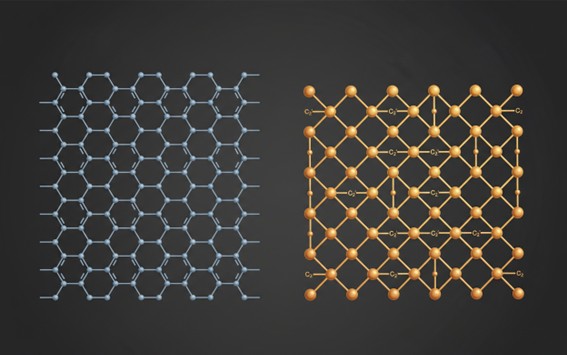 Figure 2: Side-by-side comparison of graphene (left, pure sp2 hexagonal lattice) and graphdiyne (right, sp/sp2 hybrid network with diacetylene linkages and intrinsic nanopores).
Graphdiyne Films on Copper Foil: As-Grown for Device Integration
For researchers who prefer to work with graphdiyne in its as-grown state, we supply large-area GDY films directly on copper foil substrates. These films are synthesized by the same copper-mediated acetylenic coupling process, with growth parameters optimized for film uniformity and coverage. The copper substrate can serve as a current collector in electrochemical devices, or the GDY film can be transferred to insulating substrates for electronic device fabrication.
- Film area: up to several square centimeters, limited by Cu foil dimensions.
- Thickness: 10-100 nm, controllable by monomer concentration and reaction time.
- Transfer service: available to SiO2/Si, quartz, PET, or customer-provided substrates.
Graphdiyne Nanotubes: One-Dimensional Architecture
Graphdiyne nanotubes are synthesized using anodic aluminum oxide (AAO) templates as cylindrical molds. HEB monomers undergo acetylenic coupling at the inner surfaces of the AAO pores, yielding hollow GDY tubes with controllable diameter and length determined by the template geometry. These one-dimensional structures exhibit enhanced field emission properties and serve as excellent catalytic nanoreactors.
- Diameter: 50-300 nm, controlled by AAO pore size.
- Length: 1-100 um, controlled by AAO template thickness.
- Wall thickness: 5-20 nm, depending on monomer concentration and growth time.
3D Graphdiyne Frameworks: High-Surface-Area Scaffolds
Two-dimensional materials have inherently limited surface area when stacked. Our three-dimensional graphdiyne frameworks overcome this constraint by templating GDY growth on diatomite or other porous scaffolds, followed by template removal to yield freestanding 3D architectures with specific surface areas exceeding 500 m2/g. These frameworks serve as high-capacity electrodes and three-dimensional catalyst supports.
- Specific surface area: >500 m2/g (BET method).
- Pore volume: tunable by template choice and processing conditions.
- Mechanical stability: sufficient for direct use as battery anodes without binder.
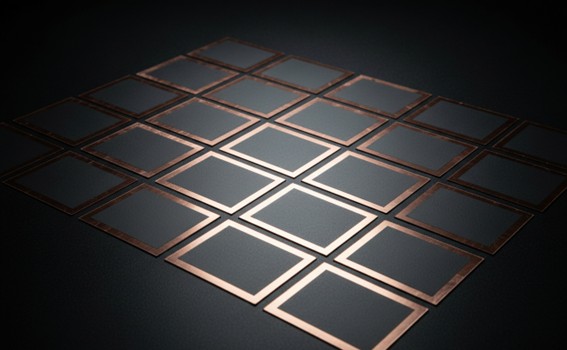 Figure 3: Multiple graphdiyne thin films grown on copper foil substrates, showing the uniform dark grey-black film coverage characteristic of high-quality acetylenic coupling synthesis.
Graphdiyne Quantum Dots: Luminescent Nanocrystals
When graphdiyne is fragmented into sub-10 nm particles, quantum confinement effects emerge, producing blue-green fluorescence that is absent in the bulk material. Our graphdiyne quantum dots are synthesized by controlled oxidative cutting of GDY nanosheets, followed by surface functionalization for aqueous dispersibility. N- and S-doping variants are available for enhanced photoluminescence quantum yield.
- Lateral size: <10 nm, confirmed by TEM and DLS.
- Emission: blue-green, tunable by size and doping.
- Dispersibility: water and organic solvents, depending on surface functionalization.
Graphdiyne-Noble Metal Composites for Catalysis
The diacetylene bonds in graphdiyne exhibit strong affinity for transition metal ions, enabling in-situ growth of noble metal nanoparticles with exceptionally small size and uniform distribution. Our GDY/Pt, GDY/Pd, and GDY/Au composites have demonstrated catalytic activity exceeding commercial Pt/C for oxygen reduction reaction, with the GDY support preventing nanoparticle agglomeration through the multicavity space limiting effect.
- Metal loading: 1-50 wt%, tunable by precursor concentration.
- Particle size: <5 nm for atomic catalyst variants, confirmed by HAADF-STEM.
- Applications: HER, ORR, CO2 reduction, formate/ethylene production.
Where Graphdiyne Makes the Difference
Graphdiyne occupies a unique position in the materials landscape. It is not merely a carbon variant; it is a platform material whose properties can be engineered through nanostructure control, heteroatom doping, metal decoration, and organic functionalization. Here are the domains where our customers achieve breakthrough results.
- Energy storage: lithium-ion battery anodes with theoretical lithium storage capacity double that of graphite, thanks to the porous structure and sp-hybridized carbon sites; sodium-ion and potassium-ion battery electrodes; high-rate supercapacitors leveraging the 2D electron transfer channels and 3D ion diffusion pathways.
- Electrocatalysis: graphdiyne-supported atomic catalysts for hydrogen evolution reaction (HER), oxygen evolution reaction (OER), and overall water splitting (OWS); GDY/Cu composites achieving >95% Faradaic efficiency for CO2-to-formate conversion; Ag-Cu/GDY tandem catalysts for C2+ product generation with FE up to 55.1%.
- Photocatalysis: graphdiyne/ZnO and graphdiyne/TiO2 heterojunctions for photocatalytic hydrogen production; GDY-sensitized solar cells with 20% efficiency improvement over conventional architectures.
- Membrane separation: atomically thin GDY membranes with sub-nanometer pores for gas separation (H2/CO2, H2/CH4), water desalination with 100% salt rejection, and proton conduction exceeding commercial Nafion.
- Biomedical applications: GDY quantum dots for bioimaging and fluorescent sensing; GDY-based photothermal therapy agents with strong NIR absorption and high photothermal conversion efficiency; drug delivery platforms leveraging pi-pi stacking and hydrophobic loading.
- Electronic and optoelectronic devices: field-effect transistors exploiting the intrinsic bandgap; UV photodetectors with enhanced photoresponsivity; transparent conductive films for flexible electronics.
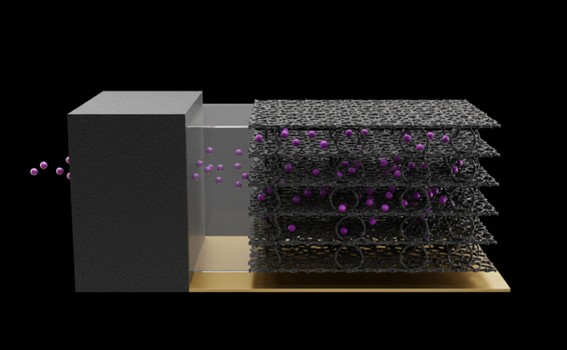 Figure 4: A lithium-ion battery half-cell showing layered graphdiyne sheets as the anode material, with lithium ions intercalating between the porous carbon layers during charge-discharge cycling.
Characterization Protocols: Ensuring Material Integrity
Every batch of graphdiyne undergoes comprehensive analytical characterization before release. The data accompanies your order as a batch-specific report, not as a generic certificate.
- Raman spectroscopy: D band (~1350 cm-1), G band (~1580 cm-1), and characteristic alkyne vibration peaks for structural confirmation.
- X-ray diffraction (XRD): crystal phase identification, interlayer spacing, and degree of graphitization.
- Atomic force microscopy (AFM): layer count, thickness profile, and surface morphology.
- Scanning electron microscopy (SEM): nanostructure morphology, film coverage, and pore network visualization.
- Transmission electron microscopy (TEM): lattice imaging, pore structure, and metal nanoparticle size distribution for composites.
- X-ray photoelectron spectroscopy (XPS): elemental composition, carbon bonding states (sp vs sp2 ratio), and dopant identification.
- Nitrogen adsorption-desorption (BET): specific surface area and pore size distribution.
- Scanning tunneling microscopy (STS): electronic density of states and local bandgap mapping.
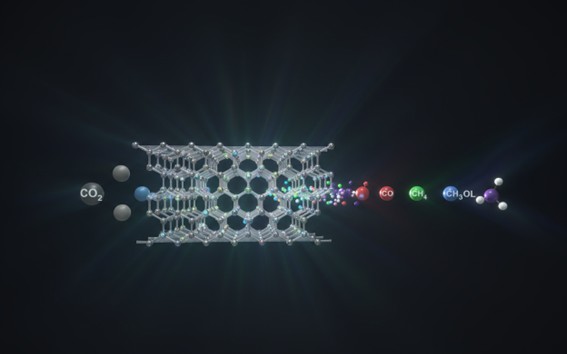 Figure 5: A graphdiyne-based catalytic membrane for CO2 reduction, showing CO2 molecules approaching the porous GDY sheet with anchored catalyst nanoparticles and product molecules emerging on the other side.
Custom Graphdiyne Synthesis and Functionalization
Standard graphdiyne products meet many research needs, but frontier projects often require tailored materials. Our custom synthesis service leverages the full flexibility of graphdiyne chemistry to produce materials with precisely engineered properties. We have synthesized N-doped graphdiyne with enhanced electrocatalytic activity for nitrogen reduction, fluorinated GDY with widened bandgap for transistor applications, holey graphdiyne (HGDY) with enlarged pores for battery electrolyte infiltration, and graphdiyne analogs with tunable pore sizes (2.3-5.4 nm) by varying the phenylene bridge length in the monomer unit. We have also developed GDY-metal composites with controlled metal loading and particle size, as well as GDY-polymer hybrids for solution-processable device fabrication.
Describe your target nanostructure, functionalization, or application requirement. Our materials chemists will design a synthesis route, provide a feasibility assessment and quotation, and deliver a purified, characterized batch for your evaluation.
Request a Data Sheet or Discuss a Custom Project
Browse our Graphdiyne catalog, request detailed characterization data, or describe the specific nanostructure, functionalization, or application target your research requires. Our team of materials scientists is available to advise on product selection, integration strategies, and custom synthesis.
| Catalog Number | Product Name | Order | Quantity |
|---|---|---|---|
| GRAP-0001 | Graphdiyne Powder (2-20 nm) |
-
+
|
|
| GRAP-0002 | Graphdiyne Monomer HEB-TMS (White Powder) |
-
+
|
|
| GRAP-0003 | Triple-Nitrogen-Doped Graphdiyne (50 nm-1 μm) |
-
+
|
|
| GRAP-0004 | Oxidized Graphdiyne (Black Powder) |
-
+
|
|
| GRAP-0005 | Single-Nitrogen-Doped Graphdiyne (50 nm-1 μm) |
-
+
|
|
| GRAP-0006 | Graphdiyne Film on Copper Foil (2 cm×2 cm to 2 cm×10 cm) |
-
+
|
|
| GRAP-0007 | Oxidized Graphdiyne Dispersion (0.1 mg/mL, Aqueous) |
-
+
|
|
| GRAP-0008 | Single-Nitrogen-Doped Graphdiyne Dispersion (0.1 mg/mL, Aqueous) |
-
+
|
|
| GRAP-0009 | Graphdiyne Dispersion (0.1 mg/mL, Aqueous) |
-
+
|
For Research or Industrial Raw Materials, Not For Personal Medical Use!