

Energy Storage Nanomaterial Integration Services
Conventional lithium-ion batteries are approaching the theoretical limits of their electrode materials. Graphite anodes plateau at 372 milliampere-hours per gram. Layered oxide cathodes struggle to exceed 200 milliampere-hours per gram at acceptable cycle stability. These constraints cap cell-level energy density around 250 watt-hours per kilogram, insufficient for the 500-plus watt-hour-per-kilogram targets demanded by next-generation electric aviation and long-range electric vehicles. Breaking through this ceiling requires nanomaterial-enabled electrode architectures that unlock the full potential of high-capacity active materials.
Eata Nanomaterials provides end-to-end integration services that transform promising nanomaterials into functional energy storage components. We work with silicon, sulfur, lithium metal, solid-state electrolytes, and nanostructured carbon materials to design, fabricate, and electrochemically validate electrodes and electrolyte systems in coin cell and pouch cell configurations. Every project combines nanomaterials synthesis expertise with battery engineering knowledge to deliver research-grade cell components ready for performance evaluation.
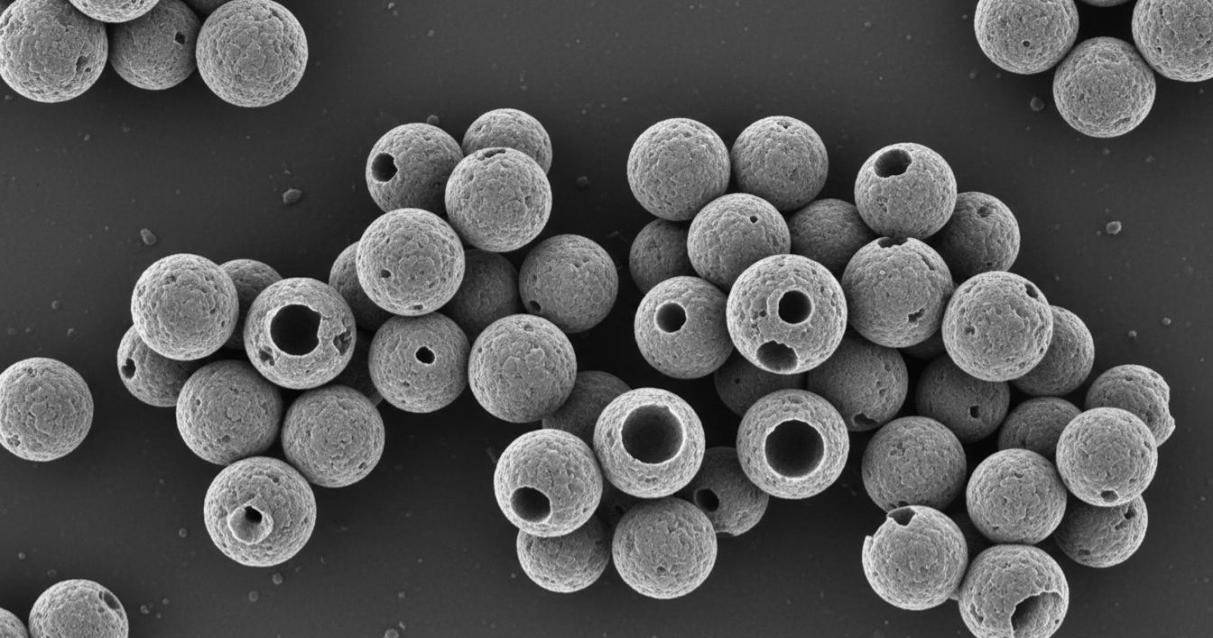 Figure 1: A scanning electron microscope image of hollow silicon nanospheres for lithium-ion battery anode applications, showing uniform particle size and porous structure.
Silicon Anode Integration for High-Energy Lithium-Ion Batteries
Silicon offers a theoretical specific capacity of 4,200 milliampere-hours per gram, more than ten times that of graphite. However, silicon anodes face two formidable challenges: extreme volume expansion exceeding 300 percent during lithiation, which pulverizes the electrode structure and destroys electrical contact, and low initial Coulombic efficiency due to irreversible consumption of lithium in forming the solid electrolyte interphase layer.
Our silicon anode integration services address these challenges through engineered nanostructure and composite design:
- Silicon-carbon composite architectures where nano-silicon is embedded within a porous carbon matrix or coated with a conductive carbon layer. The carbon framework buffers the mechanical stress from silicon expansion, maintains electronic conductivity through the volume change cycle, and stabilizes the SEI layer on the carbon surface rather than the dynamically changing silicon surface
- Hollow and yolk-shell silicon nanostructures that provide internal void space to accommodate expansion without disrupting the external electrode morphology. These structures maintain stable solid-electrolyte interphase layers and demonstrate dramatically improved cycle life compared to solid silicon particles of equivalent size
- Silicon nanosphere anodes with precisely controlled particle sizes between 50 and 500 nanometers, engineered to minimize diffusion length while maintaining structural integrity. Pre-lithiation strategies are employed to compensate for first-cycle lithium loss, with our LESG-type composites achieving initial Coulombic efficiencies exceeding 115 percent and stable cycling over 400 cycles with only 6 percent volume increase after 100 cycles
- Silicon-graphite blended electrodes that leverage the capacity advantage of silicon while preserving the cycling stability of graphite. We optimize blend ratios, binder systems, and electrolyte additives to balance energy density and cycle life for specific application targets
Lithium-Sulfur Battery Nanomaterial Solutions
Lithium-sulfur batteries promise theoretical energy densities above 2,600 watt-hours per kilogram, nearly an order of magnitude beyond conventional lithium-ion systems. The challenges are equally formidable: the insulating nature of sulfur and its discharge products, the polysulfide shuttle effect that causes active material loss and anode corrosion, and substantial volume changes during charge and discharge cycles.
Eata Nanomaterials develops integrated cathode, separator, and electrolyte solutions that tackle each of these challenges:
- Sulfur host materials based on hierarchically porous carbons, nitrogen-doped carbon frameworks, and conductive polymer composites. These hosts provide continuous electron pathways to insulating sulfur, physically confine polysulfides within pores, and chemically adsorb soluble lithium polysulfide intermediates through Lewis acid-base interactions between nitrogen functional groups and lithium ions
- CNT/C3N4 composite cathodes where carbon nanotubes provide the conductive backbone and carbon nitride supplies polar adsorption sites for polysulfide trapping. This synergistic combination achieves sulfur loadings up to 70 weight percent, initial discharge capacities of 1,074 milliampere-hours per gram at 0.1C, and capacity retention of 73 percent after 650 cycles at 0.5C
- Functionalized separator coatings using conductive carbon layers and metal oxide nanoparticles (TiO2, MnO2, Sm2O3) that create a secondary barrier against polysulfide migration. These coatings not only block polysulfide shuttle but also provide catalytic sites that accelerate polysulfide conversion, improving sulfur utilization and rate capability
- Polar composite hosts incorporating transition metal oxides, sulfides, carbides, and MOF-derived materials that bind polysulfides through strong chemical interactions. CoS-embedded nitrogen-doped hollow carbon composites demonstrate capacity decay as low as 0.05 percent per cycle over 800 cycles at 1C
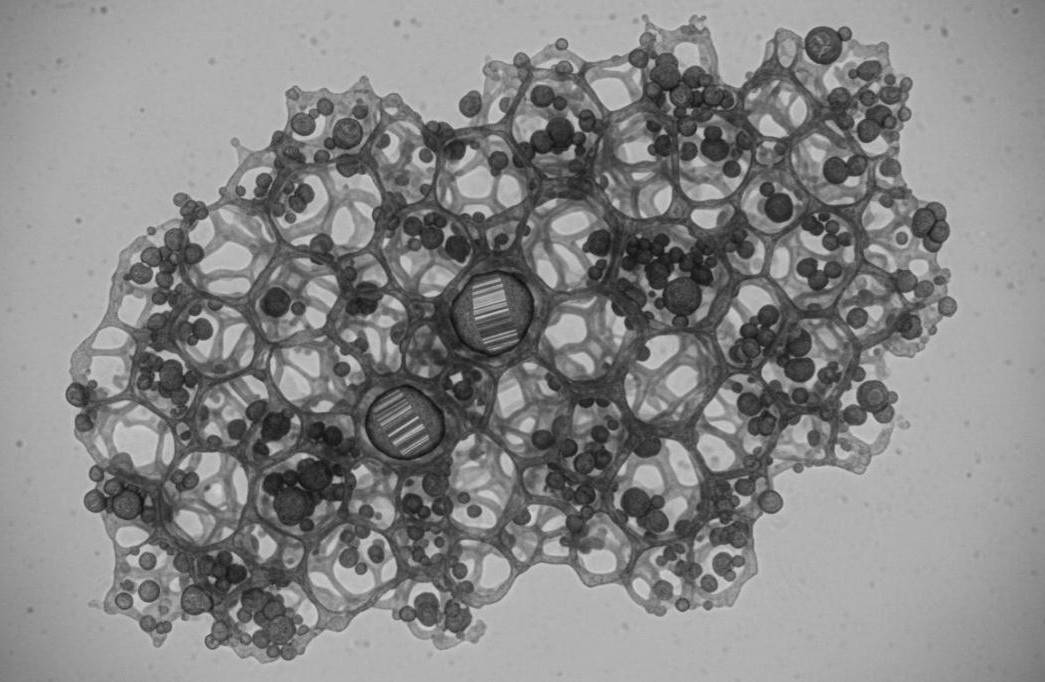 Figure 2: A transmission electron microscope image of a sulfur-carbon composite cathode material showing sulfur nanoparticles embedded within a three-dimensional porous carbon framework.
Solid-State Electrolyte Development
Replacing flammable liquid electrolytes with solid-state alternatives represents the most promising pathway to simultaneously improving battery safety and energy density. Solid-state batteries enable lithium metal anodes, which offer 3,860 milliampere-hours per gram, and permit higher-voltage cathodes that are incompatible with liquid electrolytes. However, solid electrolytes must simultaneously achieve high ionic conductivity, a wide electrochemical stability window, and good mechanical compatibility with electrodes.
Our solid-state electrolyte integration services include:
- Sulfide-based solid electrolytes including Li6PS5Cl and Li10GeP2S12 with room-temperature ionic conductivities exceeding 10 millisiemens per centimeter, approaching those of liquid electrolytes. We synthesize these materials through solid-state reaction and mechanochemical methods, and fabricate dense pellets through cold pressing and sintering protocols
- Oxide garnet electrolytes such as Li7La3Zr2O12 with high chemical stability against lithium metal and wide electrochemical stability windows. Dopant strategies including Ta and Nb substitution are employed to stabilize the cubic phase and enhance conductivity. Thin-film LLZO layers are deposited by pulsed laser deposition for interface engineering
- Nanocomposite polymer-ceramic electrolytes combining PVDF-HFP or PEO polymer matrices with LLZTO or LATP ceramic fillers. These composites leverage the flexibility of polymers with the high conductivity of ceramics, achieving conductivities above 10^-4 siemens per centimeter at room temperature while maintaining processability for large-format cell fabrication
- Halide electrolytes including Li3YCl6 and Li3InCl6 offering high ionic conductivity above 10^-3 siemens per centimeter, wide voltage windows exceeding 5.5 volts, and air stability that simplifies manufacturing compared to sulfide counterparts
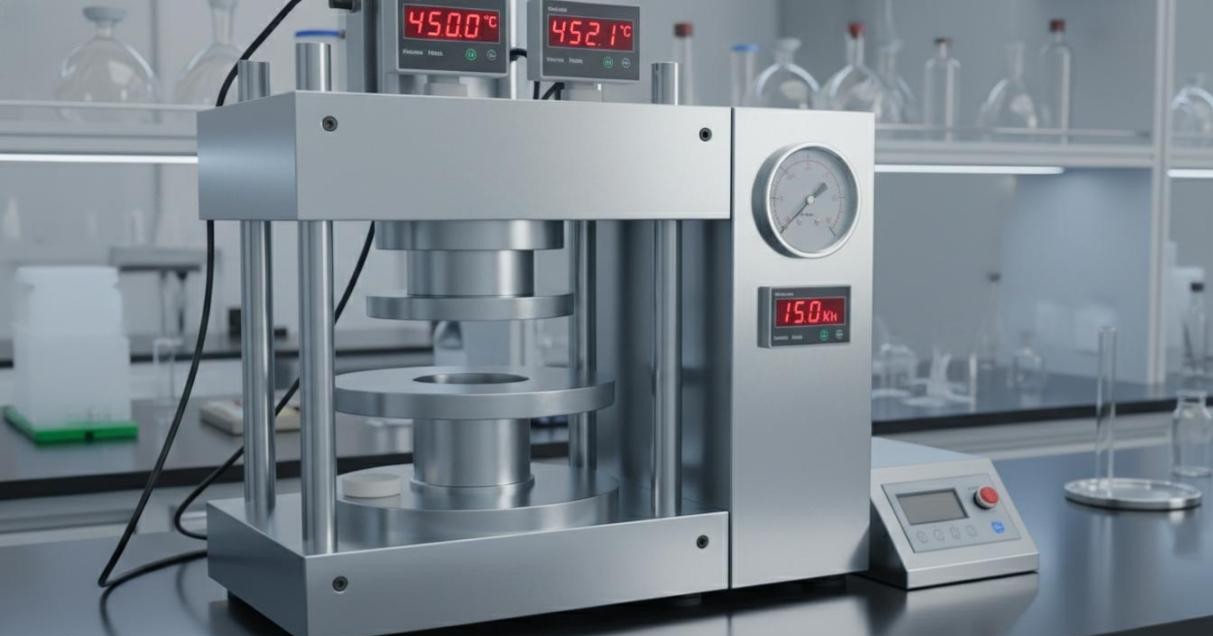 Figure 3: A hydraulic hot press system with heated platens pressing solid-state electrolyte powder into a dense pellet for all-solid-state battery fabrication.
Sodium-Ion Battery Nanomaterial Development
Sodium-ion batteries offer a sustainable and cost-effective alternative to lithium-ion systems for grid-scale energy storage, where lithium supply constraints and cost are significant concerns. The U.S. Department of Energy has identified sodium-ion batteries as a priority diversification pathway for stationary storage applications.
Eata Nanomaterials supports sodium-ion battery research through:
- Hard carbon anode development with tailored porosity and surface chemistry to optimize sodium storage capacity and initial Coulombic efficiency. We explore morphology engineering, heteroatom functionalization, and defect engineering strategies to enhance the intercalation and adsorption of sodium ions in hard carbon structures
- Cathode material integration for layered oxide, Prussian blue analog, and polyanionic cathode systems. Nanostructuring approaches including particle size reduction and carbon coating are employed to improve rate capability and cycling stability
- Novel electrolyte formulations including PVDF-HFP based nanocomposite electrolytes with NaClO4 and MWCNT additives, achieving conductivities as high as 8.46 times 10^-3 siemens per centimeter, the highest reported in the literature for sodium-ion systems
Electrochemical Characterization and Cell Testing
Quantifying the performance of nanomaterial-enabled energy storage components requires specialized testing infrastructure. Eata Nanomaterials maintains a battery testing laboratory equipped for comprehensive electrochemical evaluation:
- Multi-channel battery cyclers for galvanostatic charge-discharge testing of coin cells and pouch cells at currents from microamperes to amperes, with programmable voltage windows and current rates. Cycling protocols include rate capability tests, long-term cycling stability assessment, and galvanostatic intermittent titration technique for diffusion coefficient measurement
- Potentiostat-galvanostat with electrochemical impedance spectroscopy for cyclic voltammetry, AC impedance analysis, and potentiostatic intermittent titration. EIS spectra are acquired over frequencies from 1 MHz to 10 mHz to deconvolute bulk electrolyte resistance, charge transfer resistance, and solid-electrolyte interphase impedance
- In-situ and operando characterization capabilities including in-situ X-ray diffraction for phase evolution monitoring during cycling, Raman spectroscopy for structural changes, and electrochemical dilatometry for electrode volume change quantification
- Post-mortem analysis of cycled cells by disassembling cells in an inert atmosphere glovebox and analyzing electrodes by SEM, TEM, XPS, and ICP-MS to diagnose degradation mechanisms including particle cracking, SEI thickening, active material dissolution, and lithium dendrite formation
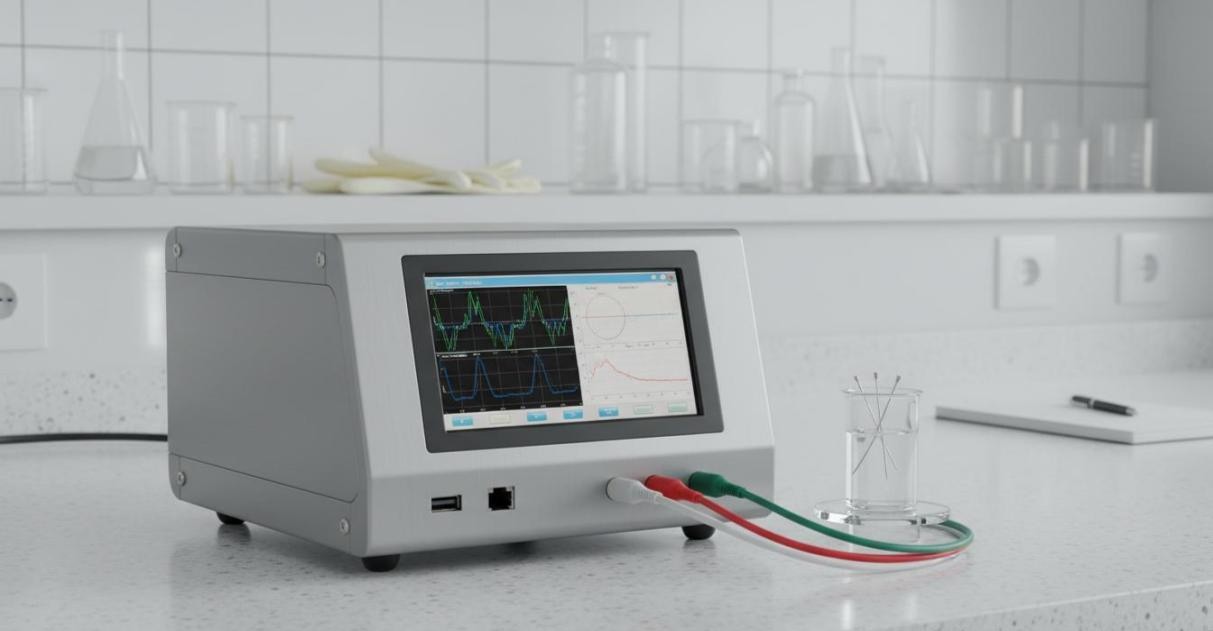 Figure 4: An electrochemical workstation with touchscreen display showing cyclic voltammetry and impedance analysis data, connected to a three-electrode test cell.
Nanomaterial-Enabled Energy Storage Platform Comparison
| System | Nanomaterial | Target Metric | Key Challenge | Our Solution |
| Si-Li-ion | Si nanospheres | 4200 mAh/g | Volume expansion | Hollow core-shell |
| Li-S | S-C composites | 2600 Wh/kg | Polysulfide shuttle | N-doped carbon host |
| Solid-state | LLZO, LGPS | 500+ Wh/kg | Interface resistance | Nanocomposite |
| Na-ion | Hard carbon | 300+ Wh/kg | Low ICE | Defect engineering |
| Supercapacitor | CNT, rGO | High power | Energy density | Pseudocapacitive doping |
Application-Focused Development Programs
Our energy storage nanomaterial integration services support diverse research programs:
- Electric vehicle battery development: integrating silicon-graphite composite anodes with high-nickel NMC cathodes to achieve cell-level energy densities above 300 watt-hours per kilogram while maintaining calendar life targets
- Grid-scale stationary storage: developing sodium-ion battery systems with hard carbon anodes and nanostructured cathodes for cost-effective, long-duration energy storage with 20-year service life
- Aerospace and aviation: fabricating lithium-sulfur pouch cells with lightweight nanostructured sulfur cathodes for unmanned aerial vehicles and electric aircraft requiring 500-plus watt-hour-per-kilogram specific energy
- Consumer electronics: integrating solid-state electrolytes with lithium metal anodes for next-generation wearable devices requiring thin form factors, high safety, and flexible packaging
- Marine and offshore: developing seawater batteries with nanostructured hard carbon anodes and SWCNT-interweaved cathode architectures for autonomous underwater vehicles and offshore energy storage
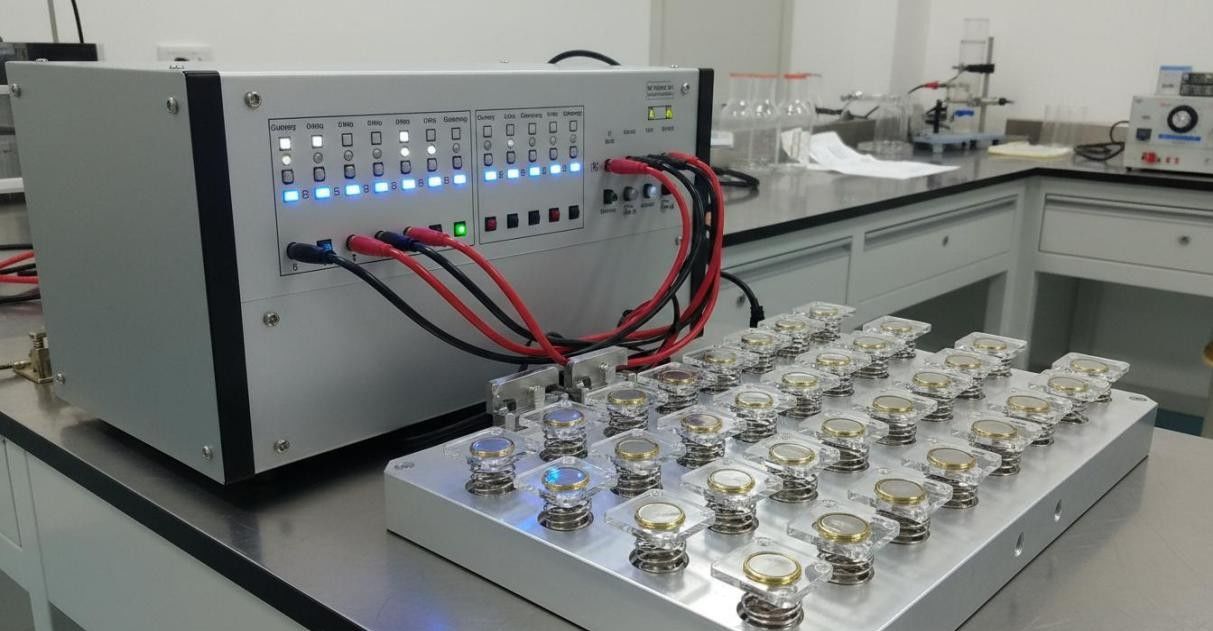 Figure 5: A multichannel battery cycler system with coin cell battery holders and LED status indicators for parallel electrochemical testing of multiple cells.
Collaboration and Project Phases
Energy storage projects typically proceed through three phases. The feasibility phase involves material selection, preliminary electrode formulation, and coin cell assembly for initial capacity and rate capability screening. The optimization phase systematically varies active material loading, binder content, electrolyte composition, and formation protocols to maximize target performance metrics. The validation phase produces larger batches of optimized electrodes for extended cycling, abuse testing, and technology transfer to manufacturing partners.
All projects are conducted under strict confidentiality with client-owned intellectual property. We accommodate client-supplied nanomaterials, commercial active materials, and in-house synthesized nanostructures. Deliverables include complete fabrication protocols, characterization data, electrochemical test results, and where applicable, prototype coin cells or pouch cells for independent validation.
If you are interested in our products or services, please don't hesitate to contact us.