

Products
- High-Quality Graphene
- CVD Graphene, Graphene-Like Materials
- Graphene-Like Series
- Defect-Free Single-Crystal Graphene and Graphene-Like Materials (Mechanical Exfoliation)
- Quantum Dot Series
- Aggregation-Induced Emission (AIE)
- Near-Infrared II (NIR-II) Fluorescent Dyes
- Graphdiyne
- Two-Dimensional Transition Metal Carbides/Nitrides/Borides (MXene)
- Metal Nanomaterials and Other Functional Bio-Nanomaterials
- Metal-Organic Frameworks (MOF)
- Covalent Organic Frameworks (COF)
- Two-Dimensional Layered Metal Oxides (LDH)
- Carbon Nanotube Powders, Pastes
- Carbon Nanotube Arrays and Special Carbon Nanotube Materials
- High-Quality Metallic and Semiconducting High-Purity Single-Walled Carbon Nanotubes
- Carbon Nanotube Sponges
- Mesoporous Carbon and Carbon Nanomaterials
- High-Quality Fullerenes
- One-Dimensional Nanomaterials
- Molecular Sieves
- Inorganic Nanomaterials
- Perovskite Materials
- Highly Oriented Pyrolytic Graphite (HOPG)
- Organic Materials
- Single-Atom Catalysts
- Thermoelectric Materials
- Sodium Storage Materials
- Industrial-Grade Nanomaterials
- Solid-State Lithium Batteries
- Hydrogel Series and Consumables
Online Inquiry
Molecular Sieves
At the molecular scale, separation is an art of precision. Distinguishing one compound from another — when both are merely angstroms apart in size — demands materials with an almost architectural exactitude. Molecular sieves, crystalline aluminosilicates with uniformly sized pore openings, have mastered this art. Their frameworks, constructed from corner-sharing SiO4 and AlO4 tetrahedra, create three-dimensional networks of channels and cavities that admit molecules smaller than a critical diameter while excluding everything larger. The result is a molecular-sized filter capable of separating water from organic solvents, linear hydrocarbons from branched isomers, carbon dioxide from methane, and nitrogen from oxygen — operations fundamental to the petrochemical, pharmaceutical, environmental, and energy industries.
Eata Nanomaterials supplies a comprehensive range of molecular sieve products, from classical zeolites (3A, 4A, 5A, 13X) to ordered mesoporous materials (MCM-41, SBA-15) and hierarchical structures that bridge the micro- and mesopore regimes. Our catalog encompasses powders, pellets, extrudates, and spheres in various mesh sizes, as well as ion-exchanged variants, metal-doped catalytic grades, and custom-synthesized structures for specialized separation challenges. Every product ships with a certificate of analysis including XRD pattern, BET surface area, static water adsorption capacity, and crush strength data.
Zeolite Molecular Sieves: 3A, 4A, 5A, and 13X
The cornerstone of our molecular sieve portfolio is the classic zeolite A and X family, differentiated by their effective pore apertures controlled through ion exchange. Zeolite 3A — produced by replacing sodium cations in the parent 4A structure with potassium — features a pore opening of approximately 3 angstroms, ideal for drying unsaturated hydrocarbons and polar solvents where exclusion of larger molecules is essential. Water (kinetic diameter 2.65 A) enters freely and is strongly bound within the polar cavities, while propylene and butadiene are rejected at the entrance, preventing undesirable co-adsorption and coking.
Zeolite 4A, with its 4-angstrom aperture and sodium cation charge-balancing framework aluminum, serves as the workhorse for general gas and liquid drying, including air separation prepurification, natural gas dehydration, and refrigerant drying. Calcium exchange converts 4A into 5A, expanding the pore opening to 5 angstroms and enabling the separation of n-paraffins from iso-paraffins and cyclic hydrocarbons — a process of immense value in the production of high-purity solvents and diesel fuel. Zeolite 13X, built on the faujasite framework with its spacious 10-angstrom supercages, handles the largest molecules in the zeolite family: it removes mercaptans from LPG, captures CO2 from biogas and flue gas, and serves as a catalyst support for fluid catalytic cracking and hydrocracking operations where large feedstock molecules must access active sites within the pore network.
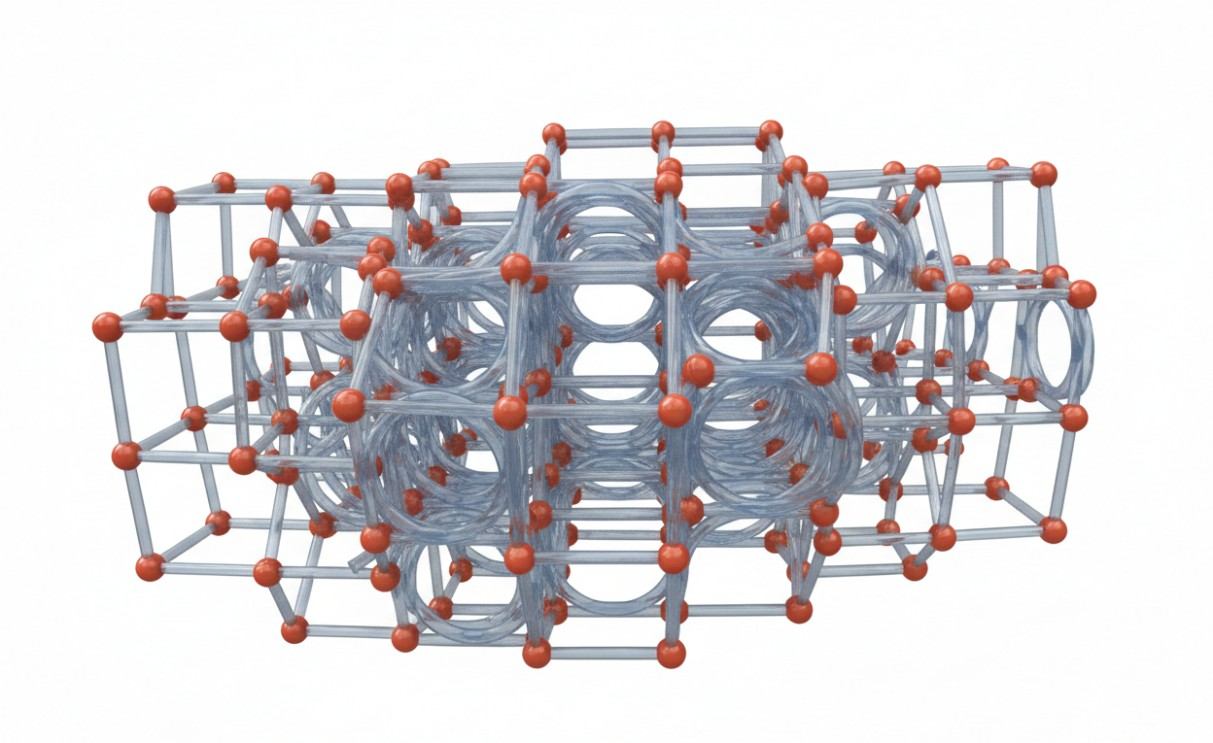 Three-dimensional crystalline framework structure of a zeolite molecular sieve showing interconnected pore channels
Adsorption, Separation, and Purification
The selectivity of molecular sieves arises from a combination of size exclusion and energetic discrimination. Within the polar cavities of an aluminosilicate framework, compensating cations (Na+, K+, Ca2+) create intense electrostatic fields that preferentially attract polar molecules such as water, ammonia, and hydrogen sulfide through dipole-ion interactions. Non-polar molecules like methane and nitrogen experience weaker van der Waals forces and are adsorbed less strongly, enabling efficient separation even when molecular sizes overlap. This dual mechanism — steric plus energetic — gives molecular sieves their unparalleled separation performance.
Pressure swing adsorption (PSA) systems exploit these properties for continuous gas purification. In hydrogen production, 5A molecular sieves remove CO2 and moisture from reformate gas to yield hydrogen purities exceeding 99.9%. In air separation, 13X zeolites preferentially adsorb nitrogen over oxygen in PSA and vacuum swing adsorption (VPSA) units, producing high-purity oxygen for medical and industrial applications. For carbon capture, 13X molecular sieves demonstrate exceptional CO2 selectivity in post-combustion flue gas treatment, achieving capture capacities significantly higher than activated carbon or amine-based scrubbers at a fraction of the energy penalty.
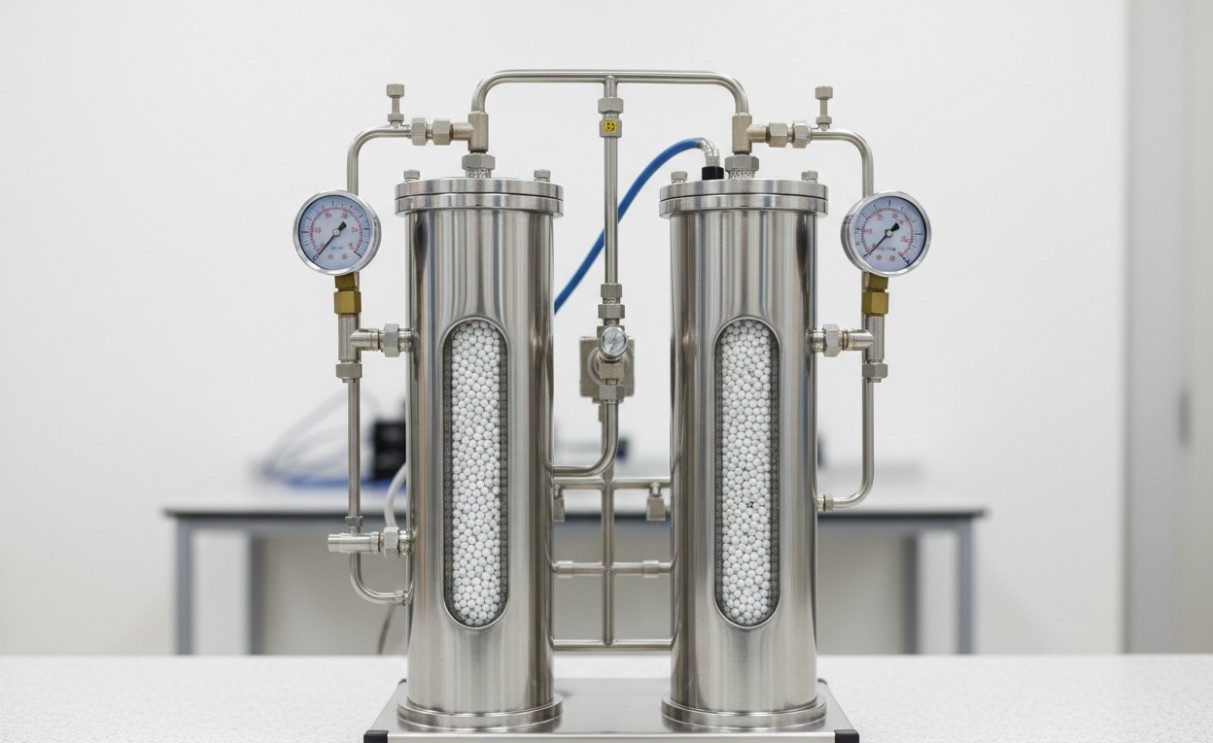 Stainless steel adsorption columns packed with molecular sieve material for gas separation and purification
Catalytic Applications in Petrochemical Processing
Beyond their role as adsorbents, zeolites function as the most widely used solid acid catalysts in the chemical industry. The substitution of Si4+ by Al3+ in the tetrahedral framework generates a negative charge that is compensated by a proton, creating a Bronsted acid site of tunable strength. The SiO2/Al2O3 ratio determines acidity and hydrothermal stability: low ratios (below 30) yield strong acidity suited for cracking and alkylation, while high ratios (above 50) provide enhanced stability for steam-rich environments such as fluid catalytic cracking (FCC) regenerators.
ZSM-5, a medium-pore zeolite with intersecting 10-membered ring channels, stands at the center of petrochemical catalysis. Its three-dimensional pore system, composed of straight and sinusoidal channels, selectively converts methanol to gasoline-range hydrocarbons (MTG process), isomerizes xylenes to produce para-xylene for polyester manufacturing, and catalyzes the cracking of larger hydrocarbon feedstocks into lighter, more valuable products. In FCC operations, ZSM-5 additives boost propylene yields by cracking gasoline-range olefins into lighter fractions, responding to the petrochemical industry's growing demand for propylene as a feedstock for polypropylene and acrylic acid production.
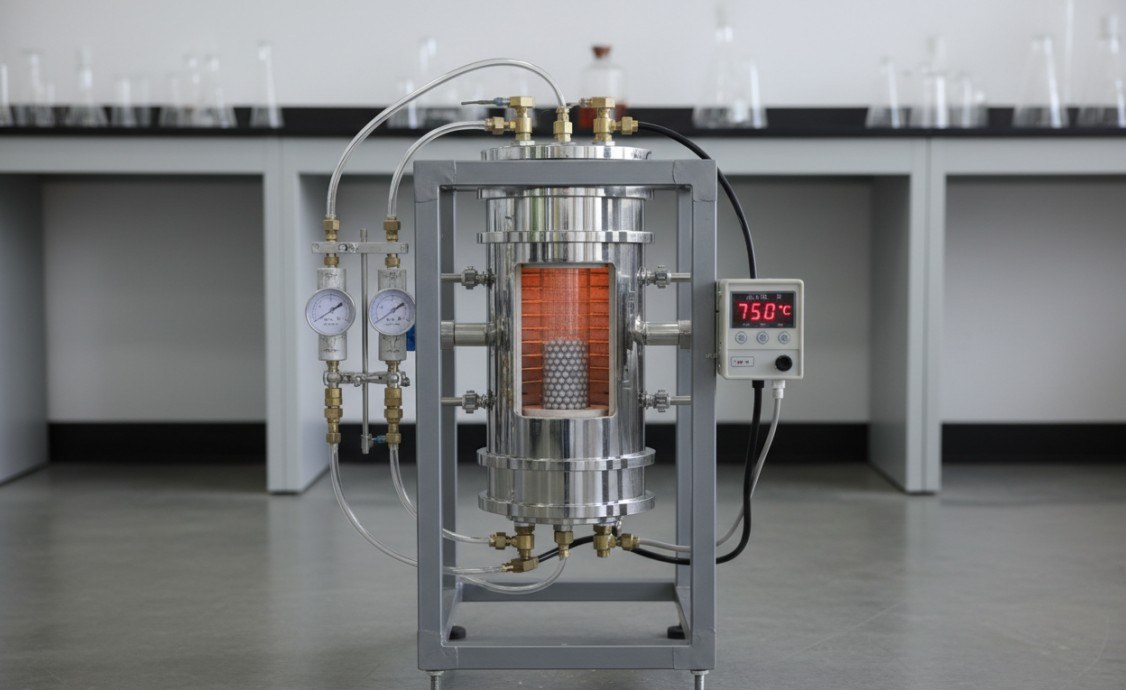 High-temperature tubular reactor setup with molecular sieve catalyst bed for catalytic process evaluation
Ordered Mesoporous Sieves: MCM-41 and SBA-15
While zeolites excel at separating small molecules, their micropore dimensions exclude larger species encountered in pharmaceutical synthesis, biomolecule processing, and heavy hydrocarbon upgrading. Ordered mesoporous materials bridge this gap. MCM-41 and SBA-15, synthesized through surfactant-templated self-assembly, possess hexagonally arranged cylindrical pores in the 2–10 nm range — large enough to accommodate bulky molecules while maintaining the high surface areas and uniform pore geometries that make zeolites so effective.
MCM-41 features pore diameters of 2–4 nm with relatively thin amorphous silica walls and isolated cylindrical channels, delivering surface areas up to 1200 m^2/g. SBA-15 offers larger pores of 5–10 nm with thicker walls that contain embedded micropores, providing greater mechanical and hydrothermal stability. Both materials serve as supports for large-molecule catalysts, hosts for drug delivery systems, templates for nanomaterial synthesis, and adsorbents for organic pollutants too large to enter zeolite pores. We supply these mesoporous sieves as-calcined, functionalized with amino or mercapto groups, or loaded with transition metal catalysts upon request.
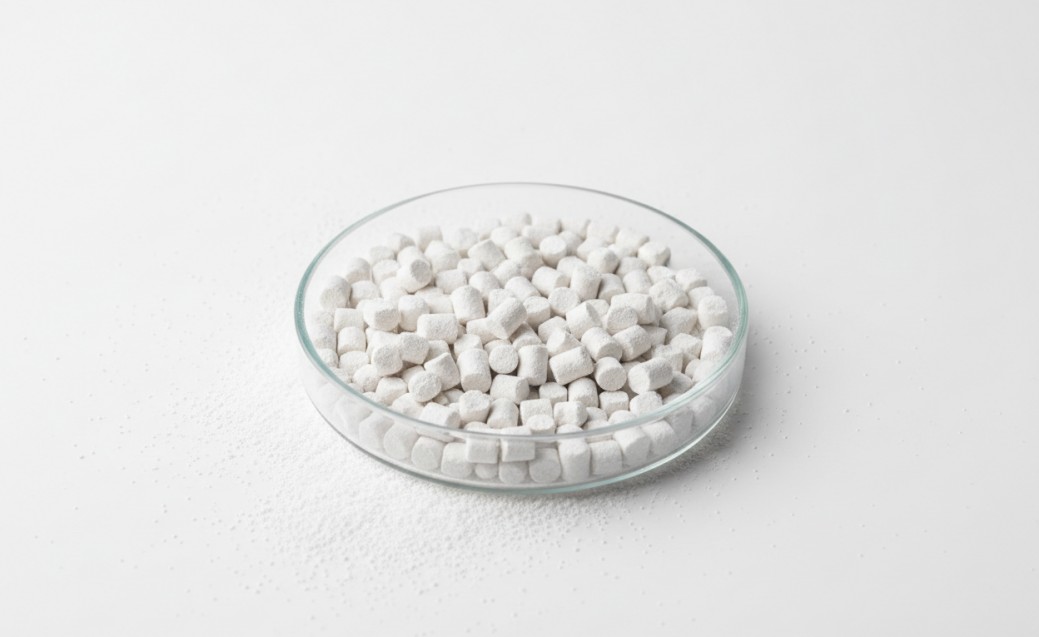 High-quality zeolite molecular sieve pellets in a glass dish showing uniform cylindrical extrudate morphology
Featured Products
| Products | Specifications | Applications |
| Zeolite 3A | Pore: 3 A; K+ exchanged; H2O adsorption >20% | Unsaturated hydrocarbon drying |
| Zeolite 4A | Pore: 4 A; Na+ form; Bulk density >0.60 g/ml | Air drying, natural gas dehydration |
| Zeolite 5A | Pore: 5 A; Ca2+ exchanged; Crush >45 N | H2 purification, n-/iso-paraffin separation |
| Zeolite 13X | Pore: 10 A; FAU structure; SSA >700 m^2/g | CO2 capture, air separation, LPG sweetening |
| ZSM-5 catalyst | MFI structure; Si/Al: 15-300; Dual pore system | MTO, xylene isomerization, FCC additive |
| MCM-41 sieve | Pore: 2-4 nm; SSA: >1000 m^2/g; Hexagonal | Large-molecule catalysis, drug delivery |
| SBA-15 sieve | Pore: 5-10 nm; Thick walls; CMI-1 | Heavy hydrocarbon upgrading, templates |
| Carbon molecular sieve | Microporous carbon; PSA N2/O2 separation | Nitrogen generation, gas separation |
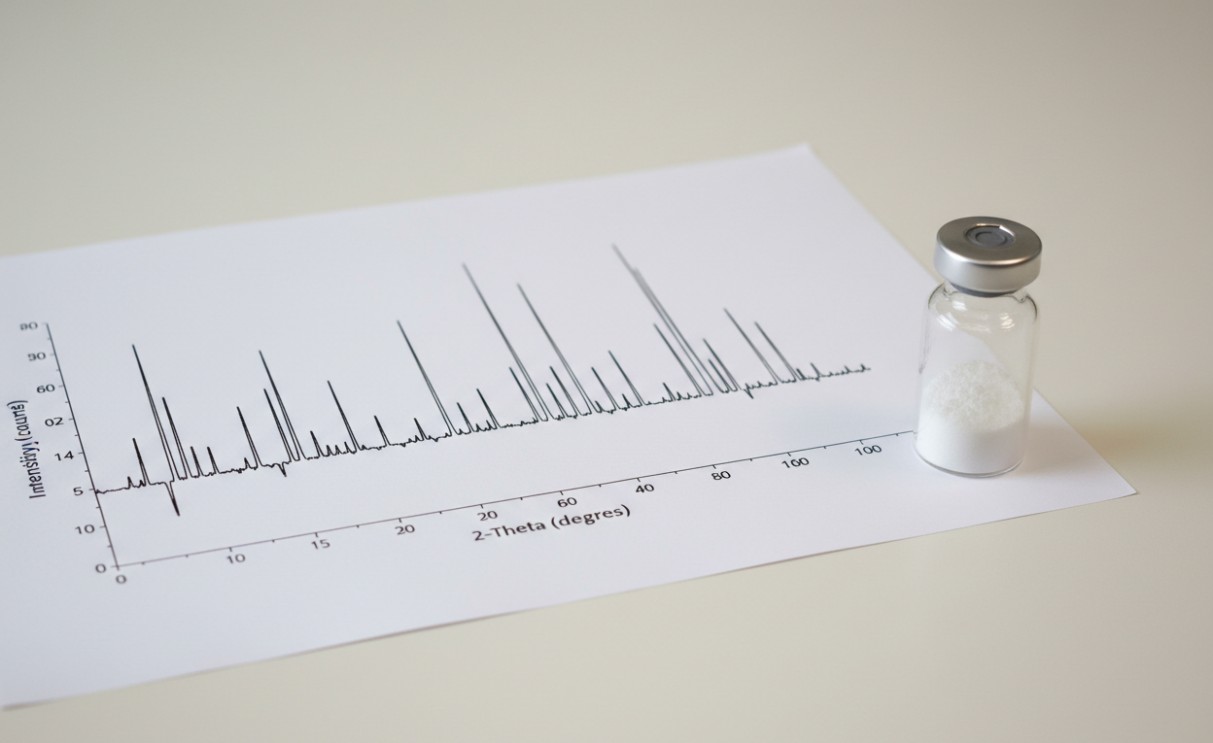 X-ray diffraction pattern of a highly crystalline zeolite molecular sieve alongside a vial of the white powder product
Across Industry and Research
Gas Drying and Purification: 3A, 4A, and 13X zeolites remove water, CO2, and H2S from natural gas, air, and industrial gas streams to ppm levels, preventing pipeline corrosion and cryogenic plugging.
Air Separation: 13X and LiX zeolites in PSA/VPSA systems produce high-purity oxygen and nitrogen for medical, industrial, and electronics applications.
Petrochemical Catalysis: ZSM-5, USY, and Beta zeolites catalyze cracking, isomerization, alkylation, and methanol-to-olefins processes that underpin modern fuel and chemical production.
Carbon Capture: 13X molecular sieves selectively adsorb CO2 from flue gas and biogas with capacities exceeding those of activated carbon, enabling low-energy regeneration cycles.
Hydrogen Purification: 5A molecular sieves in PSA units remove CO2, CH4, and N2 from reformate gas, delivering hydrogen purity above 99.9% for fuel cell and refinery applications.
Solvent and Refrigerant Drying: 3A and 4A zeolites dehydrate organic solvents, refrigerants, and insulating glass units without co-adsorbing organic molecules.
Quality Control and Characterization
Every molecular sieve batch undergoes a standardized quality protocol before release. Powder X-ray diffraction confirms crystalline phase purity and identifies any contaminant phases. Nitrogen adsorption-desorption isotherms at 77 K provide BET surface area, total pore volume, and pore size distribution. Static water adsorption capacity is measured gravimetrically at 25 C and 10% relative humidity to verify functional performance. Crush strength and abrasion resistance are determined for pellet and sphere products to ensure mechanical integrity under industrial loading and regeneration conditions. Thermogravimetric analysis evaluates thermal stability and template removal completeness. For catalytic grades, additional tests include ammonia temperature-programmed desorption (NH3-TPD) to quantify acid site concentration and strength, and inductively coupled plasma mass spectrometry (ICP-MS) to verify metal doping levels. All data accompany the shipment in a detailed certificate of analysis.
Custom Synthesis and Formulation Services
Beyond our standard catalog, we offer custom molecular sieve development tailored to specific separation and catalytic challenges. Our capabilities include ion exchange with Li+, Na+, K+, Ca2+, Mg2+, Ba2+, Ag+, Cu2+, or Ce3+ to tune pore size and adsorption selectivity; transition metal doping with Pt, Pd, Ni, Co, or Fe for catalytic activation; SiO2/Al2O3 ratio adjustment from 5 to infinity (silicalite) to modulate acidity and hydrophobicity; hierarchical structuring combining micropores and mesopores to accelerate mass transport in catalytic applications; and shaped body manufacturing including extrudates, spheres, and monoliths with tailored binder systems for specific reactor configurations. Whether you require a few kilograms of a modified zeolite for pilot testing or metric-ton quantities for commercial deployment, our team is equipped to scale from laboratory synthesis to industrial production.
Request a Quote— Contact Eata Nanomaterials to discuss your molecular sieve requirements, request product samples, or explore custom synthesis and formulation services for your adsorption, separation, or catalytic application.
| Catalog Number | Product Name | Order | Quantity |
|---|---|---|---|
| MSV-0001 | Aminated Mesoporous Silica Nanoparticles |
-
+
|
|
| MSV-0002 | Spherical Mesoporous Silica Nanoparticles |
-
+
|
|
| MSV-0003 | Carbon Molecular Sieve (CMS) |
-
+
|
|
| MSV-0004 | ZSM-23 Molecular Sieve |
-
+
|
|
| MSV-0005 | ZSM-5 Molecular Sieve (Strip Form) |
-
+
|
|
| MSV-0006 | Amino-Modified Dendritic Large-Pore Mesoporous Silica |
-
+
|
|
| MSV-0007 | Dendritic Large-Pore Mesoporous Silica |
-
+
|
|
| MSV-0008 | Carboxyl-Modified Dendritic Large-Pore Mesoporous Silica |
-
+
|
|
| MSV-0009 | Nano H-ZSM-5 Molecular Sieve |
-
+
|
|
| MSV-0010 | Hollow Mesoporous Silica Nanoparticles Aqueous Dispersion (Globular) |
-
+
|
For Research or Industrial Raw Materials, Not For Personal Medical Use!