

Products
- High-Quality Graphene
- CVD Graphene, Graphene-Like Materials
- Graphene-Like Series
- Defect-Free Single-Crystal Graphene and Graphene-Like Materials (Mechanical Exfoliation)
- Quantum Dot Series
- Aggregation-Induced Emission (AIE)
- Near-Infrared II (NIR-II) Fluorescent Dyes
- Graphdiyne
- Two-Dimensional Transition Metal Carbides/Nitrides/Borides (MXene)
- Metal Nanomaterials and Other Functional Bio-Nanomaterials
- Metal-Organic Frameworks (MOF)
- Covalent Organic Frameworks (COF)
- Two-Dimensional Layered Metal Oxides (LDH)
- Carbon Nanotube Powders, Pastes
- Carbon Nanotube Arrays and Special Carbon Nanotube Materials
- High-Quality Metallic and Semiconducting High-Purity Single-Walled Carbon Nanotubes
- Carbon Nanotube Sponges
- Mesoporous Carbon and Carbon Nanomaterials
- High-Quality Fullerenes
- One-Dimensional Nanomaterials
- Molecular Sieves
- Inorganic Nanomaterials
- Perovskite Materials
- Highly Oriented Pyrolytic Graphite (HOPG)
- Organic Materials
- Single-Atom Catalysts
- Thermoelectric Materials
- Sodium Storage Materials
- Industrial-Grade Nanomaterials
- Solid-State Lithium Batteries
- Hydrogel Series and Consumables
Online Inquiry
Two-Dimensional Layered Metal Oxides (LDH)
Layered double hydroxides, also known as hydrotalcite-like compounds or anionic clays, occupy a distinctive niche in the nanomaterials landscape. While most naturally occurring clays are negatively charged silicates that exchange cations between their layers, LDHs turn this architecture inside out. They are positively charged metal hydroxide layers that intercalate anions in the gallery spaces between them. This inversion of charge — rare among layered solids — opens a suite of properties and applications unavailable to conventional cationic clays. The general formula [M2+1-xM3+x(OH)2]x+(An-x/n)-mh3O captures the essential tunability: by varying the divalent metal M2+ (Mg, Ni, Co, Zn, Cu), the trivalent metal M3+ (Al, Fe, Cr, Ga), and the charge-compensating anion An- (Cl-, NO3-, CO3 2-, organic anions, polyoxometalates), researchers can dial in acidity, basicity, redox activity, magnetic response, catalytic selectivity, and biocompatibility with remarkable precision.
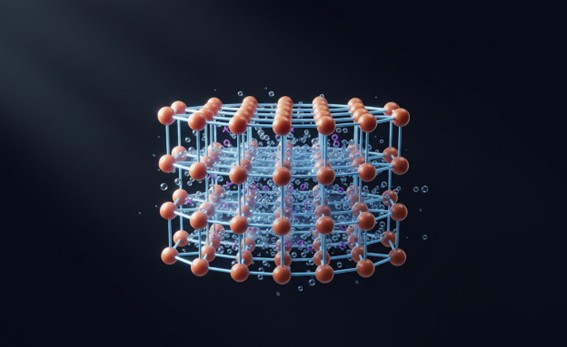 Figure 1: Cross-sectional view of a layered double hydroxide crystal showing positively charged brucite-like metal hydroxide layers with exchangeable anions and water molecules in the interlayer gallery spaces.
What makes LDHs particularly compelling in the current research landscape is their structural memory effect. When heated to moderate temperatures, LDHs lose interlayer water and dehydroxylate into mixed metal oxides that are themselves porous, high-surface-area materials. Remarkably, exposure to water and anions causes these oxides to reconstruct back into the original layered LDH structure, reincorporating whatever anions are present in the solution. This reversible transformation underpins applications in CO2 capture, where calcined LDHs cycle between oxide and hydroxide forms while sequestering atmospheric carbon. At Eata Nanomaterials, we supply a comprehensive portfolio of LDH compositions across all major metal combinations, in both pristine and organically modified forms, each synthesized with batch-to-batch consistency and fully characterized for research and industrial use.
Featured Products
| LDH Type | High-Volume Search Specs | Primary Applications |
| MgAl-LDH | Hydrotalcite, M2+/M3+ ratio 2-4, CO3 2- interlayer, co-precipitation, basic sites, acid scavenger, particle 50-500 nm | PVC stabilizer, acid neutralizer, CO2 capture, catalysis support, flame retardant |
| NiAl-LDH | Ni-based, high redox activity, pseudocapacitance, battery electrode, electrochemical, M(OH)2/MOOH | Supercapacitor, Ni-MH battery, Ni-Cd battery, electrocatalysis, energy storage |
| ZnAl-LDH | Zinc-based, antimicrobial, UV absorption, transparent, Zn2+ release, dermatological | Antimicrobial coating, sunscreen additive, wound dressing, cosmetic formulation |
| CoAl-LDH | Cobalt-based, OER catalysis, water oxidation, magnetic properties, layered cobaltite | Oxygen evolution reaction, overall water splitting, magnetic separation, spintronics |
| Fe-containing LDH | Green synthesis, magnetic, MRI contrast, Fe3O4 composite, environmentally friendly | MRI contrast agent, magnetic hyperthermia, drug targeting, wastewater treatment |
| Exfoliated LDH Nanosheets | Single-layer, 1-2 nm thickness, positively charged, colloidal dispersion, delamination | Nanocomposite, thin film, membrane coating, 2D material research, sensor |
| Organically Modified LDH | Anion exchange, surfactant intercalation, hydrophobic, polymer-LDH nanocomposite, compatibilizer | Polymer reinforcement, barrier coating, flame retardant, drug delivery vehicle |
| Calcined LDH (LDO) | Mixed metal oxide, structural memory effect, high SSA, basic sites, regenerable | CO2 capture at high temperature, catalysis base support, adsorption, sorption-enhanced |
| LDH Nanoparticles for Bio | 50-200 nm, biocompatible, pH-responsive drug release, gene transfection, DDS | Cancer therapy, gene delivery, oral drug carrier, vaccine adjuvant, bioimaging |
LDH Products in Our Catalog
MgAl-LDH: The Foundation of the Field
Magnesium-aluminum layered double hydroxide, also known as hydrotalcite in its naturally occurring mineral form, is the most widely produced and extensively characterized LDH. Its combination of low cost, biocompatibility, high anion exchange capacity, and abundance of both metals makes it the default choice for applications ranging from polymer stabilization to CO2 capture. Our MgAl-LDHs are synthesized by controlled co-precipitation under low supersaturation conditions, yielding well-crystallized hexagonal platelets with tunable particle dimensions and M2+/M3+ ratios.
- M2+/M3+ ratio: 2.0 to 4.0, tunable by synthesis stoichiometry.
- Particle size: 50 nm to 500 nm, controlled by pH, temperature, and aging time.
- Interlayer anion: CO3 2- (as-synthesized), Cl-, NO3-, or custom anion by ion exchange.
- BET surface area: 50-150 m2/g depending on composition and drying method.
- Available as: spray-dried powder, aqueous suspension, or calcined LDO form.
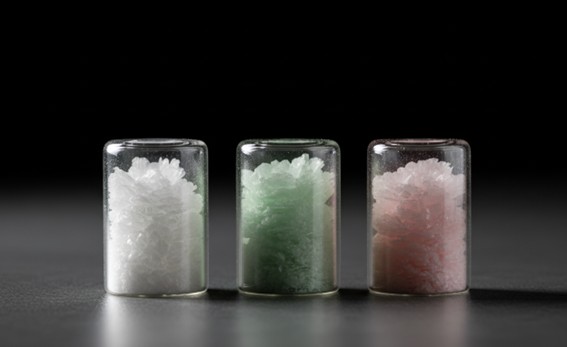 Figure 2: Crystalline layered double hydroxide powder samples of different compositions in glass vials, showing the characteristic color variations from pure white to pale green and pink.
NiAl-LDH and CoAl-LDH: Electrochemically Active Systems
When electrochemical performance is the priority, nickel and cobalt bring something that magnesium cannot: reversible redox chemistry. NiAl-LDH undergoes the Ni(OH)2/NiOOH transformation with a Faradaic efficiency exceeding 95%, making it a cornerstone material for alkaline battery electrodes and pseudocapacitors. CoAl-LDH exhibits outstanding catalytic activity for the oxygen evolution reaction (OER), a critical bottleneck in water electrolysis and rechargeable metal-air batteries.
- NiAl-LDH: specific capacitance >1000 F/g at 1 A/g in alkaline electrolyte.
- CoAl-LDH: OER overpotential <300 mV at 10 mA/cm2.
- Both available as: hexagonal nanoplates, nanosheets, or exfoliated single layers.
ZnAl-LDH and CuAl-LDH: Functional Diversification
Zinc brings antimicrobial activity and UV absorption to the LDH platform. ZnAl-LDH releases Zn2+ ions that disrupt bacterial cell membranes and inhibit microbial growth on coated surfaces. Copper introduces even stronger antimicrobial action and redox activity for catalytic applications.
- ZnAl-LDH: Zn2+ release tunable by M2+/M3+ ratio, transparent in polymer matrices.
- CuAl-LDH: superior antimicrobial efficacy against Gram-positive and Gram-negative bacteria.
Exfoliated LDH Nanosheets: Two-Dimensional Building Blocks
When LDH crystals are delaminated into individual layers, they become positively charged 2D nanosheets roughly 1 nanometer thick with lateral dimensions of hundreds of nanometers. These nanosheets disperse in water as stable colloids and serve as building blocks for layer-by-layer assembly, nanocomposite fabrication, and membrane coating. The positive surface charge facilitates electrostatic deposition onto negatively charged substrates.
- Thickness: 1-2 nm per nanosheet, confirmed by AFM.
- Lateral dimensions: 100-500 nm depending on precursor crystal size.
- Zeta potential: +30 to +50 mV in neutral aqueous dispersion.
- Dispersion concentration: up to 10 mg/mL stable colloid.
 Figure 3: Exfoliated LDH nanosheets dispersed in aqueous solution, showing individual ultra-thin two-dimensional platelets only a few nanometers thick with hexagonal crystalline edges.
Organically Modified LDH: Bridging the Organic-Inorganic Divide
The anion exchange capacity of LDHs enables intercalation of organic molecules — surfactants, dyes, drugs, polymers, and biomolecules — between the hydroxide layers. This transforms hydrophilic inorganic LDH into a hydrophobic, organophilic material compatible with polymer matrices and organic solvents. The gallery height expands to accommodate the intercalated species, creating a nanoscale organic-inorganic hybrid with synergistic properties.
- Dodecyl sulfate (DS-LDH): hydrophobic surface for polymer nanocomposites.
- Amino acid intercalated LDH: biocompatible carrier for oral drug delivery.
- Polymer intercalated LDH: in-situ polymerization within expanded galleries.
Calcined LDH (LDO): The Structural Memory Effect
Thermal decomposition of LDH at 400-600 C removes interlayer water and hydroxyl groups, producing a mixed metal oxide (MMO) with high surface area and abundant basic sites. When exposed to aqueous solutions containing anions, these oxides reconstruct into the original LDH structure, reincorporating the available anions. This structural memory effect is the basis for LDH-based CO2 capture, pollutant removal, and dynamic drug delivery systems.
- Calcination temperature: 400-600 C under air or inert atmosphere.
- BET surface area: 150-300 m2/g for calcined LDO.
- CO2 capture capacity: 0.5-2.0 mmol/g at elevated temperatures, regenerable.
Where LDHs Make the Difference
The breadth of LDH applications reflects the extraordinary tunability of this materials platform. Our customers deploy LDH products across a diverse range of research and industrial programs.
- CO2 capture and sequestration: calcined MgAl-LDH cycling between oxide and hydroxide forms at 200-400 C for post-combustion and pre-combustion carbon capture, with lower energy penalties than amine-based systems.
- Energy storage: NiAl-LDH cathodes for Ni-MH batteries, CoAl-LDH catalysts for OER in water electrolyzers, and LDH-derived materials for supercapacitors and lithium-ion battery electrodes.
- Polymer nanocomposites: LDH-reinforced plastics with enhanced mechanical strength, thermal stability, gas barrier properties, and flame retardancy for packaging and construction applications.
- Drug delivery and gene therapy: biocompatible LDH nanoparticles for pH-triggered intracellular drug release, gene transfection agents, and vaccine adjuvants.
- Environmental remediation: heavy metal adsorption (As, Cr, Pb, Cd), phosphate and nitrate removal from wastewater, and anionic dye decolorization.
- Catalysis: LDH-supported metal catalysts for fine chemical synthesis, base-catalyzed reactions, and photocatalytic pollutant degradation.
- Flame retardancy and polymer stabilization: MgAl-CO3-LDH as halogen-free flame retardant and acid scavenger in PVC and polyolefin formulations.
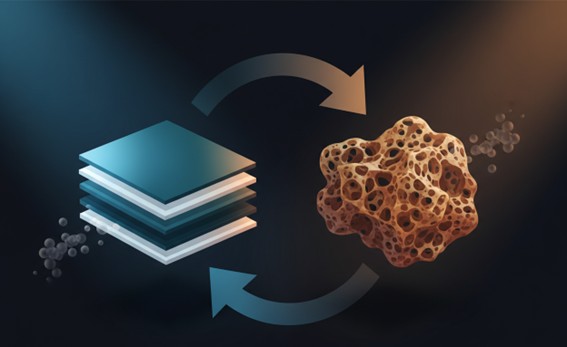 Figure 4: The structural memory effect of layered double hydroxides: calcination converts the layered structure into a porous mixed metal oxide, which reconstructs upon exposure to water and anions, enabling cyclic CO2 capture.
Analytical Characterization: Every Batch Verified
We subject every LDH batch to comprehensive analytical testing before release. The data accompanies your order as a batch-specific report.
- Powder X-ray diffraction (PXRD): phase purity, crystallinity, interlayer spacing d(003).
- N2 adsorption at 77 K: BET surface area, total pore volume.
- Thermogravimetric analysis (TGA): thermal decomposition profile, water and anion content.
- Scanning electron microscopy (SEM): particle morphology, size distribution.
- Transmission electron microscopy (TEM): layer structure, exfoliation quality.
- Inductively coupled plasma (ICP-OES): metal ratio confirmation, elemental purity.
- Zeta potential: surface charge in aqueous dispersion.
- Dynamic light scattering (DLS): hydrodynamic diameter for nanoparticle dispersions.
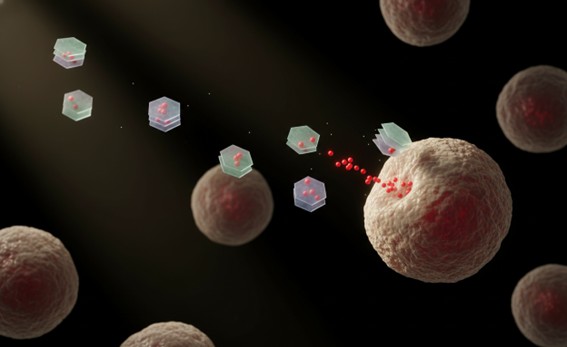 Figure 5: LDH nanoparticles interacting with biological cells for drug delivery, showing hexagonal platelets encapsulating drug molecules within their interlayer galleries and releasing payloads near cell surfaces.
Custom LDH Synthesis and Functionalization
Standard LDH compositions cover many research needs, but frontier projects often require tailored materials. Our custom synthesis service produces LDHs with non-standard metal combinations, precisely controlled particle dimensions, custom interlayer anions, and surface modifications for specific applications. We have synthesized ternary LDHs with three different metals, produced sub-50 nm nanoparticles for enhanced cellular uptake, intercalated pharmaceutical molecules for controlled release formulations, and fabricated LDH thin films on various substrates for sensor and device applications. We have also developed scalable continuous-flow co-precipitation processes for consistent production of large batches.
Describe your target metal combination, particle size, interlayer anion, or application requirement. Our materials chemists will propose a synthesis protocol, provide a feasibility assessment, and deliver a purified, characterized batch.
Request a Data Sheet or Start a Custom Project
Browse our LDH catalog, request detailed characterization data, or describe the specific composition, morphology, or functionalization your research requires. Our materials scientists are available to advise on LDH selection and application optimization.
| Catalog Number | Product Name | Order | Quantity |
|---|---|---|---|
| TDLMO-0001 | CoFe-LDH Two-Dimensional Layered Bimetallic Hydroxide |
-
+
|
|
| TDLMO-0002 | MgFe-LDH Two-Dimensional Layered Bimetallic Hydroxide |
-
+
|
|
| TDLMO-0003 | NiFe-LDH Two-Dimensional Layered Bimetallic Hydroxide |
-
+
|
|
| TDLMO-0004 | ZnFe-LDH Two-Dimensional Layered Bimetallic Hydroxide |
-
+
|
|
| TDLMO-0005 | NiCo-LDH Hollow Polyhedron Bimetallic Hydroxide |
-
+
|
|
| TDLMO-0006 | CaAl-LDH Two-Dimensional Layered Bimetallic Hydroxide |
-
+
|
|
| TDLMO-0007 | MgAl-LDH Two-Dimensional Layered Bimetallic Hydroxide |
-
+
|
|
| TDLMO-0008 | NiAl-LDH Two-Dimensional Layered Bimetallic Hydroxide |
-
+
|
|
| TDLMO-0009 | ZnNiAl-LDH Two-Dimensional Layered Trimallic Hydroxide |
-
+
|
|
| TDLMO-0010 | ZnAl-LDH Two-Dimensional Layered Bimetallic Hydroxide |
-
+
|
For Research or Industrial Raw Materials, Not For Personal Medical Use!