

Catalytic Nanomaterial Design and Optimization Services
Catalysis underpins virtually every industrial chemical process, from petroleum refining to pharmaceutical synthesis to environmental remediation. Yet the performance of a catalyst is dictated by features spanning from individual atomic sites to nanometer-scale particle morphologies. A Pt nanocrystal with exposed high-index facets such as (730) or (520) can exhibit four times the electrocatalytic activity of conventional low-index surfaces. A bimetallic core-shell architecture with a Pt monolayer on a non-noble metal core can reduce platinum loading by an order of magnitude while maintaining or even surpassing the activity of pure Pt. These design principles transform how researchers approach catalytic materials development.
Eata Nanomaterials provides an integrated catalyst development pipeline encompassing computational design guidance, wet-chemical synthesis, advanced physicochemical characterization, and rigorous catalytic activity testing. Our services span heterogeneous thermal catalysis, electrocatalysis for energy conversion, and photocatalysis for solar-driven chemistry. Each project combines materials expertise with analytical rigor to deliver catalyst systems with quantified structure-activity relationships.
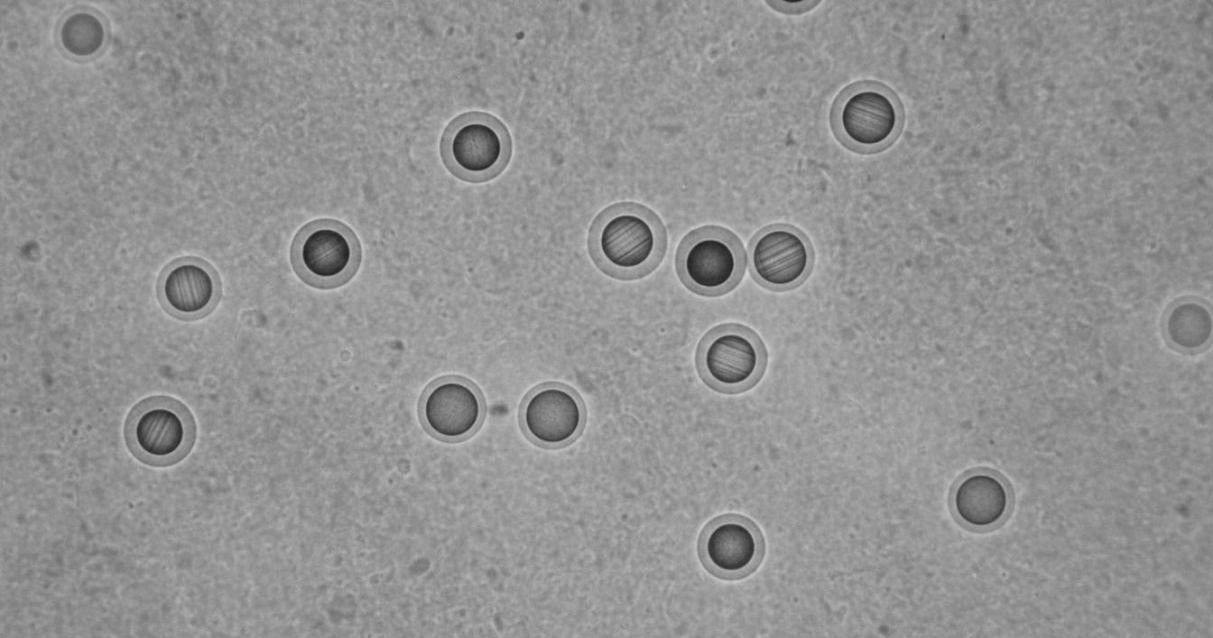 Figure 1: A transmission electron microscope image showing Pt-Co core-shell nanoparticles with distinct core-shell contrast uniformly dispersed on a carbon support for fuel cell electrocatalysis.
Heterogeneous Catalyst Synthesis and Morphology Control
The activity, selectivity, and stability of a metal nanocatalyst depend critically on particle size, shape, composition, and the nature of the support material. Eata Nanomaterials employs precision synthesis methods to control each of these parameters:
- Colloidal synthesis in polyol or organic solvent media for preparing monodisperse metal nanoparticles with controlled sizes from 1 to 20 nanometers. Polyol methods leverage the high boiling point and coordinating ability of ethylene glycol to produce well-crystallized Pt, Pd, Au, and Ag nanocrystals. Surfactant selection directs particle morphology: cetyltrimethylammonium bromide favors nanorods, polyvinylpyrrolidone stabilizes quasi-spherical particles, and citrate produces truncated octahedra
- Seed-mediated growth for fabricating anisotropic nanocrystals including nanoframes, nanowires, and branched structures. By controlling the ratio of seeds to metal precursor and the reducing kinetics, successive overgrowth on pre-formed seed crystals creates complex architectures with high surface-to-volume ratios and abundant active edge sites
- Bimetallic and core-shell architectures including Pt-Co, Pd-Cu, Pt-Ag, and Au-Pd systems. Core-shell particles are synthesized by galvanic replacement, successive reduction, or co-reduction with differential kinetics. These structures exploit electronic and strain effects between core and shell metals to optimize adsorption energies of reaction intermediates, following the Sabatier principle of catalysis
- Support engineering with high-surface-area carbons, metal oxides (TiO2, Al2O3, CeO2, ZrO2), zeolites, and magnetic Fe3O4. The choice of support affects metal dispersion, electron transfer, stability under reaction conditions, and ease of catalyst recovery. We offer functionalized supports with tailored surface chemistry to maximize metal-support interaction and prevent particle sintering
Facet engineering represents one of our most powerful capabilities. By manipulating synthesis conditions, we prepare Pt nanocrystals enclosed by specific crystal facets including cubes bound by (100), octahedra by (111), and tetrahexahedra by high-index (730) facets. The catalytic activity for structure-sensitive reactions such as oxygen reduction and formic acid oxidation follows well-established facet-dependent trends that we leverage for targeted catalyst optimization.
Electrocatalyst Development for Energy Applications
Electrocatalysis drives the core reactions of fuel cells, electrolyzers, and metal-air batteries. The oxygen reduction reaction (ORR) at the cathode of a proton exchange membrane fuel cell remains the most significant kinetic bottleneck, requiring Pt-based catalysts to achieve practical current densities. Eata Nanomaterials develops next-generation electrocatalysts that reduce precious metal content while enhancing durability:
- Pt-based intermetallic nanoparticles including PtCo, PtNi, and PtFe with ordered atomic arrangements synthesized through high-temperature annealing of disordered precursors. The L10-ordered PtCo structure delivers specific activities up to 3.6 milliamperes per square centimeter Pt and maintains activity after 10,000 potential cycles, compared to rapid degradation of conventional alloy catalysts
- Core-shell architectures with Pt monolayers or Pt-skin surfaces on non-noble metal cores. PtML/PdAu nanoparticles retain over 92 percent of initial mass activity after 100,000 fuel cell cycles, while Pt-Co nanoframes achieve ORR mass activities of 0.40 A per milligram Pt initially and 0.34 A per milligram Pt after 10,000 cycles
- Ternary intermetallic systems such as L10-PtNiCo that achieve the theoretical volcano-plot optimum through anisotropic strain on distorted Pt surfaces. These catalysts demonstrate mass activities exceeding 3 A per milligram Pt with only 16 percent activity loss after 30,000 cycles
- Non-precious metal catalysts including transition metal-nitrogen coordinated species on carbon supports for alkaline fuel cells, and Ni-Fe layered double hydroxide-derived materials for oxygen evolution in alkaline electrolyzers
Electrochemical characterization includes rotating disk electrode voltammetry for activity measurement, accelerated stress testing for durability assessment, and CO stripping voltammetry for electrochemical surface area determination. We report all results against benchmark commercial catalysts under identical test conditions.
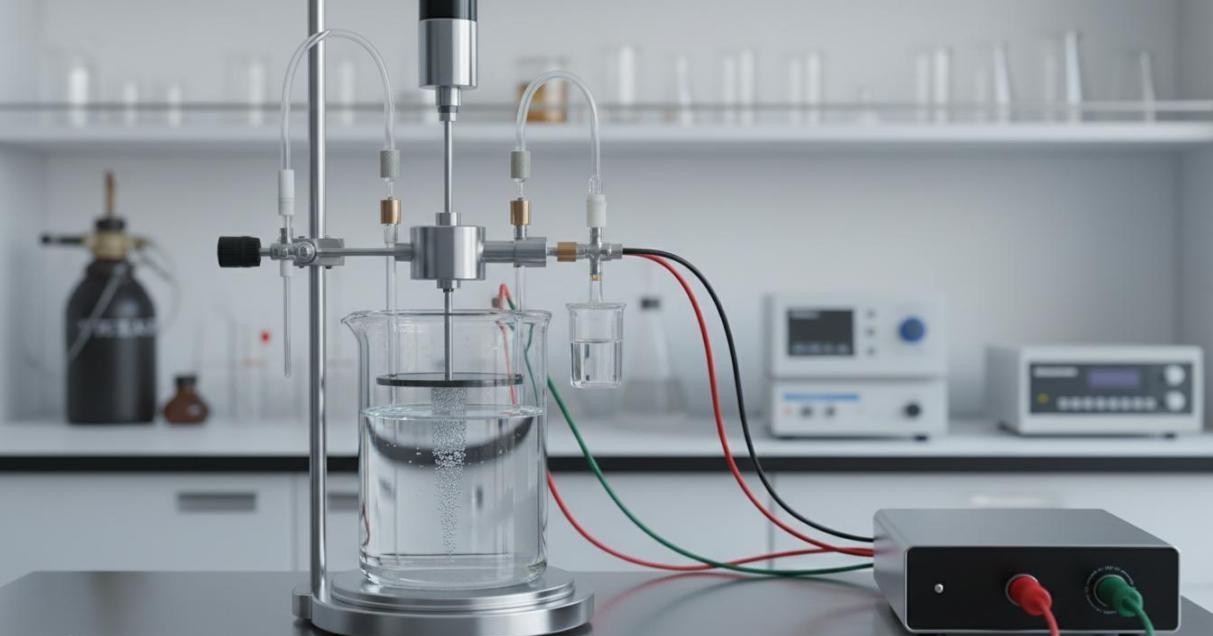 Figure 2: A rotating disk electrode setup with a glassy carbon disk mounted in a three-electrode electrochemical cell, connected to a potentiostat for electrocatalytic activity measurement.
Photocatalytic Material Design
Photocatalysis harnesses solar energy to drive chemical reactions including water splitting, CO2 reduction, and pollutant degradation. The efficiency of a photocatalyst depends on light absorption, charge carrier generation and separation, surface redox chemistry, and mass transport. Eata Nanomaterials designs photocatalysts that optimize each of these steps:
- Engineered TiO2 nanostructures with controlled crystal phase and exposed facets. Mixed-phase anatase-rutile junctions create built-in electric fields that promote electron-hole separation. Nanostructures with exposed high-energy (001) facets exhibit enhanced photocatalytic activity compared to conventional (101)-dominated particles due to favorable surface energy and adsorption properties
- Perovskite-based photocatalysts including halide perovskites and oxide perovskites (BiVO4, SrTiO3) with tunable band gaps spanning the visible spectrum. We engineer heterojunctions between perovskites and electron transport layers to improve charge extraction and reduce recombination losses
- Noble metal decoration with Au and Ag nanoparticles for plasmon-enhanced photocatalysis. Surface plasmon resonance generates intense local electromagnetic fields and injects hot electrons into the semiconductor, extending light absorption into the visible and near-infrared regions and boosting reaction rates
- Z-scheme and Type-II heterojunction architectures combining two or more semiconductors with staggered band alignments. These structures spatially separate oxidation and reduction reactions on different components, suppressing charge recombination while maintaining strong redox driving forces
Photocatalytic performance is evaluated in custom-built reactors under simulated solar illumination (AM 1.5G, 100 mW per square centimeter) with online gas chromatography for hydrogen and oxygen quantification during water splitting, or HPLC for liquid product analysis in CO2 reduction studies.
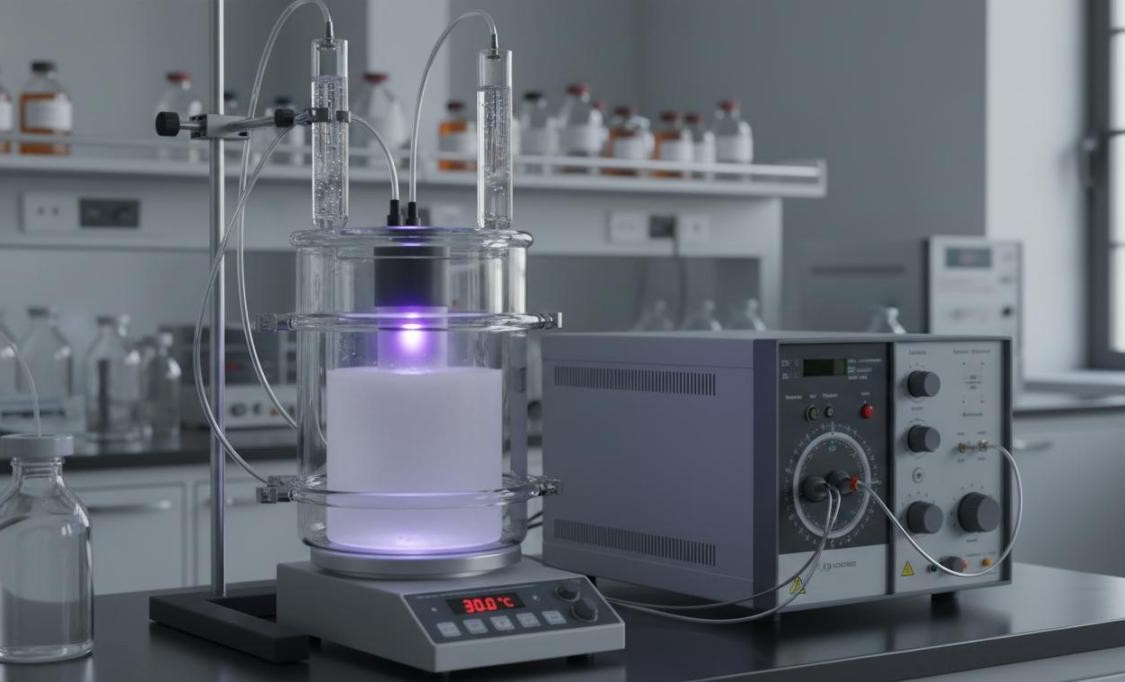 Figure 3: A photocatalytic water splitting reactor with a UV-Vis light source, cooling jacket, gas collection tubes, and online analysis system for hydrogen and oxygen quantification.
Comprehensive Catalyst Characterization
Establishing quantitative structure-activity relationships requires thorough characterization of catalyst composition, morphology, electronic structure, and surface properties. Eata Nanomaterials provides a complete analytical suite:
- Transmission electron microscopy and high-angle annular dark-field STEM for particle size distribution, morphology, crystallographic facet identification, and core-shell structure verification. Energy-dispersive X-ray spectroscopy mapping reveals elemental distribution within individual particles
- X-ray photoelectron spectroscopy for oxidation state analysis, surface elemental composition, and electronic structure probing through binding energy shifts. This technique is essential for verifying metal-support charge transfer and detecting surface contaminants that may poison active sites
- Temperature-programmed reduction (H2-TPR) and temperature-programmed desorption (NH3-TPD, CO2-TPD) for probing redox properties and surface acidity or basicity. TPR profiles reveal reduction temperatures of metal oxide species and their interaction strength with the support
- Chemisorption analysis including CO pulse chemisorption and H2 chemisorption for measuring metal dispersion and active site counting. These data enable turnover frequency calculation, the most fundamental metric of intrinsic catalytic activity
- BET surface area and pore structure analysis to quantify support morphology and its influence on reactant accessibility and product diffusion
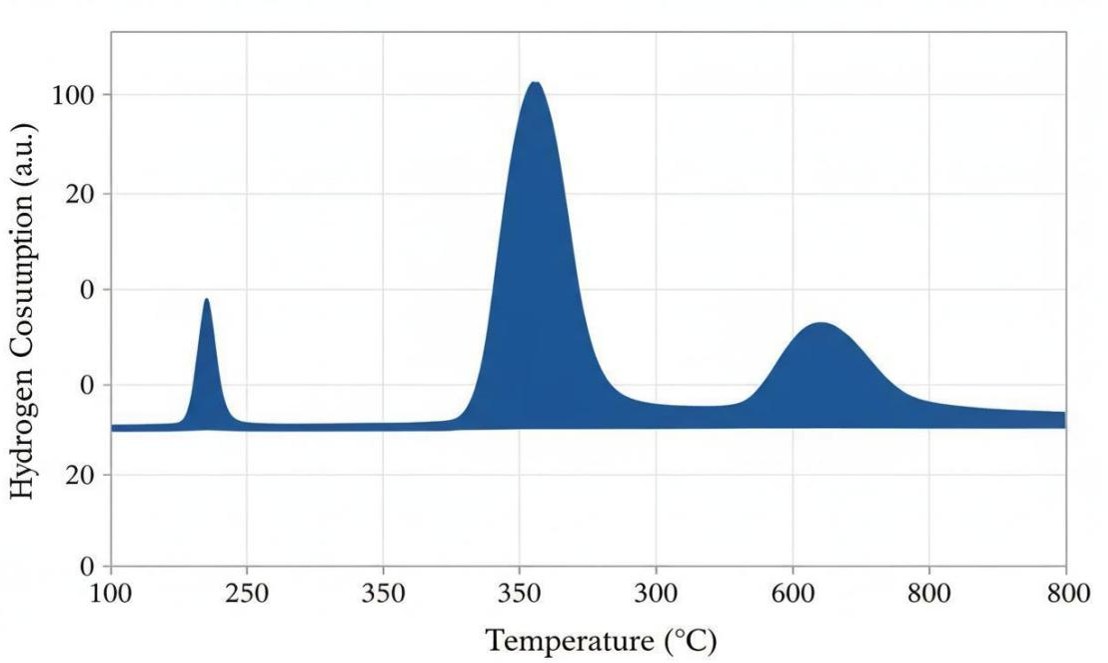 Figure 4: A temperature-programmed reduction profile showing multiple hydrogen consumption peaks corresponding to sequential reduction steps of metal oxide species on a supported catalyst.
Catalytic Performance Testing
Beyond synthesis and characterization, Eata Nanomaterials operates dedicated catalytic testing reactors to validate catalyst performance under realistic operating conditions:
- Fixed-bed continuous flow reactors for gas-phase heterogeneous catalysis including CO oxidation, selective hydrogenation, Fischer-Tropsch synthesis, and CO2 methanation. Reactors operate at pressures from atmospheric to 30 bar and temperatures to 600 degrees Celsius, with online GC-MS product analysis and mass balance closure verification
- Rotating disk and rotating ring-disk electrode systems for electrocatalytic ORR, OER, and HER activity measurements in acidic and alkaline electrolytes. The RDE configuration eliminates mass transport limitations, enabling extraction of intrinsic kinetic parameters including Tafel slopes and exchange current densities
- Photocatalytic slurry and fixed-bed reactors for hydrogen evolution rate measurement, dye degradation kinetics, and CO2 reduction product distribution under simulated solar or UV irradiation
- Magnetic separation recovery tests for supported nanocatalysts on Fe3O4 and other magnetic supports, quantifying recovery efficiency and activity retention across multiple catalytic cycles
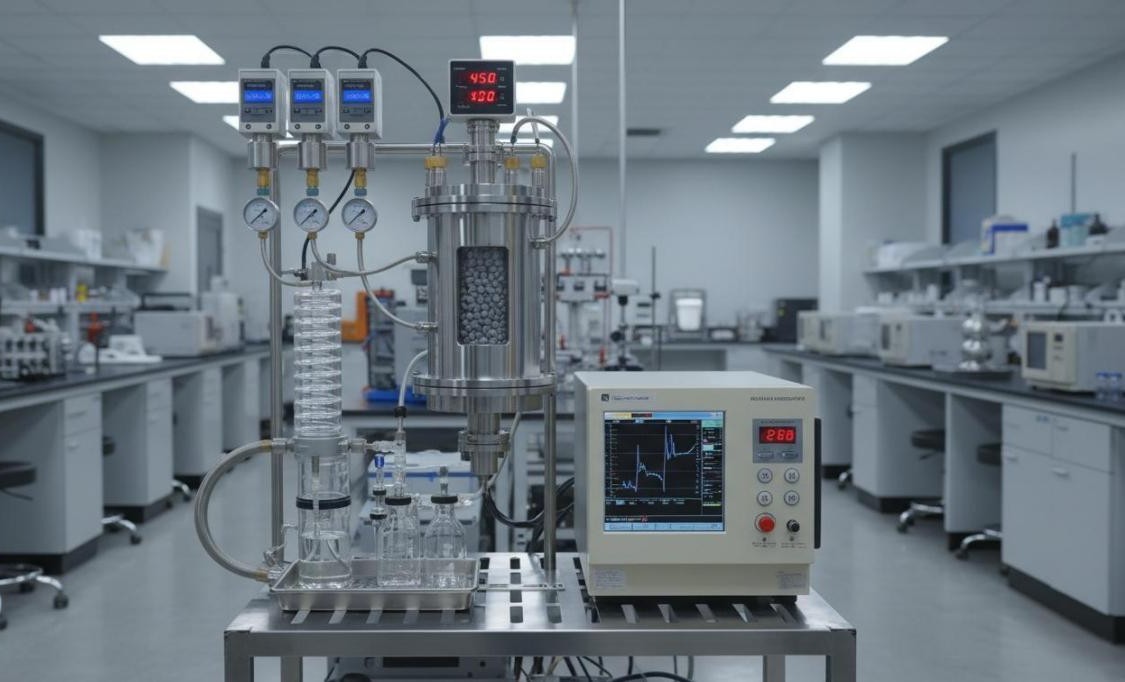 Figure 5: A fixed-bed catalytic reactor system with mass flow controllers, tube furnace, pressure gauges, online gas chromatograph, and product collection for continuous-flow heterogeneous catalysis testing.
Catalyst Platform Comparison
| Catalyst Type | Target Reaction | Key Metric | Characterization | Application |
| Pt intermetallic | ORR | 3.6 mA/cm2 Pt | RDE, XRD, TEM | PEM fuel cells |
| Core-shell PtML | ORR | 0.40 A/mgPt | STEM-EELS, XPS | Automotive fuel cells |
| Pd-Cu@Pt | ORR | 1.92 mA/cm2 | TEM, ICP-MS | Stationary fuel cells |
| TiO2 engineered | Water splitting | HER rate | XRD, PL, TEM | Solar hydrogen |
| Perovskite hetero | CO2 reduction | Product selectivity | XPS, HPLC, GC | Carbon neutral fuels |
| Fe3O4 supported | C-S coupling | 85-98% yield | TEM, XRD, VSM | Pharma synthesis |
Application Areas
Our catalytic nanomaterial development services address a broad spectrum of research and industrial applications:
- Fuel cell and electrolyzer development: designing high-activity, durable ORR and OER electrocatalysts with reduced precious metal content for hydrogen energy systems
- Fine chemical synthesis: developing supported nanocatalysts for selective hydrogenation, carbon-carbon coupling, and oxidation reactions in pharmaceutical and agrochemical manufacturing
- Environmental catalysis: creating catalysts for catalytic converters, volatile organic compound destruction, and wastewater treatment using advanced oxidation processes
- Solar fuels: engineering photocatalysts and photoelectrodes for water splitting and CO2 photoreduction to produce hydrogen and carbon-based fuels using renewable energy
- Biomass conversion: designing acid-base bifunctional catalysts and metal-supported systems for converting lignocellulosic feedstocks into platform chemicals and biofuels
Engagement and Collaboration
Catalysis projects typically begin with a consultation to define target reactions, performance benchmarks, and operating constraints. We offer catalyst synthesis at scales from milligrams for preliminary screening to tens of grams for extended testing. Clients may provide their own support materials and precursors or request sourcing through our supply chain.
All catalysts are delivered with complete synthesis protocols, full characterization data, and when applicable, catalytic performance results compared against commercial reference catalysts. We maintain strict confidentiality for proprietary catalytic processes and formulations, with clear intellectual property agreements ensuring client ownership of all developed catalyst systems and associated data.
If you are interested in our products or services, please don't hesitate to contact us.