

Products
- High-Quality Graphene
- CVD Graphene, Graphene-Like Materials
- Graphene-Like Series
- Defect-Free Single-Crystal Graphene and Graphene-Like Materials (Mechanical Exfoliation)
- Quantum Dot Series
- Aggregation-Induced Emission (AIE)
- Near-Infrared II (NIR-II) Fluorescent Dyes
- Graphdiyne
- Two-Dimensional Transition Metal Carbides/Nitrides/Borides (MXene)
- Metal Nanomaterials and Other Functional Bio-Nanomaterials
- Metal-Organic Frameworks (MOF)
- Covalent Organic Frameworks (COF)
- Two-Dimensional Layered Metal Oxides (LDH)
- Carbon Nanotube Powders, Pastes
- Carbon Nanotube Arrays and Special Carbon Nanotube Materials
- High-Quality Metallic and Semiconducting High-Purity Single-Walled Carbon Nanotubes
- Carbon Nanotube Sponges
- Mesoporous Carbon and Carbon Nanomaterials
- High-Quality Fullerenes
- One-Dimensional Nanomaterials
- Molecular Sieves
- Inorganic Nanomaterials
- Perovskite Materials
- Highly Oriented Pyrolytic Graphite (HOPG)
- Organic Materials
- Single-Atom Catalysts
- Thermoelectric Materials
- Sodium Storage Materials
- Industrial-Grade Nanomaterials
- Solid-State Lithium Batteries
- Hydrogel Series and Consumables
Online Inquiry
Near-Infrared II (NIR-II) Fluorescent Dyes
Seeing Deeper Than Ever Before
For decades, fluorescence imaging was confined to the visible spectrum and the first near-infrared window (NIR-I, 700-1000 nm). Researchers accepted the trade-offs: shallow penetration, heavy photon scattering from tissue, and overwhelming autofluorescence from hemoglobin, melanin, and endogenous chromophores. Then the second near-infrared window (NIR-II, 1000-1700 nm) opened, and everything changed. In this spectral range, biological tissues become remarkably transparent. Photon scattering drops by orders of magnitude compared to the visible region. Tissue autofluorescence is virtually eliminated. The result is an unprecedented combination of spatial resolution, penetration depth, and signal-to-background ratio that allows optical imaging several millimeters beneath the surface of intact tissue — a feat previously thought impossible without ionizing radiation.
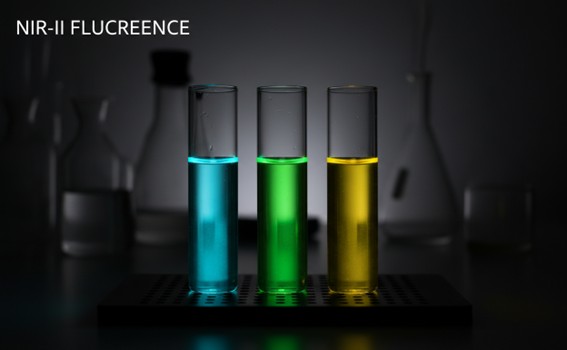 Figure 1: NIR-II fluorescent dye solutions in glass cuvettes, with emission spanning 1000-1700 nm rendered as false-color bands — the invisible light of deep-tissue imaging made visible through detection technology.
The critical bottleneck was the fluorescent probes themselves. Early NIR-II imaging relied on inorganic nanomaterials — single-walled carbon nanotubes, quantum dots, rare-earth nanoparticles — which raised legitimate concerns about long-term bioretention, immunogenicity, and regulatory pathways. The field needed organic small-molecule dyes: compounds with low molecular weight, tunable structure, clean metabolic profiles, and the kind of flexible chemistry that enables rapid functionalization. That is precisely what our NIR-II Fluorescent Dyes Series delivers. From donor-acceptor-donor (D-A-D) fluorophores with emission extending past 1600 nm to polymethine cyanines engineered for NIR-IIa and NIR-IIb sub-windows, from BODIPY derivatives reaching into the shortwave infrared to AIE-active NIR-II luminogens that defy aggregation quenching — Eata Nanomaterials supplies the organic fluorescent toolbox that deep-tissue imaging has been waiting for.
Why the NIR-II Window Outperforms Everything Else
The physics governing light-tissue interaction is unambiguous: as wavelength increases, both scattering and autofluorescence diminish. In the NIR-I window, photon scattering still limits imaging depth to roughly 1-2 mm. In the NIR-II window, scattering scales with wavelength to the negative power of 0.2 to 4 depending on tissue type, meaning photons travel orders of magnitude farther before being deflected. The implications are transformative: mouse cerebral cortex imaging through intact skin and skull at depths of ~4 mm, tumor-to-normal tissue signal ratios 2-4 times higher than identical targeting moieties in the NIR-I region, and lymph node signal-to-background ratios improved by an order of magnitude.
Within the NIR-II window, further subdivision yields even finer optimization. The NIR-IIa sub-window (1300-1400 nm) and the NIR-IIb sub-window (1500-1700 nm) offer progressively deeper penetration and higher clarity, though at the cost of demanding longer-wavelength fluorophores that are inherently more challenging to synthesize with high quantum yield. Our catalog addresses both sub-windows, giving researchers the freedom to optimize for their specific depth and resolution requirements.
Featured Products
| Dye Category | High-Volume Search Specs | Primary Applications |
| D-A-D NIR-II Dyes | 1000-1700 nm emission, BBTD core, thiophene bridge, 808 nm excitation, FBS complexation, PLQY >0.2% NIR-II | Blood vessel imaging, tumor targeting, lymph node mapping, surgery guidance |
| Polymethine Cyanines | NIR-II tail emission, rigidified polymethine chain, 1089/1140 nm peak, ICG analog, 808 nm laser excitable | Deep-tissue angiography, clinical translation, hepatotoxicity monitoring, NIR-IIa imaging |
| NIR-II BODIPY Dyes | BOD-II-NAG, enzyme-activated probe, 1000 nm emission, 0.72 mU/mL detection limit, mPEG-DSPE encapsulation | Acute kidney injury imaging, diabetic nephropathy, NAG enzyme detection, early diagnosis |
| Squaraine NIR-II Dyes | Donor-acceptor engineering, malonitrile acceptor, D-A-D structure, fibronectin targeting, NIR-II emission red-shift | Tumor angiography, lung metastasis detection, photoacoustic imaging, photothermal ablation |
| AIE NIR-II Luminogens | TPE-BBT, D-A structure, ultrahigh PLQY 31.5%, aggregation enhanced, chemiluminescence imaging, SBR 130 | Arthritis inflammation imaging, vascular NIR-IIb imaging, chemiluminescence bioimaging, bright NPs |
| NIR-II Aza-BODIPY | J-aggregate formation, glucosyl modification, light-facilitated reassembly, second near-infrared emission | Bioimaging with enhanced brightness, aggregate-based probes, phototheranostic platforms |
| Fluorinated NIR-II Probes | Fluorine-substituted acceptor, enhanced QY, CH1055 analog, DCHPB, ER-targeted, <1000 Da MW | High-resolution vascular imaging, endoplasmic reticulum targeting, rapid renal clearance |
| NIR-II Organic Nanoparticles | mPEG-DSPE encapsulation, 50-100 nm diameter, water-dispersible, biocompatible, high brightness NIR-IIa/NIR-IIb | Systemic circulation imaging, tumor passive targeting, long-term in vivo tracking, surgery navigation |
| Functionalized NIR-II Dyes | FRET pair, ratiometric probe, stimuli-responsive, enzyme-activatable, reactive oxygen species detection | Accurate in vivo biosensing, ratio-metric imaging, precision disease diagnosis, smart probes |
The NIR-II Fluorescent Dyes We Offer
D-A-D Organic Small-Molecule Fluorophores
The donor-acceptor-donor architecture is the most successful molecular design strategy for achieving bright NIR-II emission from organic small molecules. An electron-deficient core — typically benzobisthiadiazole (BBTD) or its derivatives — serves as the acceptor, flanked by electron-rich thiophene or alkoxybenzene donor units. The extended conjugation pushes both absorption and emission into the NIR-II window, while the twisted molecular conformation suppresses aggregation-caused quenching in nanoparticle formulations. Our D-A-D fluorophores are synthesized by multi-step Suzuki and Stille cross-coupling reactions under rigorously anaerobic conditions, purified by column chromatography and recrystallization, and delivered as crystalline solids or pre-formulated organic nanoparticles.
- Emission range: 1000-1600 nm, tunable by donor strength and conjugation length.
- Excitation: compatible with 808 nm and 1064 nm laser diodes.
- Formulation: available as neat solid, toluene/DCM solution, or FBS-complexed aqueous dispersion.
- Brightness: some variants show >30-fold QY enhancement upon serum albumin complexation.
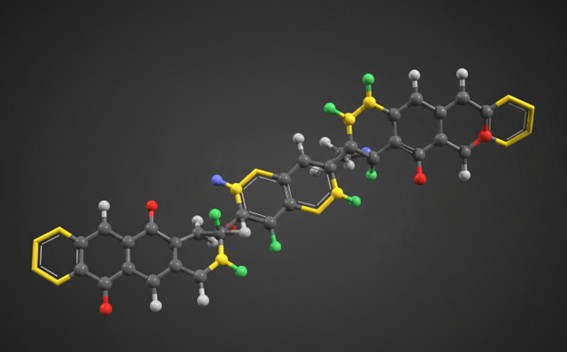 Figure 2: Ball-and-stick rendering of a donor-acceptor-donor (D-A-D) NIR-II fluorophore, showing the extended conjugated backbone with BBTD acceptor core flanked by electron-rich donor units.
Polymethine Cyanine Dyes with NIR-II Tail Emission
Indocyanine green (ICG), the most widely used NIR dye in clinical medicine, possesses a long emission tail extending past 1500 nm that had been largely ignored until researchers recognized its potential for NIR-II imaging. Building on this insight, we offer a series of rigidified polymethine cyanines specifically engineered to push absorption and emission deeper into the NIR-II window while maintaining the favorable pharmacokinetics and regulatory familiarity of the cyanine scaffold. These dyes feature rigidified polymethine chains that resist photo-isomerization and chemical degradation, with absorption/emission maxima reaching 1089/1140 nm.
- CX dye series: rigidified polymethine chain, absorption/emission at 1089/1140 nm.
- Chemical and photostability: enhanced by conformational rigidification.
- FRET capability: demonstrated in deep tissue for biosensing applications.
- Multiplexing: negligible optical cross-talk between different CX dye channels.
BODIPY and Aza-BODIPY NIR-II Emitters
BODIPY (boron-dipyrromethene) fluorophores are renowned for their high molar extinction coefficients, excellent photostability, and narrow emission bands. By extending the pi-system through fusion and substitution strategies, BODIPY derivatives can be pushed into the NIR-II region. Our NIR-II BODIPY line includes enzyme-activatable probes such as BOD-II-NAG for N-acetyl-beta-D-glucosaminidase detection, enabling high-resolution imaging of kidney injury and diabetic nephropathy with detection limits below 1 mU/mL.
- BOD-II-NAG: NAG-activated, emission at ~1000 nm, kidney-targeted imaging.
- Glucosyl aza-BODIPY: J-aggregate forming, light-facilitated reassembly, NIR-II emission.
- General BODIPY-NIR-II: narrow emission bands, high photostability, customizable surface groups.
AIE-Active NIR-II Luminogens
Traditional fluorophores quench upon aggregation. Our AIE-active NIR-II luminogens do the opposite — they get brighter. By incorporating tetraphenylethylene (TPE) or triphenylamine (TPA) donor units with benzobisthiadiazole (BBT) acceptor cores, these molecules are virtually non-emissive when molecularly dissolved but blaze with intense NIR-II fluorescence upon nanoparticle formation. The TPE-BBT system, for instance, achieves an absolute quantum yield of 1.8% in water nanoparticle form and 10.4% in crystalline solid — the highest reported for organic small molecules in the NIR-II window.
- TPE-BBT: relative QY 31.5% in water nanoparticles, crystal QY 10.4%.
- TPEO-BBT: derivative with enhanced water solubility, relative QY 23.9%.
- HQL2: NIR-IIa/NIR-IIb emitting AIE fluorophore for vascular imaging in both sub-windows.
- Chemiluminescence capability: TPE-BBT enables NIR-II chemiluminescence imaging without external excitation.
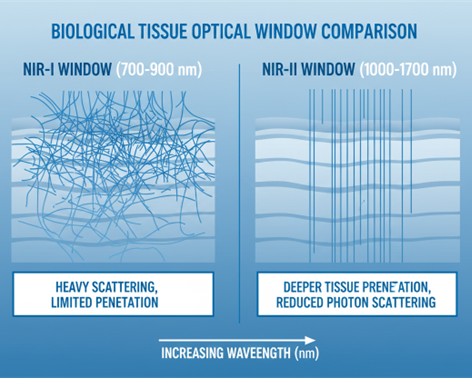 Figure 3: Comparison of light-tissue interaction in the NIR-I (700-900 nm) and NIR-II (1000-1700 nm) windows — dramatically reduced scattering and deeper penetration in the NIR-II range.
Fluorinated NIR-II Probes for Renal Clearance
Molecular weight and hydrophobicity dictate renal clearance, a critical parameter for clinical translation. By introducing fluorine atoms onto the acceptor core of D-A-D fluorophores, we produce probes with molecular weights below 1000 Da that are rapidly cleared through the kidneys, minimizing long-term bioretention. The fluorinated analog CH1055 and its descendants have demonstrated high-resolution vascular imaging with complete renal elimination within 24 hours — a profile unmatched by inorganic nanomaterial alternatives.
- Molecular weight: <1000 Da for rapid renal clearance.
- Emission: NIR-IIa/b, compatible with 808 nm excitation.
- Targetability: functionalized with RGD peptides, antibodies, or small-molecule ligands for active targeting.
Pre-Formulated NIR-II Organic Nanoparticles
Many NIR-II dyes are hydrophobic and require encapsulation for aqueous dispersion and in vivo administration. We offer pre-formulated organic nanoparticles (NPs) prepared by nanoprecipitation of dye into amphiphilic polymer matrices (mPEG-DSPE, PLGA-PEG, or DSPE-PEG), yielding monodisperse colloidal particles of 50-100 nm diameter with high brightness, biocompatibility, and long circulation half-lives.
- Encapsulation: mPEG-DSPE, PLGA-PEG, or custom polymer matrices.
- Size: 50-100 nm, PDI <0.2, confirmed by DLS and TEM.
- Stability: >6 months at 4C in aqueous buffer.
- Custom targeting: surface modification with peptides, antibodies, or aptamers on request.
Application Domains Where NIR-II Dyes Excel
The unique optical advantages of the NIR-II window translate into transformative capabilities across a broad range of research and preclinical imaging domains. Our customers are actively deploying NIR-II dyes in the following arenas:
- Deep-tissue vascular imaging: non-invasive visualization of blood vessels, capillary networks, and microvasculature through intact skin and skull at depths up to 4 mm with sub-10 um resolution.
- Tumor imaging and surgery navigation: high-contrast delineation of tumor margins, metastatic foci, and lymph node involvement with tumor-to-normal ratios 2-4 times higher than NIR-I probes.
- Image-guided photodynamic and photothermal therapy: NIR-II fluorophores with built-in photosensitization or photothermal conversion for combined imaging and treatment (theranostics).
- Organ-specific disease imaging: enzyme-activatable probes for kidney injury (BOD-II-NAG), fibronectin-targeted probes for tumor angiography, and ER-targeted fluorophores for intracellular imaging.
- Chemiluminescence imaging: AIE-NIR-II luminogens such as TPE-BBT enable excitation-free chemiluminescence imaging with signal-to-background ratios exceeding 130.
- Biosensing and diagnostics: FRET-based ratiometric probes for detecting peroxynitrite (OONO-), reactive oxygen species, and drug-induced hepatotoxicity in living subjects.
- Multiplexed detection: multiple NIR-II dyes with spectrally resolved emission enable simultaneous tracking of multiple biological targets with negligible optical cross-talk.
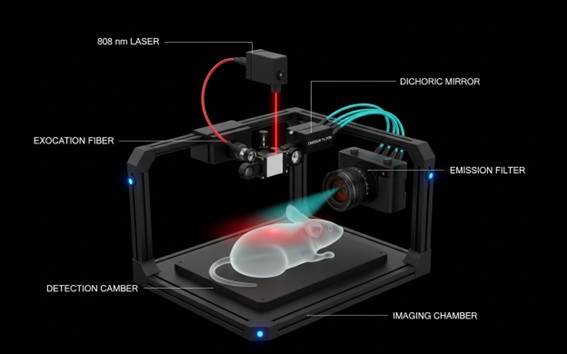 Figure 4: Schematic of a NIR-II fluorescence small-animal in vivo imaging system, showing 808 nm laser excitation, optical filters, and detection camera configured for deep-tissue fluorescence capture.
Analytical Characterization: Every Batch, Every Time
NIR-II dyes are only as good as their characterization. We subject every batch to comprehensive analytical testing before release, providing researchers with the data they need to design experiments with confidence.
- UV-Vis-NIR absorption spectroscopy: absorption maxima, extinction coefficients, spectral purity.
- NIR fluorescence spectroscopy: emission peak, FWHM, and absolute/relative quantum yield using calibrated integrating sphere.
- Time-resolved fluorescence: lifetime decay curves for understanding excited-state dynamics.
- NMR spectroscopy: 1H and 13C/19F NMR for structural confirmation and purity assessment.
- High-resolution mass spectrometry: exact mass confirmation of molecular formula.
- Dynamic light scattering: hydrodynamic diameter and polydispersity index for nanoparticle formulations.
- Transmission electron microscopy: direct visualization of nanoparticle morphology and size distribution.
- HPLC purity: >95% for all small-molecule dyes, with certificate of analysis.
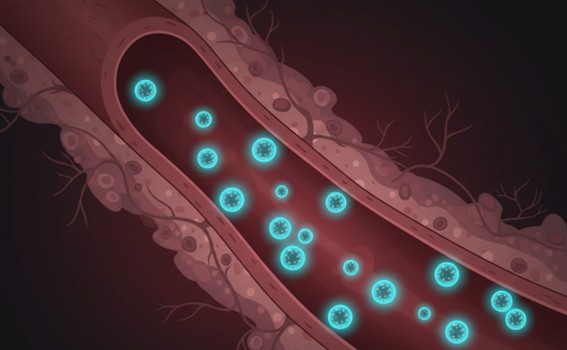 Figure 5: NIR-II fluorescent organic nanoparticles circulating within a biological vessel, illustrating their biocompatibility, dispersibility, and bright emission in physiological environments.
Custom NIR-II Dye Design and Synthesis
Standard catalog products cover the most common research needs, but frontier projects often demand something specific. Our custom synthesis service leverages the full toolkit of organic and materials chemistry to produce NIR-II fluorophores tailored to your exact specifications. We have synthesized D-A-D fluorophores with custom donor units to achieve specific emission shifts, fluorinated analogs with accelerated renal clearance profiles, AIE-NIR-II luminogens with custom surface groups for bioconjugation, and NIR-II dyes integrated into FRET pairs for ratiometric sensing. We have also developed nanoparticle encapsulation protocols for hydrophobic dyes using custom polymer matrices and surface ligands for targeted delivery.
Whatever your target wavelength, targeting strategy, or formulation requirement, describe your specification and our chemists will propose a molecular design, synthetic route, and delivery timeline. We deliver purified, characterized material ready for your in vitro or in vivo validation.
Request a Product Data Sheet or Custom Quotation
Browse our Near-Infrared II Fluorescent Dyes catalog, request detailed characterization data, or describe the specific emission wavelength, sub-window target, surface chemistry, or nanoparticle formulation your research requires. Our team of synthetic chemists and imaging specialists is available to advise on dye selection, formulation strategies, and integration protocols.
| Catalog Number | Product Name | Order | Quantity |
|---|---|---|---|
| NIFD-0001 | TTQ-TPA NIR-II Fluorescent Dye |
-
+
|
|
| NIFD-0002 | TTQF-SO₃ NIR-II Fluorescent Dye |
-
+
|
|
| NIFD-0003 | TTQF-Q NIR-II Fluorescent Dye |
-
+
|
|
| NIFD-0004 | TTQ-F NIR-II Fluorescent Dye (Custom) |
-
+
|
|
| NIFD-0005 | TTQ-F-PBA NIR-II Fluorescent Dye |
-
+
|
|
| NIFD-0006 | TTQ-F-COOH NIR-II Fluorescent Dye |
-
+
|
|
| NIFD-0007 | BBTDT-XF-TPA NIR-II Fluorescent Dye |
-
+
|
For Research or Industrial Raw Materials, Not For Personal Medical Use!